







War damage spurs urgent conservation efforts at Golestan Palace
The director of Golestan Palace UNESCO World Heritage site announced that after urgent safety measures are completed to remove immediate risks and stabilize the structure, plans for full restoration will begin following a detailed damage assessment under stable conditions.
In an interview with Mehr News Agency, Afarin Emami, director of the Golestan Palace complex, emphasized that immediate full restoration is not currently possible. She said the first priority is emergency protection and stabilizing the building to prevent secondary damage, mehrnews.com reported.
She explained that threats such as roof damage caused by impacts, rainwater infiltration, and the entry of birds or urban animals must be addressed quickly before any comprehensive restoration work can begin.
As a first step, roofs and windows have already been covered as part of the initial emergency protection process. However, because some hidden structural damage may exist, a more precise technical assessment is now required to guide the next phase of emergency measures.
Emami also announced that joint meetings of the Strategic Committee and Technical Committee are now being held weekly, instead of every one or two months as in the past, due to the urgent circumstances. Experts and veteran specialists are attending these meetings to speed up and improve decision-making.
According to her, a comprehensive coded damage survey is expected to be completed within about 10 days. This will help determine priorities for conservation work, including identifying unstable sections, detached decorative elements, and how they should be stabilized or relocated.
Regarding the palace’s historical objects, she said around 90% of the items have been properly packed and transferred to secure storage. Only objects considered too risky to move remain on site. Fortunately, none of the artifacts suffered serious damage. Only a few branches of chandeliers were damaged by the blast wave and can be repaired.
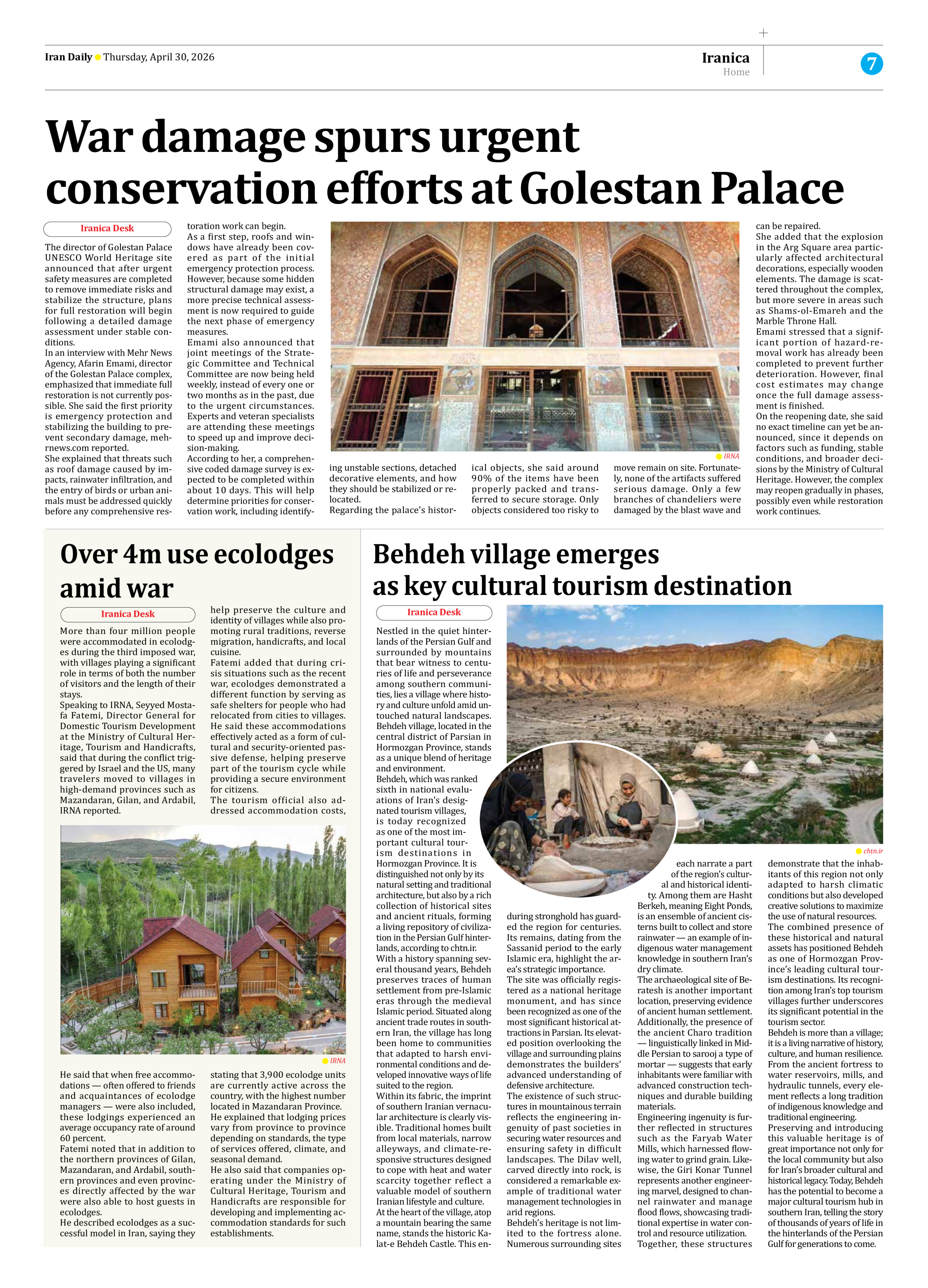
She added that the explosion in the Arg Square area particularly affected architectural decorations, especially wooden elements. The damage is scattered throughout the complex, but more severe in areas such as Shams-ol-Emareh and the Marble Throne Hall.
Emami stressed that a significant portion of hazard-removal work has already been completed to prevent further deterioration. However, final cost estimates may change once the full damage assessment is finished.
On the reopening date, she said no exact timeline can yet be announced, since it depends on factors such as funding, stable conditions, and broader decisions by the Ministry of Cultural Heritage. However, the complex may reopen gradually in phases, possibly even while restoration work continues.