







Iran keeps postal services running amid war damage
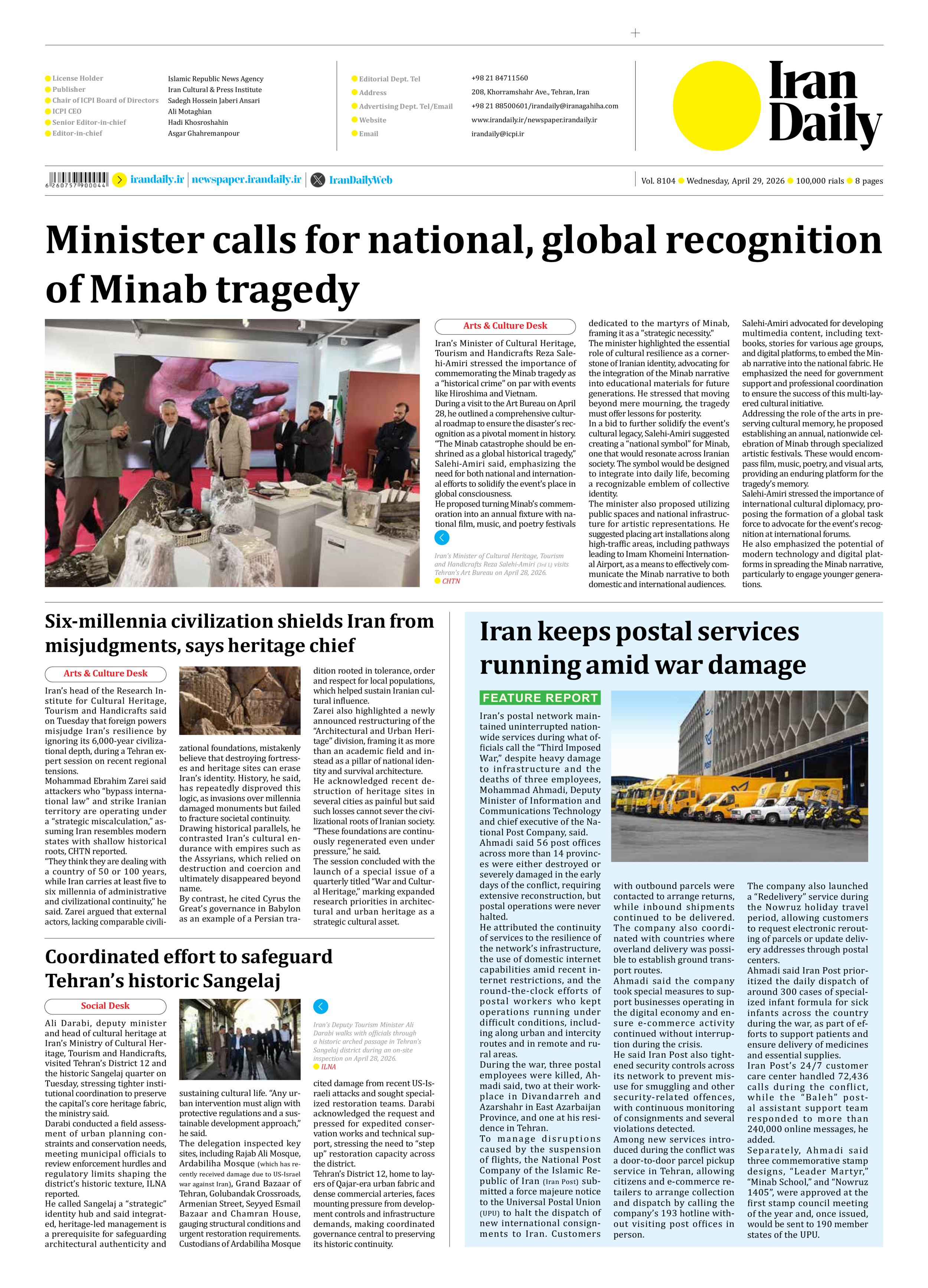
Iran’s postal network maintained uninterrupted nationwide services during what officials call the “Third Imposed War,” despite heavy damage to infrastructure and the deaths of three employees, Mohammad Ahmadi, Deputy Minister of Information and Communications Technology and chief executive of the National Post Company, said.
Ahmadi said 56 post offices across more than 14 provinces were either destroyed or severely damaged in the early days of the conflict, requiring extensive reconstruction, but postal operations were never halted.
He attributed the continuity of services to the resilience of the network’s infrastructure, the use of domestic internet capabilities amid recent internet restrictions, and the round-the-clock efforts of postal workers who kept operations running under difficult conditions, including along urban and intercity routes and in remote and rural areas.
During the war, three postal employees were killed, Ahmadi said, two at their workplace in Divandarreh and Azarshahr in East Azarbaijan Province, and one at his residence in Tehran.
To manage disruptions caused by the suspension of flights, the National Post Company of the Islamic Republic of Iran (Iran Post) submitted a force majeure notice to the Universal Postal Union (UPU) to halt the dispatch of new international consignments to Iran. Customers with outbound parcels were contacted to arrange returns, while inbound shipments continued to be delivered. The company also coordinated with countries where overland delivery was possible to establish ground transport routes.
Ahmadi said the company took special measures to support businesses operating in the digital economy and ensure e-commerce activity continued without interruption during the crisis.
He said Iran Post also tightened security controls across its network to prevent misuse for smuggling and other security-related offences, with continuous monitoring of consignments and several violations detected.
Among new services introduced during the conflict was a door-to-door parcel pickup service in Tehran, allowing citizens and e-commerce retailers to arrange collection and dispatch by calling the company’s 193 hotline without visiting post offices in person.
The company also launched a “Redelivery” service during the Nowruz holiday travel period, allowing customers to request electronic rerouting of parcels or update delivery addresses through postal centers.
Ahmadi said Iran Post prioritized the daily dispatch of around 300 cases of specialized infant formula for sick infants across the country during the war, as part of efforts to support patients and ensure delivery of medicines and essential supplies.
Iran Post’s 24/7 customer care center handled 72,436 calls during the conflict, while the “Baleh” postal assistant support team responded to more than 240,000 online messages, he added.
Separately, Ahmadi said three commemorative stamp designs, “Leader Martyr,” “Minab School,” and “Nowruz 1405”, were approved at the first stamp council meeting of the year and, once issued, would be sent to 190 member states of the UPU.