







Minister calls for national, global recognition of Minab tragedy
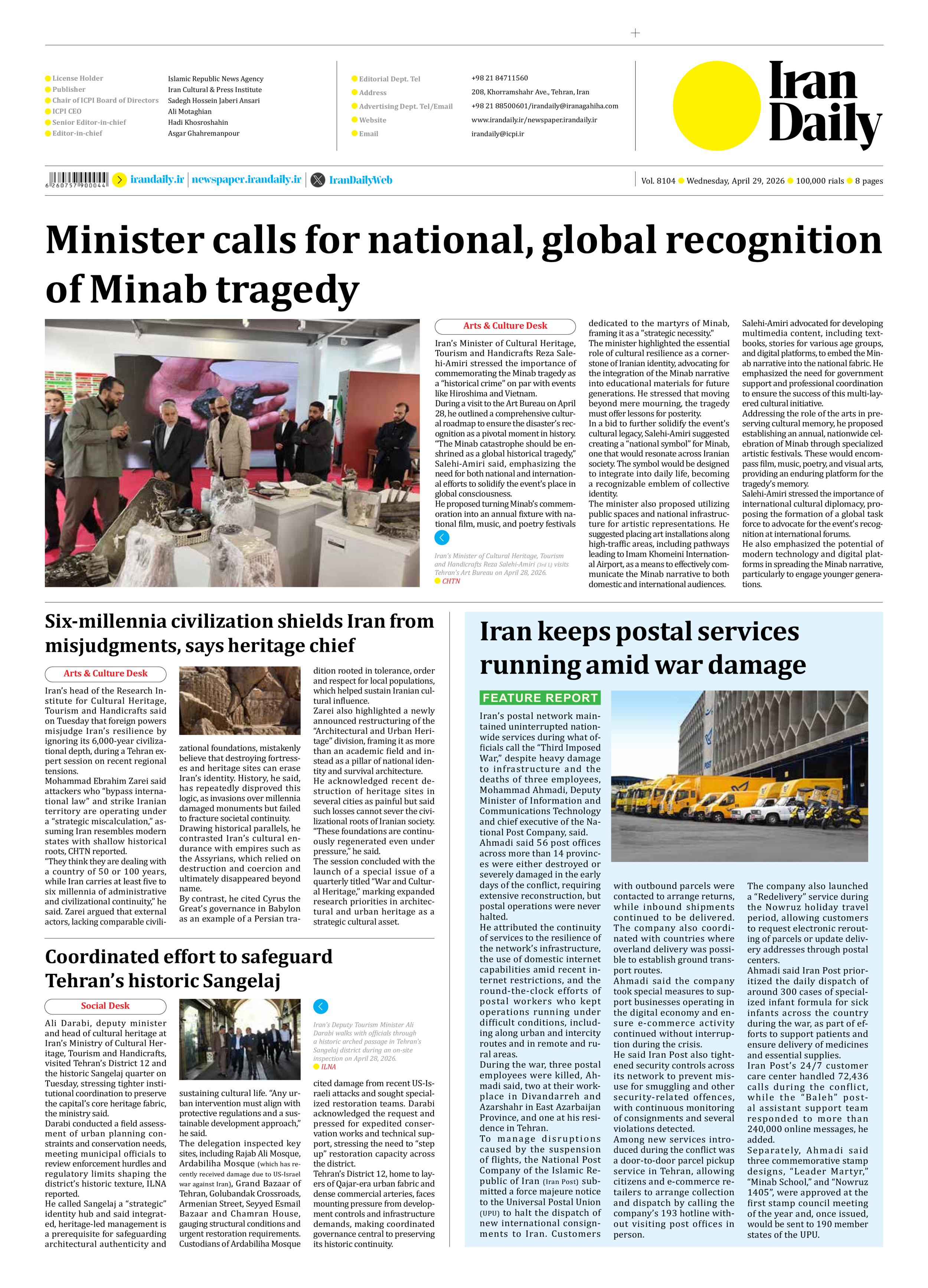
Iran’s Minister of Cultural Heritage, Tourism and Handicrafts Reza Salehi-Amiri stressed the importance of commemorating the Minab tragedy as a “historical crime” on par with events like Hiroshima and Vietnam.
During a visit to the Art Bureau on April 28, he outlined a comprehensive cultural roadmap to ensure the disaster’s recognition as a pivotal moment in history.
“The Minab catastrophe should be enshrined as a global historical tragedy,” Salehi-Amiri said, emphasizing the need for both national and international efforts to solidify the event's place in global consciousness.
He proposed turning Minab’s commemoration into an annual fixture with national film, music, and poetry festivals dedicated to the martyrs of Minab, framing it as a "strategic necessity."
The minister highlighted the essential role of cultural resilience as a cornerstone of Iranian identity, advocating for the integration of the Minab narrative into educational materials for future generations. He stressed that moving beyond mere mourning, the tragedy must offer lessons for posterity.
In a bid to further solidify the event's cultural legacy, Salehi-Amiri suggested creating a “national symbol” for Minab, one that would resonate across Iranian society. The symbol would be designed to integrate into daily life, becoming a recognizable emblem of collective identity.
The minister also proposed utilizing public spaces and national infrastructure for artistic representations. He suggested placing art installations along high-traffic areas, including pathways leading to Imam Khomeini International Airport, as a means to effectively communicate the Minab narrative to both domestic and international audiences.
Salehi-Amiri advocated for developing multimedia content, including textbooks, stories for various age groups, and digital platforms, to embed the Minab narrative into the national fabric. He emphasized the need for government support and professional coordination to ensure the success of this multi-layered cultural initiative.
Addressing the role of the arts in preserving cultural memory, he proposed establishing an annual, nationwide celebration of Minab through specialized artistic festivals. These would encompass film, music, poetry, and visual arts, providing an enduring platform for the tragedy’s memory.
Salehi-Amiri stressed the importance of international cultural diplomacy, proposing the formation of a global task force to advocate for the event’s recognition at international forums.
He also emphasized the potential of modern technology and digital platforms in spreading the Minab narrative, particularly to engage younger generations.