







Ministry allocates $4.4b to boost output with focus on small firms
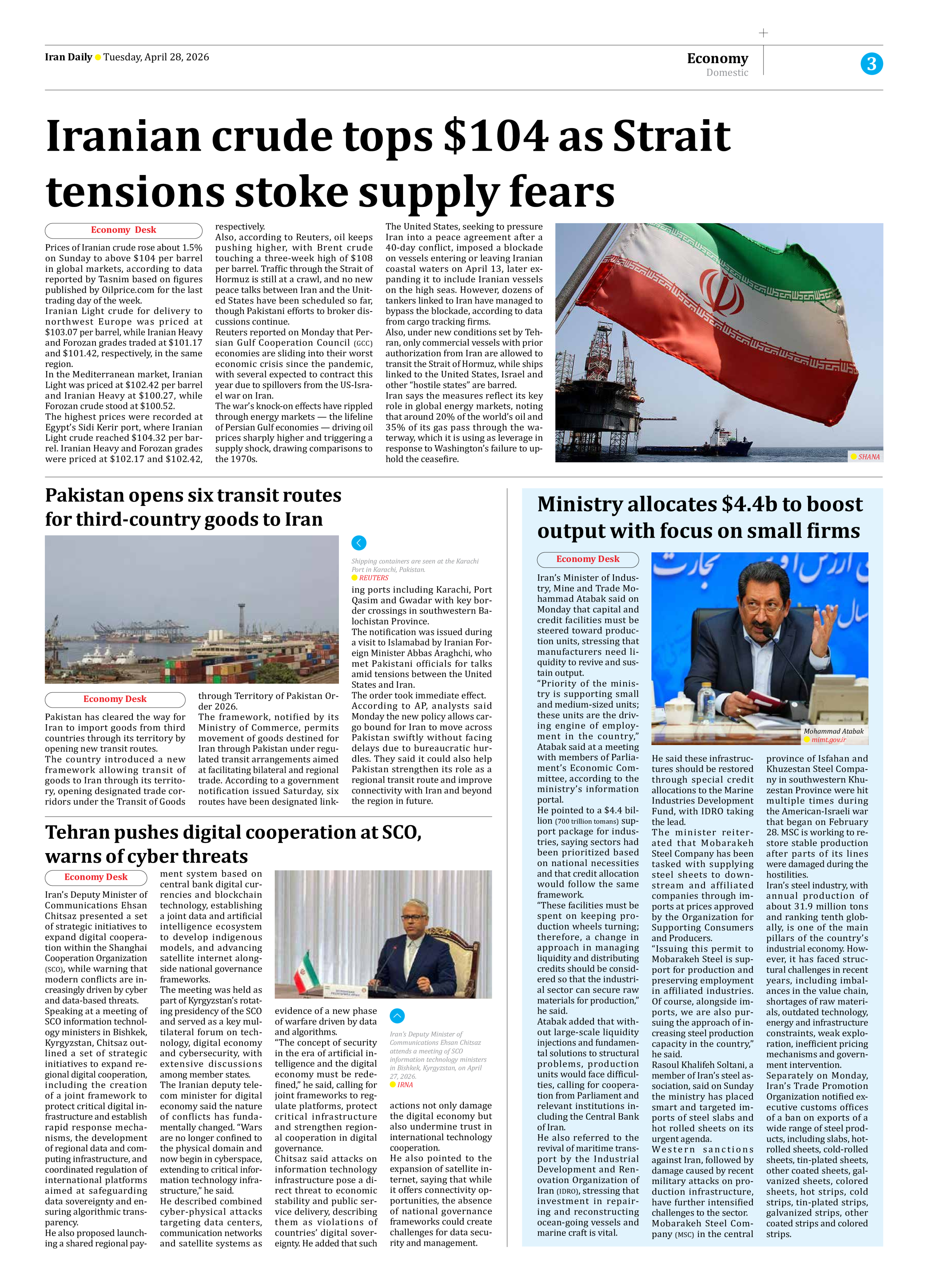
Iran’s Minister of Industry, Mine and Trade Mohammad Atabak said on Monday that capital and credit facilities must be steered toward production units, stressing that manufacturers need liquidity to revive and sustain output.
“Priority of the ministry is supporting small and medium-sized units; these units are the driving engine of employment in the country,” Atabak said at a meeting with members of Parliament’s Economic Committee, according to the ministry’s information portal.
He pointed to a $4.4 billion (700 trillion tomans) support package for industries, saying sectors had been prioritized based on national necessities and that credit allocation would follow the same framework.
“These facilities must be spent on keeping production wheels turning; therefore, a change in approach in managing liquidity and distributing credits should be considered so that the industrial sector can secure raw materials for production,” he said.
Atabak added that without large-scale liquidity injections and fundamental solutions to structural problems, production units would face difficulties, calling for cooperation from Parliament and relevant institutions including the Central Bank of Iran.
He also referred to the revival of maritime transport by the Industrial Development and Renovation Organization of Iran (IDRO), stressing that investment in repairing and reconstructing ocean-going vessels and marine craft is vital.
He said these infrastructures should be restored through special credit allocations to the Marine Industries Development Fund, with IDRO taking the lead.
The minister reiterated that Mobarakeh Steel Company has been tasked with supplying steel sheets to downstream and affiliated companies through imports at prices approved by the Organization for Supporting Consumers and Producers.
“Issuing this permit to Mobarakeh Steel is support for production and preserving employment in affiliated industries. Of course, alongside imports, we are also pursuing the approach of increasing steel production capacity in the country,” he said.
Rasoul Khalifeh Soltani, a member of Iran’s steel association, said on Sunday the ministry has placed smart and targeted imports of steel slabs and hot rolled sheets on its urgent agenda.
Western sanctions against Iran, followed by damage caused by recent military attacks on production infrastructure, have further intensified challenges to the sector.
Mobarakeh Steel Company (MSC) in the central province of Isfahan and Khuzestan Steel Company in southwestern Khuzestan Province were hit multiple times during the American-Israeli war that began on February 28. MSC is working to restore stable production after parts of its lines were damaged during the hostilities.
Iran’s steel industry, with annual production of about 31.9 million tons and ranking tenth globally, is one of the main pillars of the country’s industrial economy. However, it has faced structural challenges in recent years, including imbalances in the value chain, shortages of raw materials, outdated technology, energy and infrastructure constraints, weak exploration, inefficient pricing mechanisms and government intervention.
Separately on Monday, Iran’s Trade Promotion Organization notified executive customs offices of a ban on exports of a wide range of steel products, including slabs, hot-rolled sheets, cold-rolled sheets, tin-plated sheets, other coated sheets, galvanized sheets, colored sheets, hot strips, cold strips, tin-plated strips, galvanized strips, other coated strips and colored strips.