





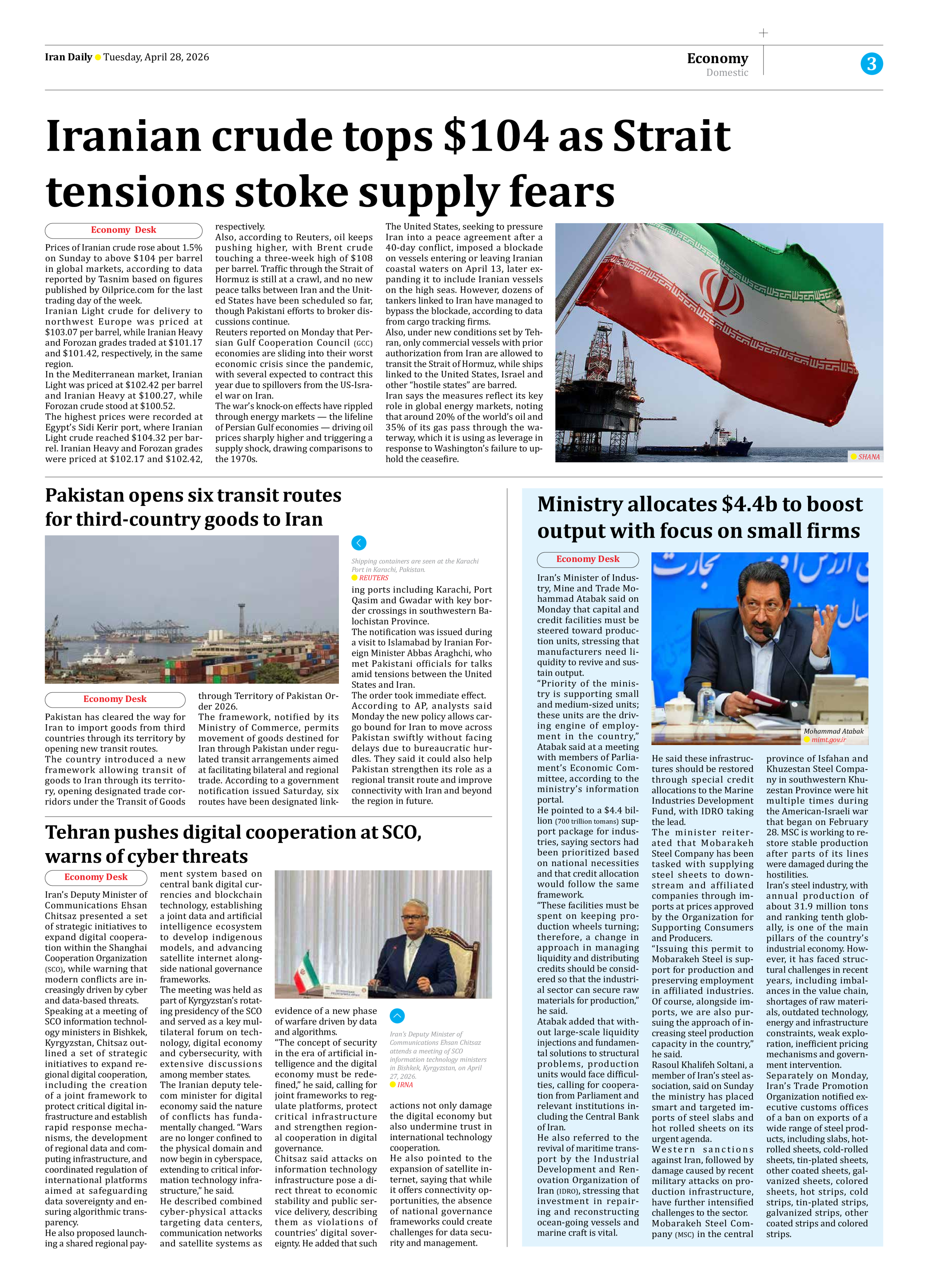


Iranian crude tops $104 as Strait tensions stoke supply fears
Prices of Iranian crude rose about 1.5% on Sunday to above $104 per barrel in global markets, according to data reported by Tasnim based on figures published by Oilprice.com for the last trading day of the week.
Iranian Light crude for delivery to northwest Europe was priced at $103.07 per barrel, while Iranian Heavy and Forozan grades traded at $101.17 and $101.42, respectively, in the same region.
In the Mediterranean market, Iranian Light was priced at $102.42 per barrel and Iranian Heavy at $100.27, while Forozan crude stood at $100.52.
The highest prices were recorded at Egypt’s Sidi Kerir port, where Iranian Light crude reached $104.32 per barrel. Iranian Heavy and Forozan grades were priced at $102.17 and $102.42, respectively.
Also, according to Reuters, oil keeps pushing higher, with Brent crude touching a three-week high of $108 per barrel. Traffic through the Strait of Hormuz is still at a crawl, and no new peace talks between Iran and the United States have been scheduled so far, though Pakistani efforts to broker discussions continue.
Reuters reported on Monday that Persian Gulf Cooperation Council (GCC) economies are sliding into their worst economic crisis since the pandemic, with several expected to contract this year due to spillovers from the US-Israel war on Iran.
The war’s knock-on effects have rippled through energy markets — the lifeline of Persian Gulf economies — driving oil prices sharply higher and triggering a supply shock, drawing comparisons to the 1970s.
The United States, seeking to pressure Iran into a peace agreement after a 40-day conflict, imposed a blockade on vessels entering or leaving Iranian coastal waters on April 13, later expanding it to include Iranian vessels on the high seas. However, dozens of tankers linked to Iran have managed to bypass the blockade, according to data from cargo tracking firms.
Also, under new conditions set by Tehran, only commercial vessels with prior authorization from Iran are allowed to transit the Strait of Hormuz, while ships linked to the United States, Israel and other “hostile states” are barred.
Iran says the measures reflect its key role in global energy markets, noting that around 20% of the world’s oil and 35% of its gas pass through the waterway, which it is using as leverage in response to Washington’s failure to uphold the ceasefire.