





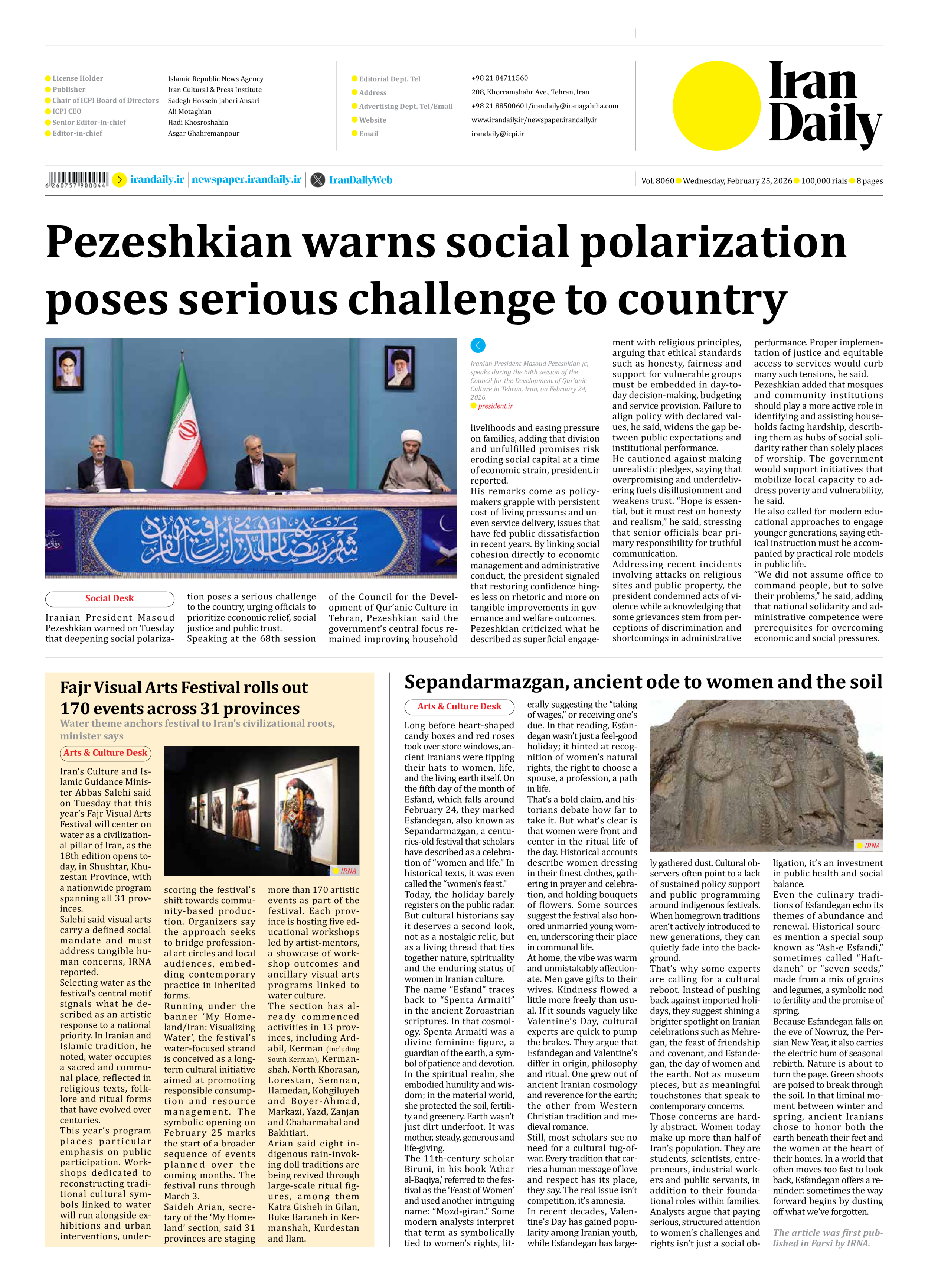


Fajr Visual Arts Festival rolls out 170 events across 31 provinces
Water theme anchors festival to Iran’s civilizational roots, minister says
Iran’s Culture and Islamic Guidance Minister Abbas Salehi said on Tuesday that this year’s Fajr Visual Arts Festival will center on water as a civilizational pillar of Iran, as the 18th edition opens today, in Shushtar, Khuzestan Province, with a nationwide program spanning all 31 provinces.
Salehi said visual arts carry a defined social mandate and must address tangible human concerns, IRNA reported.
Selecting water as the festival’s central motif signals what he described as an artistic response to a national priority. In Iranian and Islamic tradition, he noted, water occupies a sacred and communal place, reflected in religious texts, folklore and ritual forms that have evolved over centuries.
This year’s program places particular emphasis on public participation. Workshops dedicated to reconstructing traditional cultural symbols linked to water will run alongside exhibitions and urban interventions, underscoring the festival’s shift towards community-based production. Organizers say the approach seeks to bridge professional art circles and local audiences, embedding contemporary practice in inherited forms.
Running under the banner ‘My Homeland/Iran: Visualizing Water’, the festival’s water-focused strand is conceived as a long-term cultural initiative aimed at promoting responsible consumption and resource management. The symbolic opening on February 25 marks the start of a broader sequence of events planned over the coming months. The festival runs through March 3.
Saideh Arian, secretary of the ‘My Homeland’ section, said 31 provinces are staging more than 170 artistic events as part of the festival. Each province is hosting five educational workshops led by artist-mentors, a showcase of workshop outcomes and ancillary visual arts programs linked to water culture.
The section has already commenced activities in 13 provinces, including Ardabil, Kerman (including South Kerman), Kermanshah, North Khorasan, Lorestan, Semnan, Hamedan, Kohgiluyeh and Boyer-Ahmad, Markazi, Yazd, Zanjan and Chaharmahal and Bakhtiari.
Arian said eight indigenous rain-invoking doll traditions are being revived through large-scale ritual figures, among them Katra Gisheh in Gilan, Buke Baraneh in Kermanshah, Kurdestan and Ilam.