





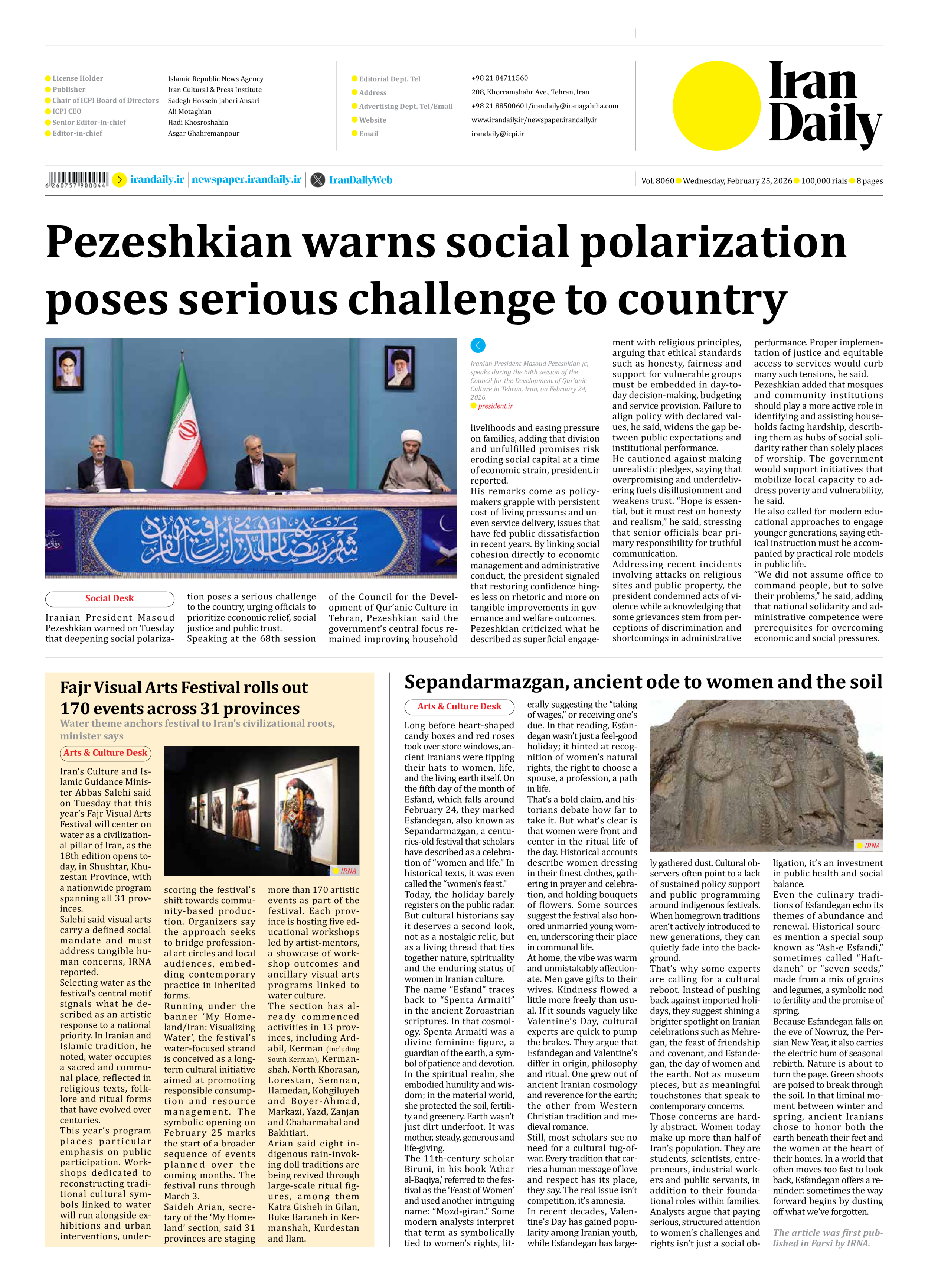


Pezeshkian warns social polarization poses serious challenge to country
Iranian President Masoud Pezeshkian warned on Tuesday that deepening social polarization poses a serious challenge to the country, urging officials to prioritize economic relief, social justice and public trust.
Speaking at the 68th session of the Council for the Development of Qur’anic Culture in Tehran, Pezeshkian said the government’s central focus remained improving household livelihoods and easing pressure on families, adding that division and unfulfilled promises risk eroding social capital at a time of economic strain, president.ir reported.
His remarks come as policymakers grapple with persistent cost-of-living pressures and uneven service delivery, issues that have fed public dissatisfaction in recent years. By linking social cohesion directly to economic management and administrative conduct, the president signaled that restoring confidence hinges less on rhetoric and more on tangible improvements in governance and welfare outcomes.
Pezeshkian criticized what he described as superficial engagement with religious principles, arguing that ethical standards such as honesty, fairness and support for vulnerable groups must be embedded in day-to-day decision-making, budgeting and service provision. Failure to align policy with declared values, he said, widens the gap between public expectations and institutional performance.
He cautioned against making unrealistic pledges, saying that overpromising and underdelivering fuels disillusionment and weakens trust. “Hope is essential, but it must rest on honesty and realism,” he said, stressing that senior officials bear primary responsibility for truthful communication.
Addressing recent incidents involving attacks on religious sites and public property, the president condemned acts of violence while acknowledging that some grievances stem from perceptions of discrimination and shortcomings in administrative performance. Proper implementation of justice and equitable access to services would curb many such tensions, he said.
Pezeshkian added that mosques and community institutions should play a more active role in identifying and assisting households facing hardship, describing them as hubs of social solidarity rather than solely places of worship. The government would support initiatives that mobilize local capacity to address poverty and vulnerability, he said.
He also called for modern educational approaches to engage younger generations, saying ethical instruction must be accompanied by practical role models in public life.
“We did not assume office to command people, but to solve their problems,” he said, adding that national solidarity and administrative competence were prerequisites for overcoming economic and social pressures.