





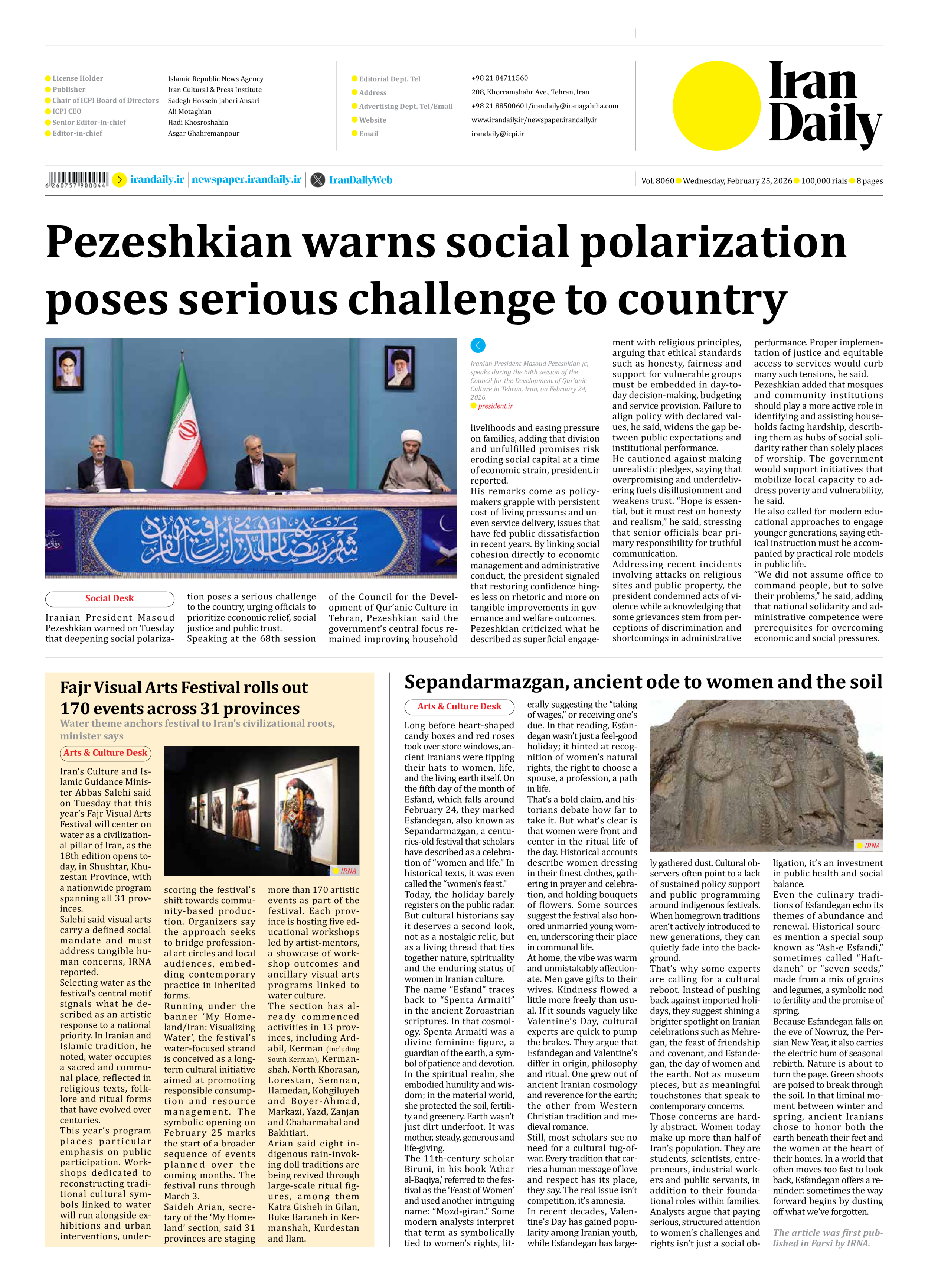


Sepandarmazgan, ancient ode to women and the soil
Long before heart-shaped candy boxes and red roses took over store windows, ancient Iranians were tipping their hats to women, life, and the living earth itself. On the fifth day of the month of Esfand, which falls around February 24, they marked Esfandegan, also known as Sepandarmazgan, a centuries-old festival that scholars have described as a celebration of “women and life.” In historical texts, it was even called the “women’s feast.”
Today, the holiday barely registers on the public radar. But cultural historians say it deserves a second look, not as a nostalgic relic, but as a living thread that ties together nature, spirituality and the enduring status of women in Iranian culture.
The name “Esfand” traces back to “Spenta Armaiti” in the ancient Zoroastrian scriptures. In that cosmology, Spenta Armaiti was a divine feminine figure, a guardian of the earth, a symbol of patience and devotion. In the spiritual realm, she embodied humility and wisdom; in the material world, she protected the soil, fertility and greenery. Earth wasn’t just dirt underfoot. It was mother, steady, generous and life-giving.
The 11th-century scholar Biruni, in his book ‘Athar al-Baqiya,’ referred to the festival as the ‘Feast of Women’ and used another intriguing name: “Mozd-giran.” Some modern analysts interpret that term as symbolically tied to women’s rights, literally suggesting the “taking of wages,” or receiving one’s due. In that reading, Esfandegan wasn’t just a feel-good holiday; it hinted at recognition of women’s natural rights, the right to choose a spouse, a profession, a path in life.
That’s a bold claim, and historians debate how far to take it. But what’s clear is that women were front and center in the ritual life of the day. Historical accounts describe women dressing in their finest clothes, gathering in prayer and celebration, and holding bouquets of flowers. Some sources suggest the festival also honored unmarried young women, underscoring their place in communal life.
At home, the vibe was warm and unmistakably affectionate. Men gave gifts to their wives. Kindness flowed a little more freely than usual. If it sounds vaguely like Valentine’s Day, cultural experts are quick to pump the brakes. They argue that Esfandegan and Valentine’s differ in origin, philosophy and ritual. One grew out of ancient Iranian cosmology and reverence for the earth; the other from Western Christian tradition and medieval romance.
Still, most scholars see no need for a cultural tug-of-war. Every tradition that carries a human message of love and respect has its place, they say. The real issue isn’t competition, it’s amnesia.
In recent decades, Valentine’s Day has gained popularity among Iranian youth, while Esfandegan has largely gathered dust. Cultural observers often point to a lack of sustained policy support and public programming around indigenous festivals. When homegrown traditions aren’t actively introduced to new generations, they can quietly fade into the background.
That’s why some experts are calling for a cultural reboot. Instead of pushing back against imported holidays, they suggest shining a brighter spotlight on Iranian celebrations such as Mehregan, the feast of friendship and covenant, and Esfandegan, the day of women and the earth. Not as museum pieces, but as meaningful touchstones that speak to contemporary concerns.
Those concerns are hardly abstract. Women today make up more than half of Iran’s population. They are students, scientists, entrepreneurs, industrial workers and public servants, in addition to their foundational roles within families. Analysts argue that paying serious, structured attention to women’s challenges and rights isn’t just a social obligation, it’s an investment in public health and social balance.
Even the culinary traditions of Esfandegan echo its themes of abundance and renewal. Historical sources mention a special soup known as “Ash-e Esfandi,” sometimes called “Haft-daneh” or “seven seeds,” made from a mix of grains and legumes, a symbolic nod to fertility and the promise of spring.
Because Esfandegan falls on the eve of Nowruz, the Persian New Year, it also carries the electric hum of seasonal rebirth. Nature is about to turn the page. Green shoots are poised to break through the soil. In that liminal moment between winter and spring, ancient Iranians chose to honor both the earth beneath their feet and the women at the heart of their homes. In a world that often moves too fast to look back, Esfandegan offers a reminder: sometimes the way forward begins by dusting off what we’ve forgotten.
The article was first published in Farsi by IRNA.