







‘Guardians of the Sun’ caught between childhood, adolescence
By Neda Almasian Tehrani
Member of Iranian Society of Film Critics and Writers (ISFCW)
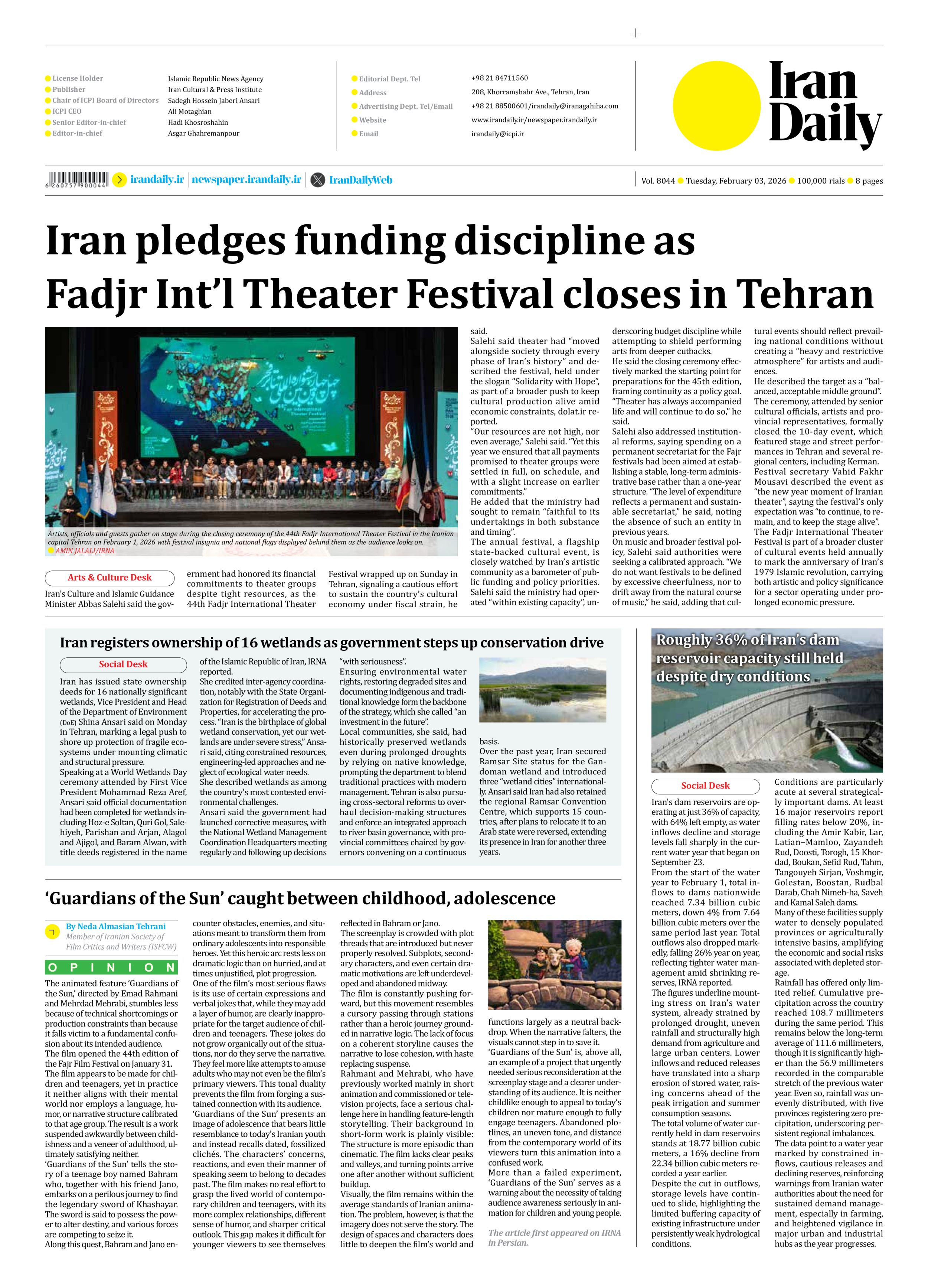
The animated feature ‘Guardians of the Sun,’ directed by Emad Rahmani and Mehrdad Mehrabi, stumbles less because of technical shortcomings or production constraints than because it falls victim to a fundamental confusion about its intended audience.
The film opened the 44th edition of the Fajr Film Festival on January 31.
The film appears to be made for children and teenagers, yet in practice it neither aligns with their mental world nor employs a language, humor, or narrative structure calibrated to that age group. The result is a work suspended awkwardly between childishness and a veneer of adulthood, ultimately satisfying neither.
‘Guardians of the Sun’ tells the story of a teenage boy named Bahram who, together with his friend Jano, embarks on a perilous journey to find the legendary sword of Khashayar. The sword is said to possess the power to alter destiny, and various forces are competing to seize it.
Along this quest, Bahram and Jano encounter obstacles, enemies, and situations meant to transform them from ordinary adolescents into responsible heroes. Yet this heroic arc rests less on dramatic logic than on hurried, and at times unjustified, plot progression.
One of the film’s most serious flaws is its use of certain expressions and verbal jokes that, while they may add a layer of humor, are clearly inappropriate for the target audience of children and teenagers. These jokes do not grow organically out of the situations, nor do they serve the narrative. They feel more like attempts to amuse adults who may not even be the film’s primary viewers. This tonal duality prevents the film from forging a sustained connection with its audience.
‘Guardians of the Sun’ presents an image of adolescence that bears little resemblance to today’s Iranian youth and instead recalls dated, fossilized clichés. The characters’ concerns, reactions, and even their manner of speaking seem to belong to decades past. The film makes no real effort to grasp the lived world of contemporary children and teenagers, with its more complex relationships, different sense of humor, and sharper critical outlook. This gap makes it difficult for younger viewers to see themselves reflected in Bahram or Jano.
The screenplay is crowded with plot threads that are introduced but never properly resolved. Subplots, secondary characters, and even certain dramatic motivations are left underdeveloped and abandoned midway.
The film is constantly pushing forward, but this movement resembles a cursory passing through stations rather than a heroic journey grounded in narrative logic. The lack of focus on a coherent storyline causes the narrative to lose cohesion, with haste replacing suspense.
Rahmani and Mehrabi, who have previously worked mainly in short animation and commissioned or television projects, face a serious challenge here in handling feature-length storytelling. Their background in short-form work is plainly visible: The structure is more episodic than cinematic. The film lacks clear peaks and valleys, and turning points arrive one after another without sufficient buildup.
Visually, the film remains within the average standards of Iranian animation. The problem, however, is that the imagery does not serve the story. The design of spaces and characters does little to deepen the film’s world and functions largely as a neutral backdrop. When the narrative falters, the visuals cannot step in to save it.
‘Guardians of the Sun’ is, above all, an example of a project that urgently needed serious reconsideration at the screenplay stage and a clearer understanding of its audience. It is neither childlike enough to appeal to today’s children nor mature enough to fully engage teenagers. Abandoned plotlines, an uneven tone, and distance from the contemporary world of its viewers turn this animation into a confused work.
More than a failed experiment, ‘Guardians of the Sun’ serves as a warning about the necessity of taking audience awareness seriously in animation for children and young people.
The article first appeared on IRNA in Persian.