







Iran pledges funding discipline as Fadjr Int’l Theater Festival closes in Tehran
Iran’s Culture and Islamic Guidance Minister Abbas Salehi said the government had honored its financial commitments to theater groups despite tight resources, as the 44th Fadjr International Theater Festival wrapped up on Sunday in Tehran, signaling a cautious effort to sustain the country’s cultural economy under fiscal strain, he said.
Salehi said theater had “moved alongside society through every phase of Iran’s history” and described the festival, held under the slogan “Solidarity with Hope”, as part of a broader push to keep cultural production alive amid economic constraints, dolat.ir reported.
“Our resources are not high, nor even average,” Salehi said. “Yet this year we ensured that all payments promised to theater groups were settled in full, on schedule, and with a slight increase on earlier commitments.”
He added that the ministry had sought to remain “faithful to its undertakings in both substance and timing”.
The annual festival, a flagship state-backed cultural event, is closely watched by Iran’s artistic community as a barometer of public funding and policy priorities. Salehi said the ministry had operated “within existing capacity”, underscoring budget discipline while attempting to shield performing arts from deeper cutbacks.
He said the closing ceremony effectively marked the starting point for preparations for the 45th edition, framing continuity as a policy goal. “Theater has always accompanied life and will continue to do so,” he said.
Salehi also addressed institutional reforms, saying spending on a permanent secretariat for the Fajr festivals had been aimed at establishing a stable, long-term administrative base rather than a one-year structure. “The level of expenditure reflects a permanent and sustainable secretariat,” he said, noting the absence of such an entity in previous years.
On music and broader festival policy, Salehi said authorities were seeking a calibrated approach. “We do not want festivals to be defined by excessive cheerfulness, nor to drift away from the natural course of music,” he said, adding that cultural events should reflect prevailing national conditions without creating a “heavy and restrictive atmosphere” for artists and audiences.
He described the target as a “balanced, acceptable middle ground”.
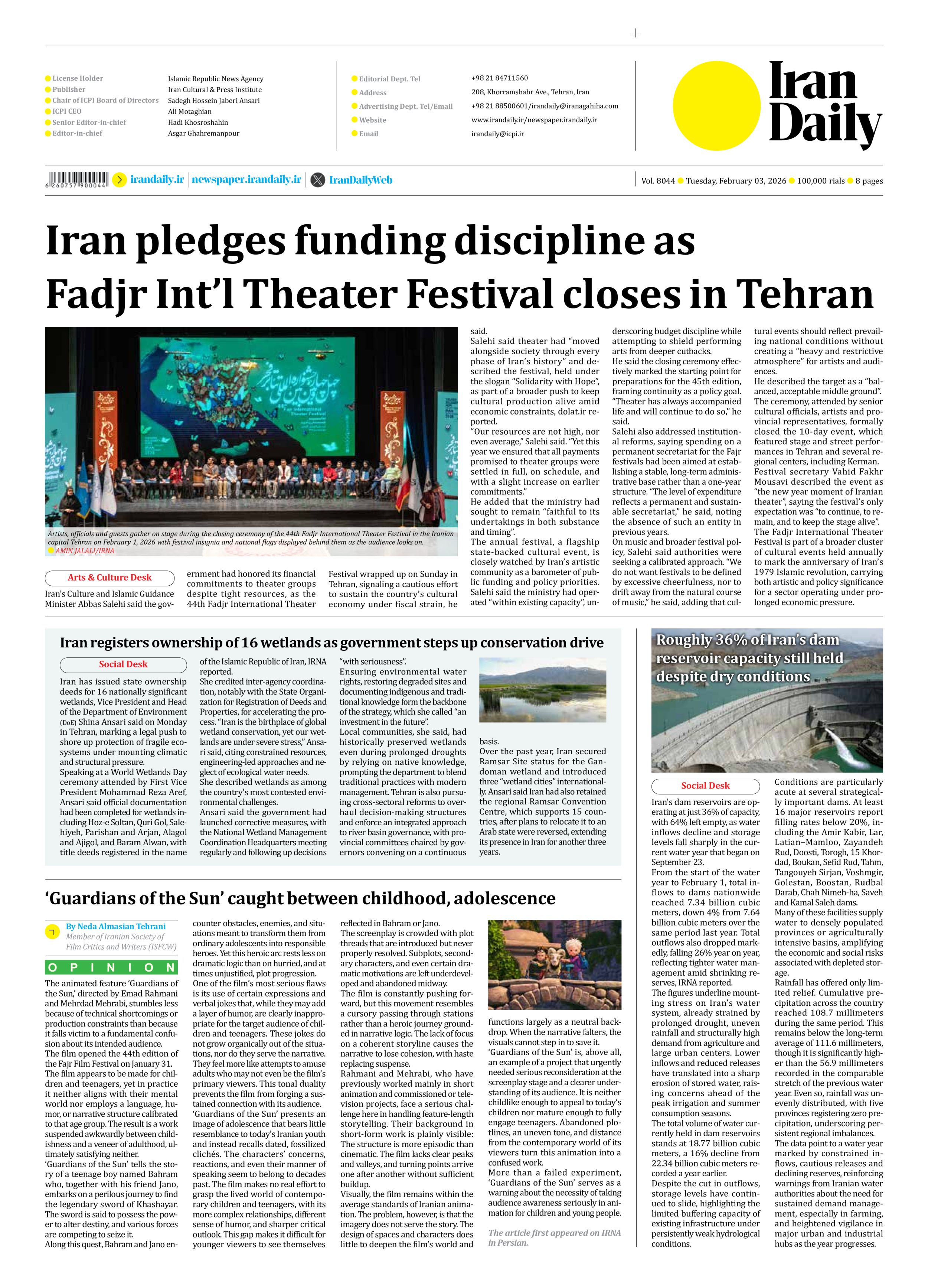
The ceremony, attended by senior cultural officials, artists and provincial representatives, formally closed the 10-day event, which featured stage and street performances in Tehran and several regional centers, including Kerman.
Festival secretary Vahid Fakhr Mousavi described the event as “the new year moment of Iranian theater”, saying the festival’s only expectation was “to continue, to remain, and to keep the stage alive”.
The Fadjr International Theater Festival is part of a broader cluster of cultural events held annually to mark the anniversary of Iran’s 1979 Islamic revolution, carrying both artistic and policy significance for a sector operating under prolonged economic pressure.