







North Khorasan’s museums feature 7,400 artifacts
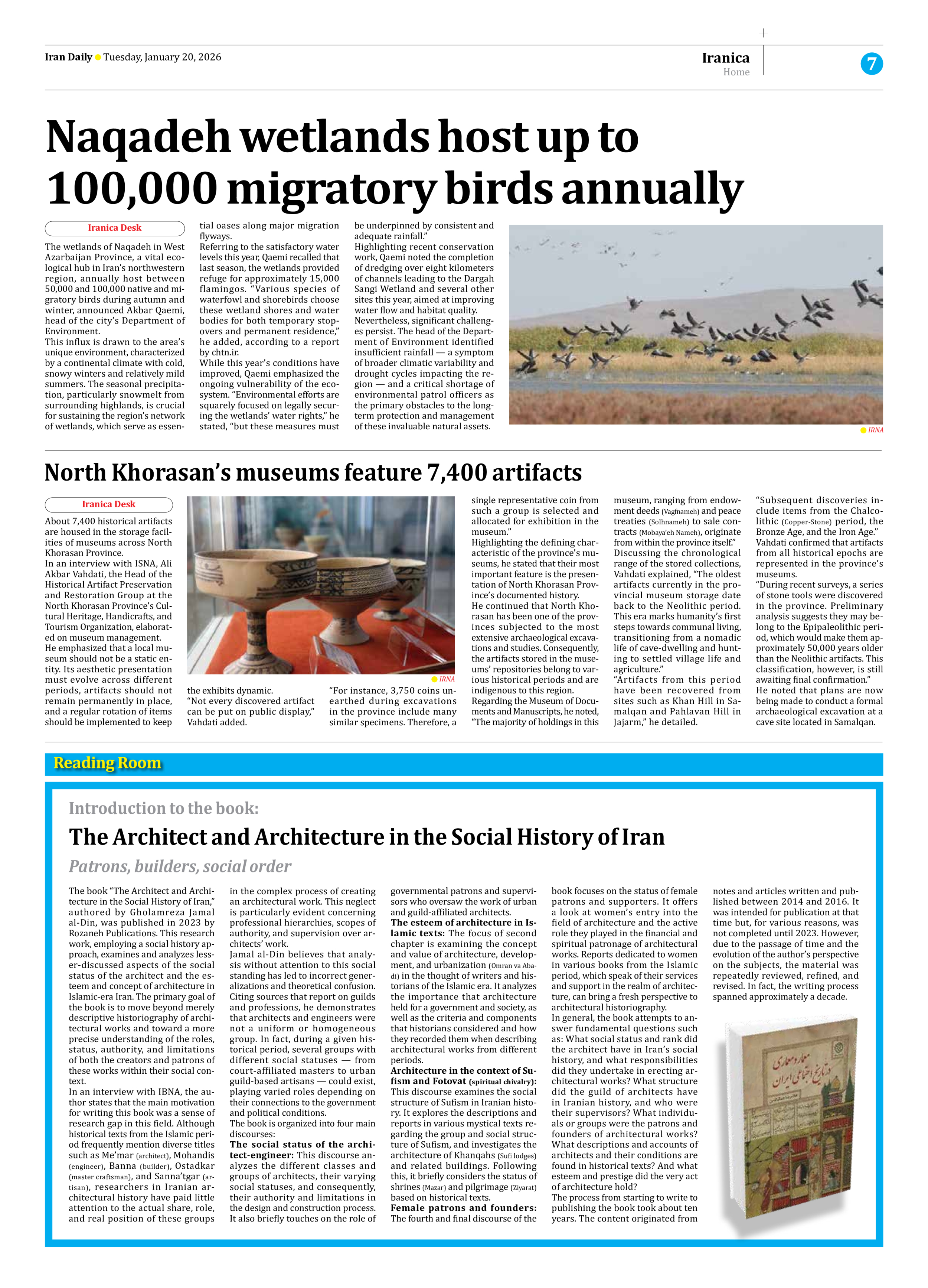
About 7,400 historical artifacts are housed in the storage facilities of museums across North Khorasan Province.
In an interview with ISNA, Ali Akbar Vahdati, the Head of the Historical Artifact Preservation and Restoration Group at the North Khorasan Province’s Cultural Heritage, Handicrafts, and Tourism Organization, elaborated on museum management.
He emphasized that a local museum should not be a static entity. Its aesthetic presentation must evolve across different periods, artifacts should not remain permanently in place, and a regular rotation of items should be implemented to keep the exhibits dynamic.
“Not every discovered artifact can be put on public display,” Vahdati added.
“For instance, 3,750 coins unearthed during excavations in the province include many similar specimens. Therefore, a single representative coin from such a group is selected and allocated for exhibition in the museum.”
Highlighting the defining characteristic of the province’s museums, he stated that their most important feature is the presentation of North Khorasan Province’s documented history.
He continued that North Khorasan has been one of the provinces subjected to the most extensive archaeological excavations and studies. Consequently, the artifacts stored in the museums’ repositories belong to various historical periods and are indigenous to this region.
Regarding the Museum of Documents and Manuscripts, he noted, “The majority of holdings in this museum, ranging from endowment deeds (Vagfnameh) and peace treaties (Solhnameh) to sale contracts (Mobaya’eh Nameh), originate from within the province itself.”
Discussing the chronological range of the stored collections, Vahdati explained, “The oldest artifacts currently in the provincial museum storage date back to the Neolithic period. This era marks humanity’s first steps towards communal living, transitioning from a nomadic life of cave-dwelling and hunting to settled village life and agriculture.”
“Artifacts from this period have been recovered from sites such as Khan Hill in Samalqan and Pahlavan Hill in Jajarm,” he detailed.
“Subsequent discoveries include items from the Chalcolithic (Copper-Stone) period, the Bronze Age, and the Iron Age.”
Vahdati confirmed that artifacts from all historical epochs are represented in the province’s museums.
“During recent surveys, a series of stone tools were discovered in the province. Preliminary analysis suggests they may belong to the Epipaleolithic period, which would make them approximately 50,000 years older than the Neolithic artifacts. This classification, however, is still awaiting final confirmation.”
He noted that plans are now being made to conduct a formal archaeological excavation at a cave site located in Samalqan.