







Khatoon; 6,000-year-old female skeleton buried with symbols of justice
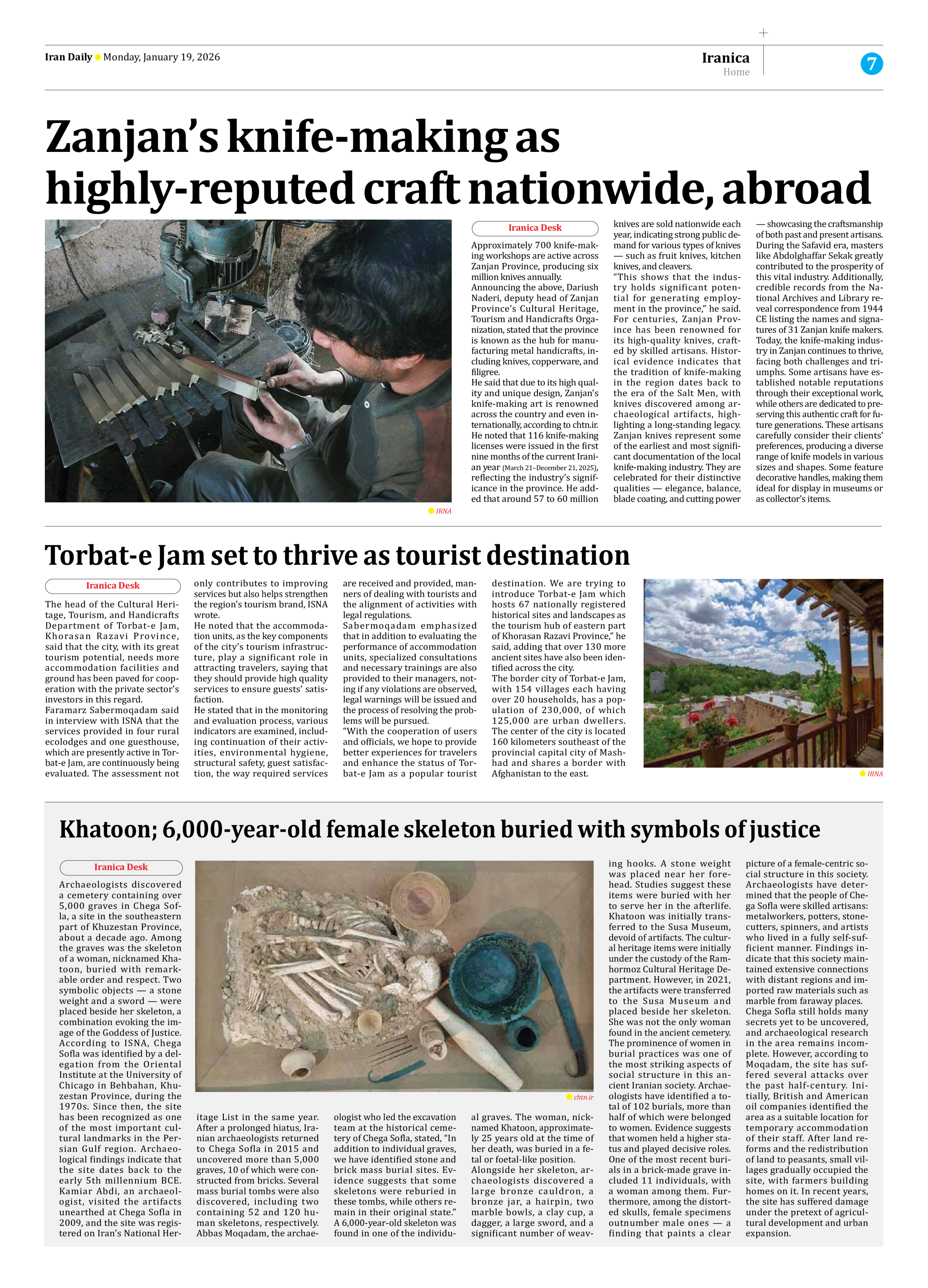
Archaeologists discovered a cemetery containing over 5,000 graves in Chega Sofla, a site in the southeastern part of Khuzestan Province, about a decade ago. Among the graves was the skeleton of a woman, nicknamed Khatoon, buried with remarkable order and respect. Two symbolic objects — a stone weight and a sword — were placed beside her skeleton, a combination evoking the image of the Goddess of Justice.
According to ISNA, Chega Sofla was identified by a delegation from the Oriental Institute at the University of Chicago in Behbahan, Khuzestan Province, during the 1970s. Since then, the site has been recognized as one of the most important cultural landmarks in the Persian Gulf region. Archaeological findings indicate that the site dates back to the early 5th millennium BCE.
Kamiar Abdi, an archaeologist, visited the artifacts unearthed at Chega Sofla in 2009, and the site was registered on Iran’s National Heritage List in the same year. After a prolonged hiatus, Iranian archaeologists returned to Chega Sofla in 2015 and uncovered more than 5,000 graves, 10 of which were constructed from bricks. Several mass burial tombs were also discovered, including two containing 52 and 120 human skeletons, respectively.
Abbas Moqadam, the archaeologist who led the excavation team at the historical cemetery of Chega Sofla, stated, “In addition to individual graves, we have identified stone and brick mass burial sites. Evidence suggests that some skeletons were reburied in these tombs, while others remain in their original state.”
A 6,000-year-old skeleton was found in one of the individual graves. The woman, nicknamed Khatoon, approximately 25 years old at the time of her death, was buried in a fetal or foetal-like position.
Alongside her skeleton, archaeologists discovered a large bronze cauldron, a bronze jar, a hairpin, two marble bowls, a clay cup, a dagger, a large sword, and a significant number of weaving hooks. A stone weight was placed near her forehead. Studies suggest these items were buried with her to serve her in the afterlife.
Khatoon was initially transferred to the Susa Museum, devoid of artifacts. The cultural heritage items were initially under the custody of the Ramhormoz Cultural Heritage Department. However, in 2021, the artifacts were transferred to the Susa Museum and placed beside her skeleton.
She was not the only woman found in the ancient cemetery. The prominence of women in burial practices was one of the most striking aspects of social structure in this ancient Iranian society. Archaeologists have identified a total of 102 burials, more than half of which were belonged to women. Evidence suggests that women held a higher status and played decisive roles.
One of the most recent burials in a brick-made grave included 11 individuals, with a woman among them. Furthermore, among the distorted skulls, female specimens outnumber male ones — a finding that paints a clear picture of a female-centric social structure in this society.
Archaeologists have determined that the people of Chega Sofla were skilled artisans: metalworkers, potters, stonecutters, spinners, and artists who lived in a fully self-sufficient manner. Findings indicate that this society maintained extensive connections with distant regions and imported raw materials such as marble from faraway places.
Chega Sofla still holds many secrets yet to be uncovered, and archaeological research in the area remains incomplete. However, according to Moqadam, the site has suffered several attacks over the past half-century. Initially, British and American oil companies identified the area as a suitable location for temporary accommodation of their staff. After land reforms and the redistribution of land to peasants, small villages gradually occupied the site, with farmers building homes on it. In recent years, the site has suffered damage under the pretext of agricultural development and urban expansion.