







Zanjan’s knife-making as highly-reputed craft nationwide, abroad
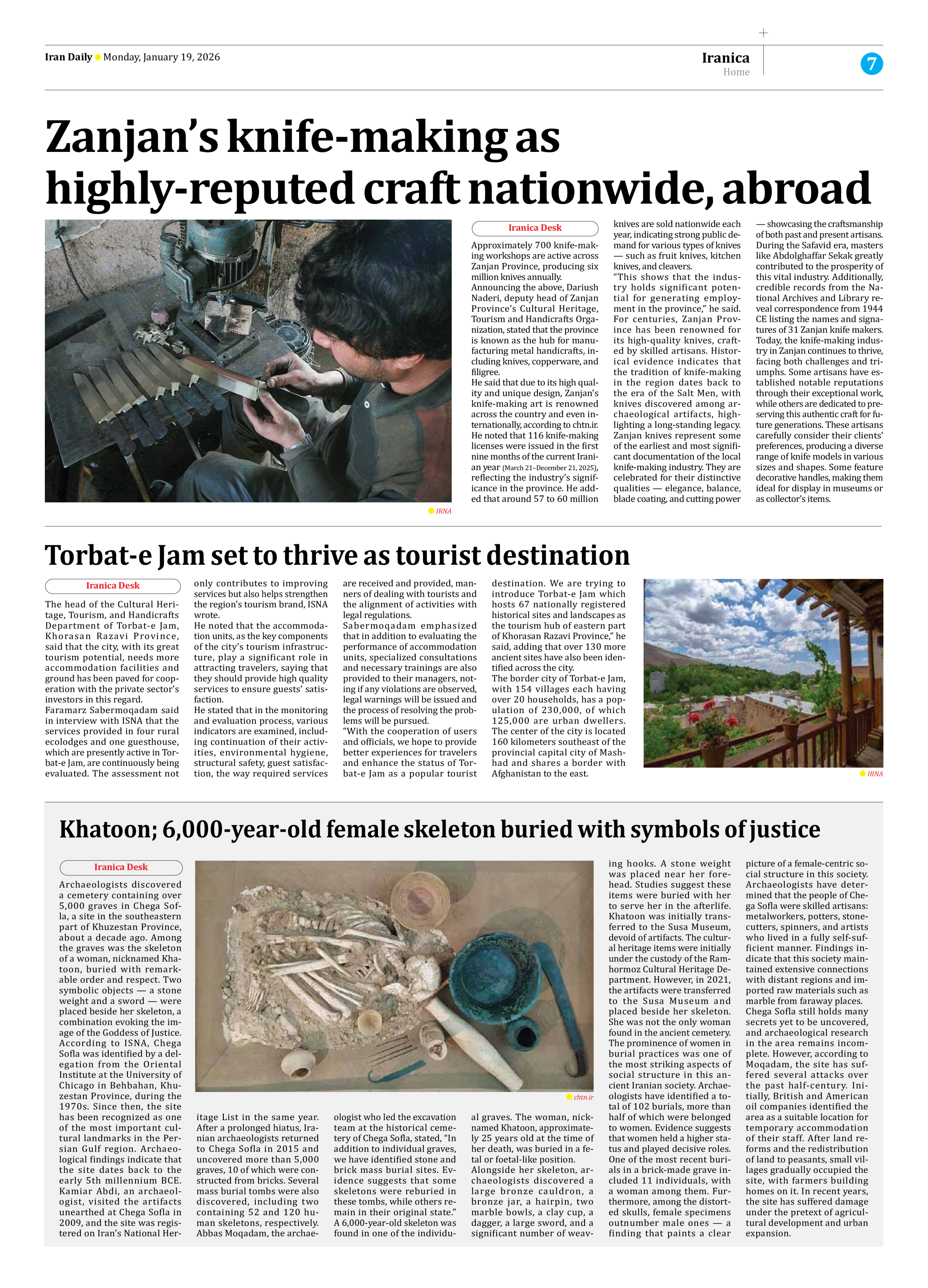
Approximately 700 knife-making workshops are active across Zanjan Province, producing six million knives annually.
Announcing the above, Dariush Naderi, deputy head of Zanjan Province’s Cultural Heritage, Tourism and Handicrafts Organization, stated that the province is known as the hub for manufacturing metal handicrafts, including knives, copperware, and filigree.
He said that due to its high quality and unique design, Zanjan’s knife-making art is renowned across the country and even internationally, according to chtn.ir.
He noted that 116 knife-making licenses were issued in the first nine months of the current Iranian year (March 21–December 21, 2025), reflecting the industry’s significance in the province. He added that around 57 to 60 million knives are sold nationwide each year, indicating strong public demand for various types of knives — such as fruit knives, kitchen knives, and cleavers.
“This shows that the industry holds significant potential for generating employment in the province,” he said.
For centuries, Zanjan Province has been renowned for its high-quality knives, crafted by skilled artisans. Historical evidence indicates that the tradition of knife-making in the region dates back to the era of the Salt Men, with knives discovered among archaeological artifacts, highlighting a long-standing legacy.
Zanjan knives represent some of the earliest and most significant documentation of the local knife-making industry. They are celebrated for their distinctive qualities — elegance, balance, blade coating, and cutting power — showcasing the craftsmanship of both past and present artisans.
During the Safavid era, masters like Abdolghaffar Sekak greatly contributed to the prosperity of this vital industry. Additionally, credible records from the National Archives and Library reveal correspondence from 1944 CE listing the names and signatures of 31 Zanjan knife makers.
Today, the knife-making industry in Zanjan continues to thrive, facing both challenges and triumphs. Some artisans have established notable reputations through their exceptional work, while others are dedicated to preserving this authentic craft for future generations. These artisans carefully consider their clients’ preferences, producing a diverse range of knife models in various sizes and shapes. Some feature decorative handles, making them ideal for display in museums or as collector’s items.