







From Dostoevsky to Shakespeare
Mehdi Persis tests language, moral climate in cross-border performance
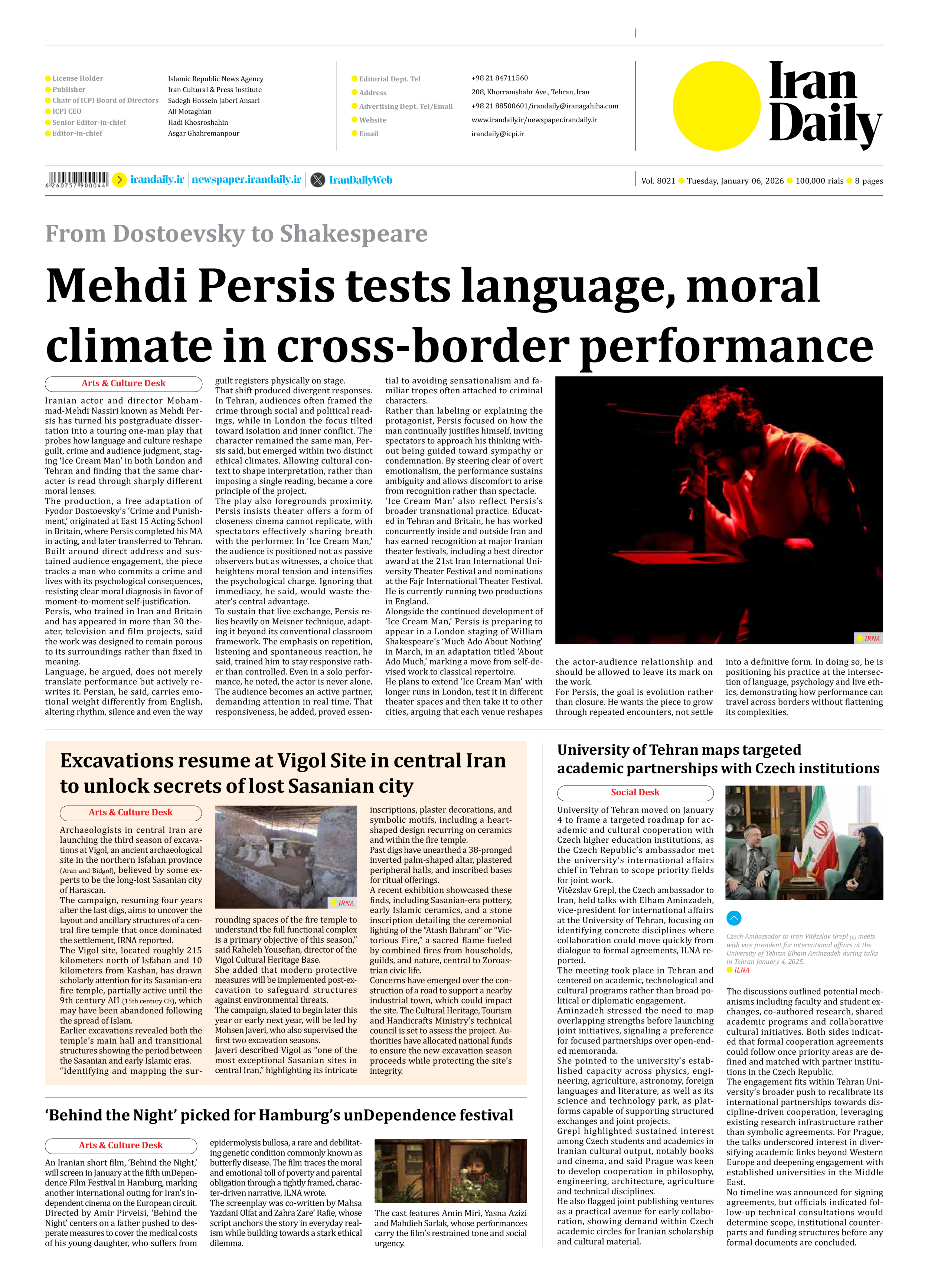
Iranian actor and director Mohammad-Mehdi Nassiri known as Mehdi Persis has turned his postgraduate dissertation into a touring one-man play that probes how language and culture reshape guilt, crime and audience judgment, staging ‘Ice Cream Man’ in both London and Tehran and finding that the same character is read through sharply different moral lenses.
The production, a free adaptation of Fyodor Dostoevsky’s ‘Crime and Punishment,’ originated at East 15 Acting School in Britain, where Persis completed his MA in acting, and later transferred to Tehran. Built around direct address and sustained audience engagement, the piece tracks a man who commits a crime and lives with its psychological consequences, resisting clear moral diagnosis in favor of moment-to-moment self-justification.
Persis, who trained in Iran and Britain and has appeared in more than 30 theater, television and film projects, said the work was designed to remain porous to its surroundings rather than fixed in meaning.
Language, he argued, does not merely translate performance but actively rewrites it. Persian, he said, carries emotional weight differently from English, altering rhythm, silence and even the way guilt registers physically on stage.
That shift produced divergent responses. In Tehran, audiences often framed the crime through social and political readings, while in London the focus tilted toward isolation and inner conflict. The character remained the same man, Persis said, but emerged within two distinct ethical climates. Allowing cultural context to shape interpretation, rather than imposing a single reading, became a core principle of the project.
The play also foregrounds proximity. Persis insists theater offers a form of closeness cinema cannot replicate, with spectators effectively sharing breath with the performer. In ‘Ice Cream Man,’ the audience is positioned not as passive observers but as witnesses, a choice that heightens moral tension and intensifies the psychological charge. Ignoring that immediacy, he said, would waste theater’s central advantage.
To sustain that live exchange, Persis relies heavily on Meisner technique, adapting it beyond its conventional classroom framework. The emphasis on repetition, listening and spontaneous reaction, he said, trained him to stay responsive rather than controlled. Even in a solo performance, he noted, the actor is never alone. The audience becomes an active partner, demanding attention in real time. That responsiveness, he added, proved essential to avoiding sensationalism and familiar tropes often attached to criminal characters.
Rather than labeling or explaining the protagonist, Persis focused on how the man continually justifies himself, inviting spectators to approach his thinking without being guided toward sympathy or condemnation. By steering clear of overt emotionalism, the performance sustains ambiguity and allows discomfort to arise from recognition rather than spectacle.
‘Ice Cream Man’ also reflect Persis’s broader transnational practice. Educated in Tehran and Britain, he has worked concurrently inside and outside Iran and has earned recognition at major Iranian theater festivals, including a best director award at the 21st Iran International University Theater Festival and nominations at the Fajr International Theater Festival. He is currently running two productions in England.
Alongside the continued development of ‘Ice Cream Man,’ Persis is preparing to appear in a London staging of William Shakespeare’s ‘Much Ado About Nothing’ in March, in an adaptation titled ‘About Ado Much,’ marking a move from self-devised work to classical repertoire.
He plans to extend ‘Ice Cream Man’ with longer runs in London, test it in different theater spaces and then take it to other cities, arguing that each venue reshapes the actor-audience relationship and should be allowed to leave its mark on the work.
For Persis, the goal is evolution rather than closure. He wants the piece to grow through repeated encounters, not settle into a definitive form. In doing so, he is positioning his practice at the intersection of language, psychology and live ethics, demonstrating how performance can travel across borders without flattening its complexities.