





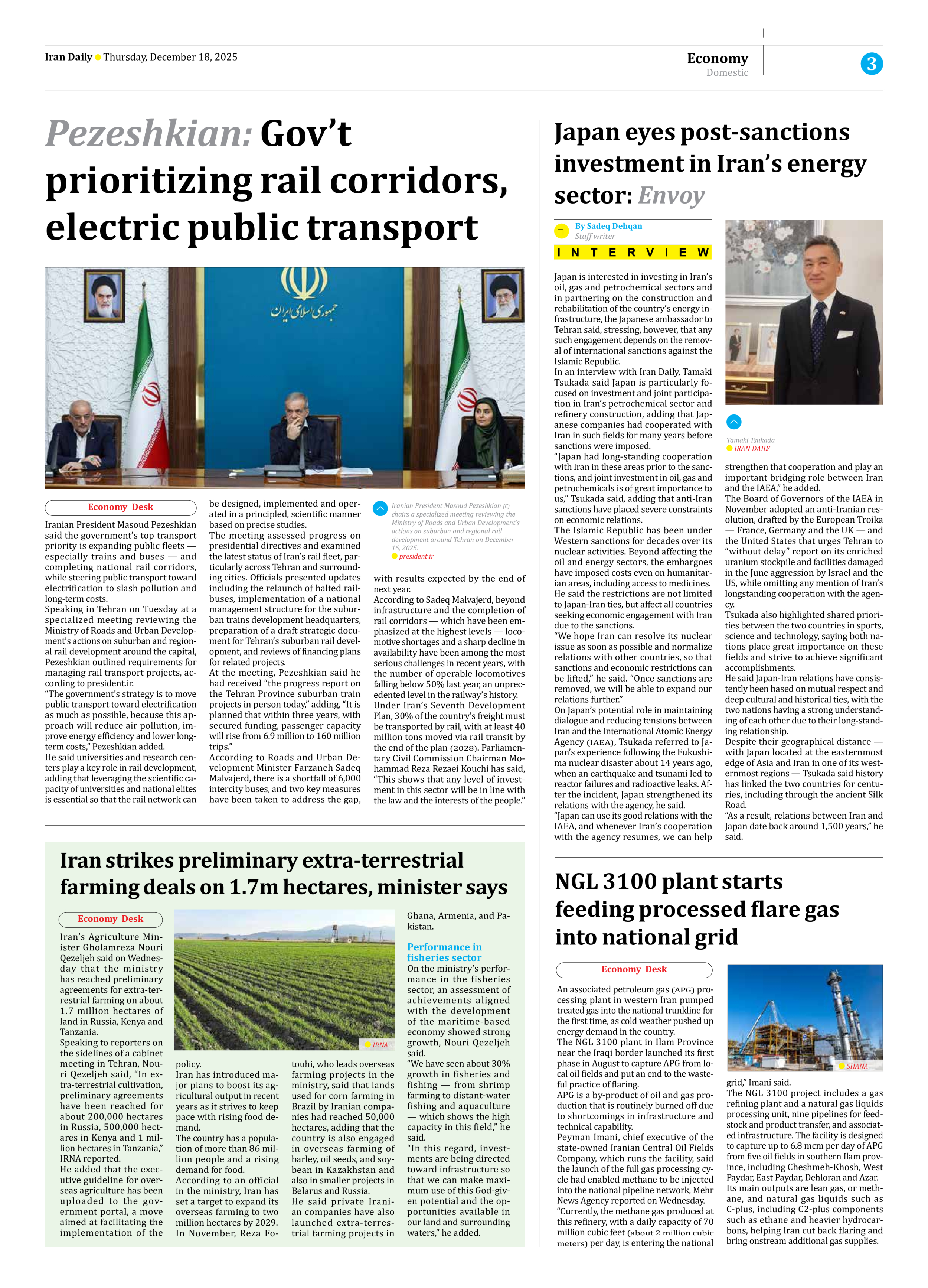


Japan eyes post-sanctions investment in Iran’s energy sector: Envoy
By Sadeq Dehqan
Staff writer
Japan is interested in investing in Iran’s oil, gas and petrochemical sectors and in partnering on the construction and rehabilitation of the country’s energy infrastructure, the Japanese ambassador to Tehran said, stressing, however, that any such engagement depends on the removal of international sanctions against the Islamic Republic.
In an interview with Iran Daily, Tamaki Tsukada said Japan is particularly focused on investment and joint participation in Iran’s petrochemical sector and refinery construction, adding that Japanese companies had cooperated with Iran in such fields for many years before sanctions were imposed.
“Japan had long-standing cooperation with Iran in these areas prior to the sanctions, and joint investment in oil, gas and petrochemicals is of great importance to us,” Tsukada said, adding that anti-Iran sanctions have placed severe constraints on economic relations.
The Islamic Republic has been under Western sanctions for decades over its nuclear activities. Beyond affecting the oil and energy sectors, the embargoes have imposed costs even on humanitarian areas, including access to medicines.
He said the restrictions are not limited to Japan-Iran ties, but affect all countries seeking economic engagement with Iran due to the sanctions.
“We hope Iran can resolve its nuclear issue as soon as possible and normalize relations with other countries, so that sanctions and economic restrictions can be lifted,” he said. “Once sanctions are removed, we will be able to expand our relations further.”
On Japan’s potential role in maintaining dialogue and reducing tensions between Iran and the International Atomic Energy Agency (IAEA), Tsukada referred to Japan’s experience following the Fukushima nuclear disaster about 14 years ago, when an earthquake and tsunami led to reactor failures and radioactive leaks. After the incident, Japan strengthened its relations with the agency, he said.
“Japan can use its good relations with the IAEA, and whenever Iran’s cooperation with the agency resumes, we can help strengthen that cooperation and play an important bridging role between Iran and the IAEA,” he added.
The Board of Governors of the IAEA in November adopted an anti-Iranian resolution, drafted by the European Troika — France, Germany and the UK — and the United States that urges Tehran to “without delay” report on its enriched uranium stockpile and facilities damaged in the June aggression by Israel and the US, while omitting any mention of Iran’s longstanding cooperation with the agency.
Tsukada also highlighted shared priorities between the two countries in sports, science and technology, saying both nations place great importance on these fields and strive to achieve significant accomplishments.
He said Japan-Iran relations have consistently been based on mutual respect and deep cultural and historical ties, with the two nations having a strong understanding of each other due to their long-standing relationship.
Despite their geographical distance — with Japan located at the easternmost edge of Asia and Iran in one of its westernmost regions — Tsukada said history has linked the two countries for centuries, including through the ancient Silk Road.
“As a result, relations between Iran and Japan date back around 1,500 years,” he said.