







Copy in clipboard...
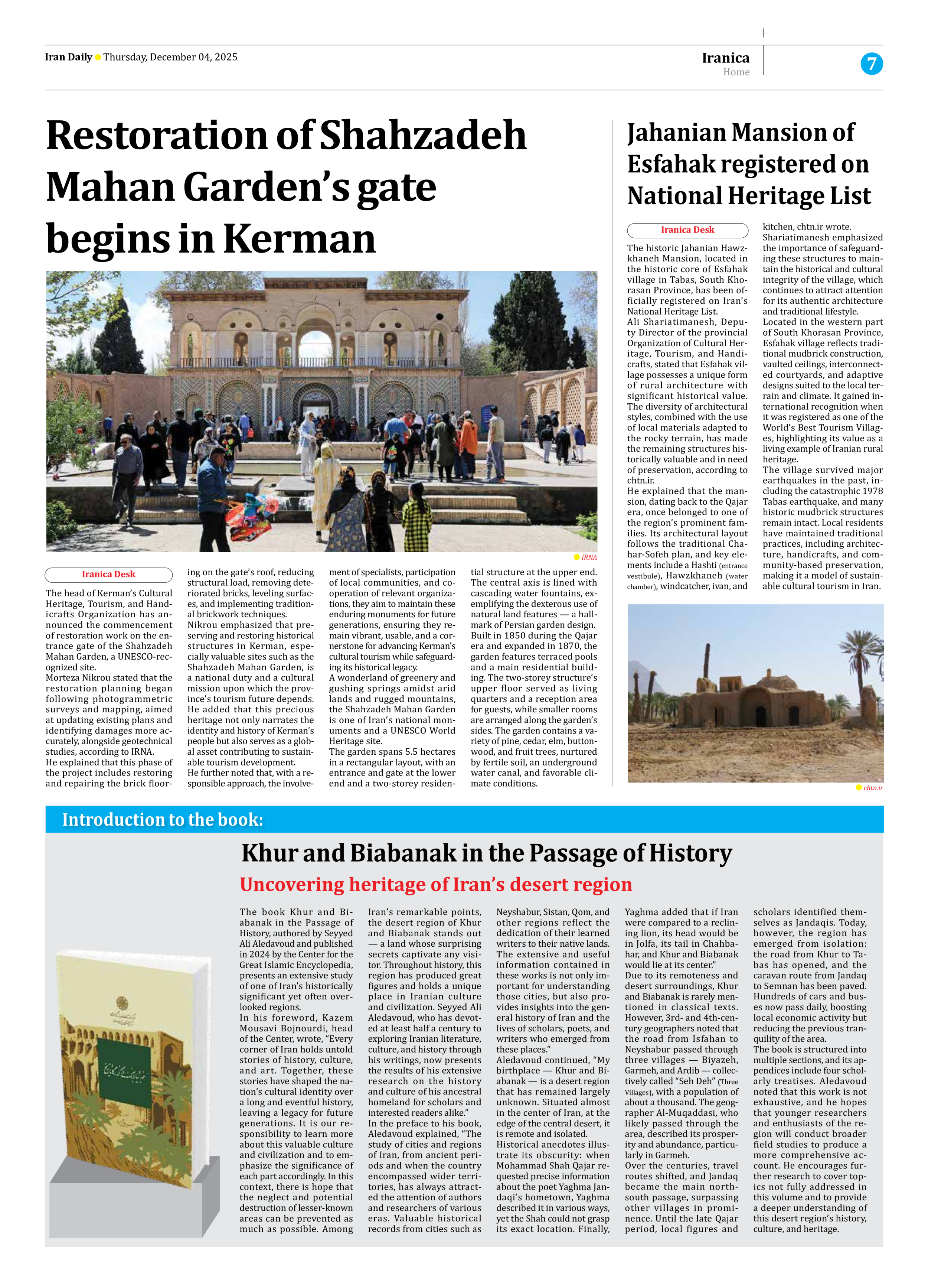
Introduction to the book:
Khur and Biabanak in the Passage of History
Uncovering heritage of Iran’s desert region
In his foreword, Kazem Mousavi Bojnourdi, head of the Center, wrote, “Every corner of Iran holds untold stories of history, culture, and art. Together, these stories have shaped the nation’s cultural identity over a long and eventful history, leaving a legacy for future generations. It is our responsibility to learn more about this valuable culture and civilization and to emphasize the significance of each part accordingly. In this context, there is hope that the neglect and potential destruction of lesser-known areas can be prevented as much as possible. Among Iran’s remarkable points, the desert region of Khur and Biabanak stands out — a land whose surprising secrets captivate any visitor. Throughout history, this region has produced great figures and holds a unique place in Iranian culture and civilization. Seyyed Ali Aledavoud, who has devoted at least half a century to exploring Iranian literature, culture, and history through his writings, now presents the results of his extensive research on the history and culture of his ancestral homeland for scholars and interested readers alike.”
In the preface to his book, Aledavoud explained, “The study of cities and regions of Iran, from ancient periods and when the country encompassed wider territories, has always attracted the attention of authors and researchers of various eras. Valuable historical records from cities such as Neyshabur, Sistan, Qom, and other regions reflect the dedication of their learned writers to their native lands. The extensive and useful information contained in these works is not only important for understanding those cities, but also provides insights into the general history of Iran and the lives of scholars, poets, and writers who emerged from these places.”
Aledavoud continued, “My birthplace — Khur and Biabanak — is a desert region that has remained largely unknown. Situated almost in the center of Iran, at the edge of the central desert, it is remote and isolated.
Historical anecdotes illustrate its obscurity: when Mohammad Shah Qajar requested precise information about the poet Yaghma Jandaqi’s hometown, Yaghma described it in various ways, yet the Shah could not grasp its exact location. Finally, Yaghma added that if Iran were compared to a reclining lion, its head would be in Jolfa, its tail in Chahbahar, and Khur and Biabanak would lie at its center.”
Due to its remoteness and desert surroundings, Khur and Biabanak is rarely mentioned in classical texts. However, 3rd- and 4th-century geographers noted that the road from Isfahan to Neyshabur passed through three villages — Biyazeh, Garmeh, and Ardib — collectively called “Seh Deh” (Three Villages), with a population of about a thousand. The geographer Al-Muqaddasi, who likely passed through the area, described its prosperity and abundance, particularly in Garmeh.
Over the centuries, travel routes shifted, and Jandaq became the main north-south passage, surpassing other villages in prominence. Until the late Qajar period, local figures and scholars identified themselves as Jandaqis. Today, however, the region has emerged from isolation: the road from Khur to Tabas has opened, and the caravan route from Jandaq to Semnan has been paved. Hundreds of cars and buses now pass daily, boosting local economic activity but reducing the previous tranquility of the area.
The book is structured into multiple sections, and its appendices include four scholarly treatises. Aledavoud noted that this work is not exhaustive, and he hopes that younger researchers and enthusiasts of the region will conduct broader field studies to produce a more comprehensive account. He encourages further research to cover topics not fully addressed in this volume and to provide a deeper understanding of this desert region’s history, culture, and heritage.