





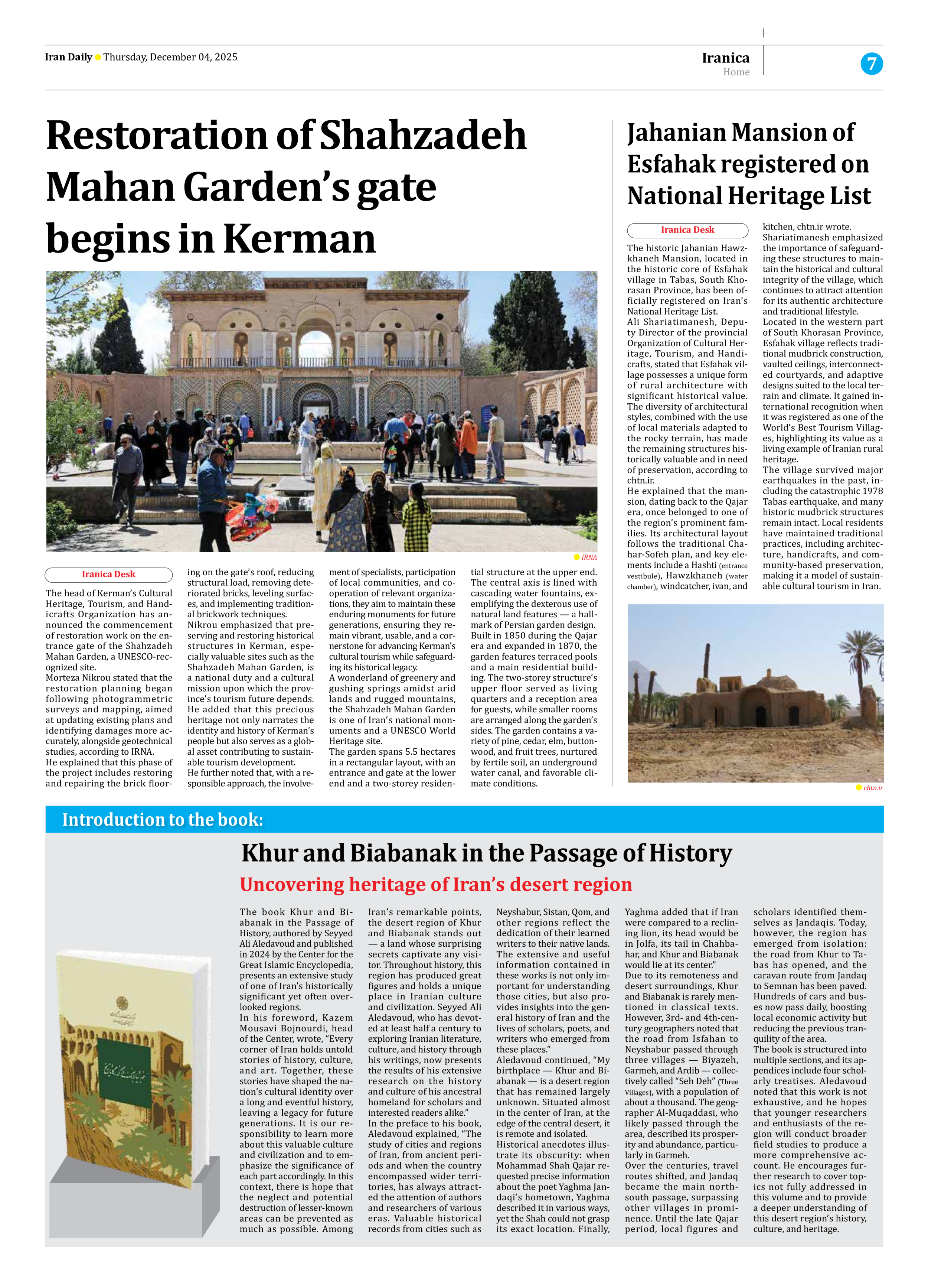


Restoration of Shahzadeh Mahan Garden’s gate begins in Kerman
The head of Kerman’s Cultural Heritage, Tourism, and Handicrafts Organization has announced the commencement of restoration work on the entrance gate of the Shahzadeh Mahan Garden, a UNESCO-recognized site.
Morteza Nikrou stated that the restoration planning began following photogrammetric surveys and mapping, aimed at updating existing plans and identifying damages more accurately, alongside geotechnical studies, according to IRNA.
He explained that this phase of the project includes restoring and repairing the brick flooring on the gate’s roof, reducing structural load, removing deteriorated bricks, leveling surfaces, and implementing traditional brickwork techniques.
Nikrou emphasized that preserving and restoring historical structures in Kerman, especially valuable sites such as the Shahzadeh Mahan Garden, is a national duty and a cultural mission upon which the province’s tourism future depends. He added that this precious heritage not only narrates the identity and history of Kerman’s people but also serves as a global asset contributing to sustainable tourism development.
He further noted that, with a responsible approach, the involvement of specialists, participation of local communities, and cooperation of relevant organizations, they aim to maintain these enduring monuments for future generations, ensuring they remain vibrant, usable, and a cornerstone for advancing Kerman’s cultural tourism while safeguarding its historical legacy.
A wonderland of greenery and gushing springs amidst arid lands and rugged mountains, the Shahzadeh Mahan Garden is one of Iran’s national monuments and a UNESCO World Heritage site.
The garden spans 5.5 hectares in a rectangular layout, with an entrance and gate at the lower end and a two-storey residential structure at the upper end. The central axis is lined with cascading water fountains, exemplifying the dexterous use of natural land features — a hallmark of Persian garden design.
Built in 1850 during the Qajar era and expanded in 1870, the garden features terraced pools and a main residential building. The two-storey structure’s upper floor served as living quarters and a reception area for guests, while smaller rooms are arranged along the garden’s sides. The garden contains a variety of pine, cedar, elm, buttonwood, and fruit trees, nurtured by fertile soil, an underground water canal, and favorable climate conditions.