







Naderi Hill tells story of Shirvan through millennia
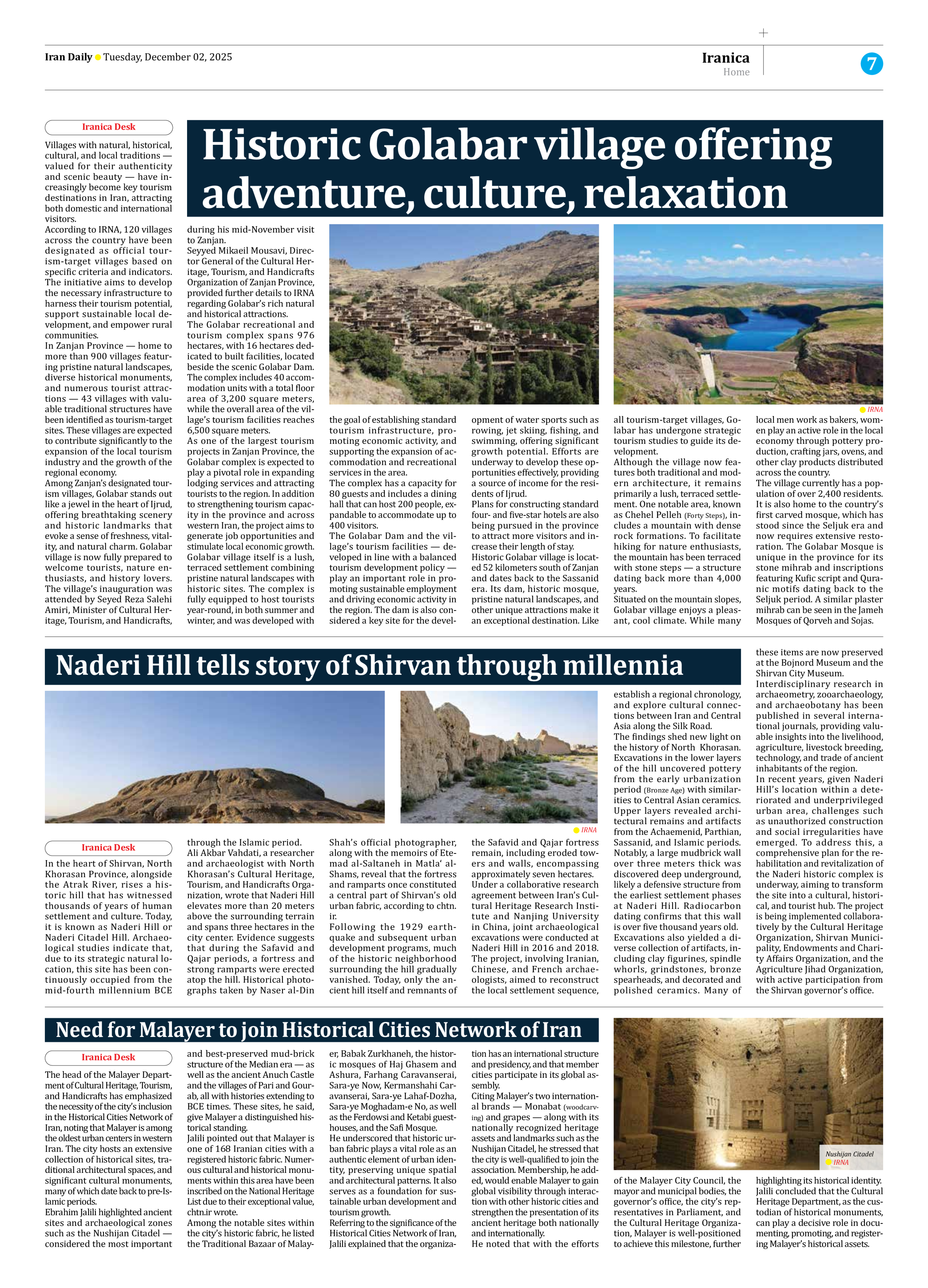
In the heart of Shirvan, North Khorasan Province, alongside the Atrak River, rises a historic hill that has witnessed thousands of years of human settlement and culture. Today, it is known as Naderi Hill or Naderi Citadel Hill. Archaeological studies indicate that, due to its strategic natural location, this site has been continuously occupied from the mid-fourth millennium BCE through the Islamic period.
Ali Akbar Vahdati, a researcher and archaeologist with North Khorasan’s Cultural Heritage, Tourism, and Handicrafts Organization, wrote that Naderi Hill elevates more than 20 meters above the surrounding terrain and spans three hectares in the city center. Evidence suggests that during the Safavid and Qajar periods, a fortress and strong ramparts were erected atop the hill. Historical photographs taken by Naser al-Din Shah’s official photographer, along with the memoirs of Etemad al-Saltaneh in Matla‘ al-Shams, reveal that the fortress and ramparts once constituted a central part of Shirvan’s old urban fabric, according to chtn.ir.
Following the 1929 earthquake and subsequent urban development programs, much of the historic neighborhood surrounding the hill gradually vanished. Today, only the ancient hill itself and remnants of the Safavid and Qajar fortress remain, including eroded towers and walls, encompassing approximately seven hectares.
Under a collaborative research agreement between Iran’s Cultural Heritage Research Institute and Nanjing University in China, joint archaeological excavations were conducted at Naderi Hill in 2016 and 2018. The project, involving Iranian, Chinese, and French archaeologists, aimed to reconstruct the local settlement sequence, establish a regional chronology, and explore cultural connections between Iran and Central Asia along the Silk Road.
The findings shed new light on the history of North Khorasan. Excavations in the lower layers of the hill uncovered pottery from the early urbanization period (Bronze Age) with similarities to Central Asian ceramics. Upper layers revealed architectural remains and artifacts from the Achaemenid, Parthian, Sassanid, and Islamic periods. Notably, a large mudbrick wall over three meters thick was discovered deep underground, likely a defensive structure from the earliest settlement phases at Naderi Hill. Radiocarbon dating confirms that this wall is over five thousand years old.
Excavations also yielded a diverse collection of artifacts, including clay figurines, spindle whorls, grindstones, bronze spearheads, and decorated and polished ceramics. Many of these items are now preserved at the Bojnord Museum and the Shirvan City Museum.
Interdisciplinary research in archaeometry, zooarchaeology, and archaeobotany has been published in several international journals, providing valuable insights into the livelihood, agriculture, livestock breeding, technology, and trade of ancient inhabitants of the region.
In recent years, given Naderi Hill’s location within a deteriorated and underprivileged urban area, challenges such as unauthorized construction and social irregularities have emerged. To address this, a comprehensive plan for the rehabilitation and revitalization of the Naderi historic complex is underway, aiming to transform the site into a cultural, historical, and tourist hub. The project is being implemented collaboratively by the Cultural Heritage Organization, Shirvan Municipality, Endowments and Charity Affairs Organization, and the Agriculture Jihad Organization, with active participation from the Shirvan governor’s office.