







Historic Golabar village offering adventure, culture, relaxation
Villages with natural, historical, cultural, and local traditions — valued for their authenticity and scenic beauty — have increasingly become key tourism destinations in Iran, attracting both domestic and international visitors.
According to IRNA, 120 villages across the country have been designated as official tourism-target villages based on specific criteria and indicators. The initiative aims to develop the necessary infrastructure to harness their tourism potential, support sustainable local development, and empower rural communities.
In Zanjan Province — home to more than 900 villages featuring pristine natural landscapes, diverse historical monuments, and numerous tourist attractions — 43 villages with valuable traditional structures have been identified as tourism-target sites. These villages are expected to contribute significantly to the expansion of the local tourism industry and the growth of the regional economy.
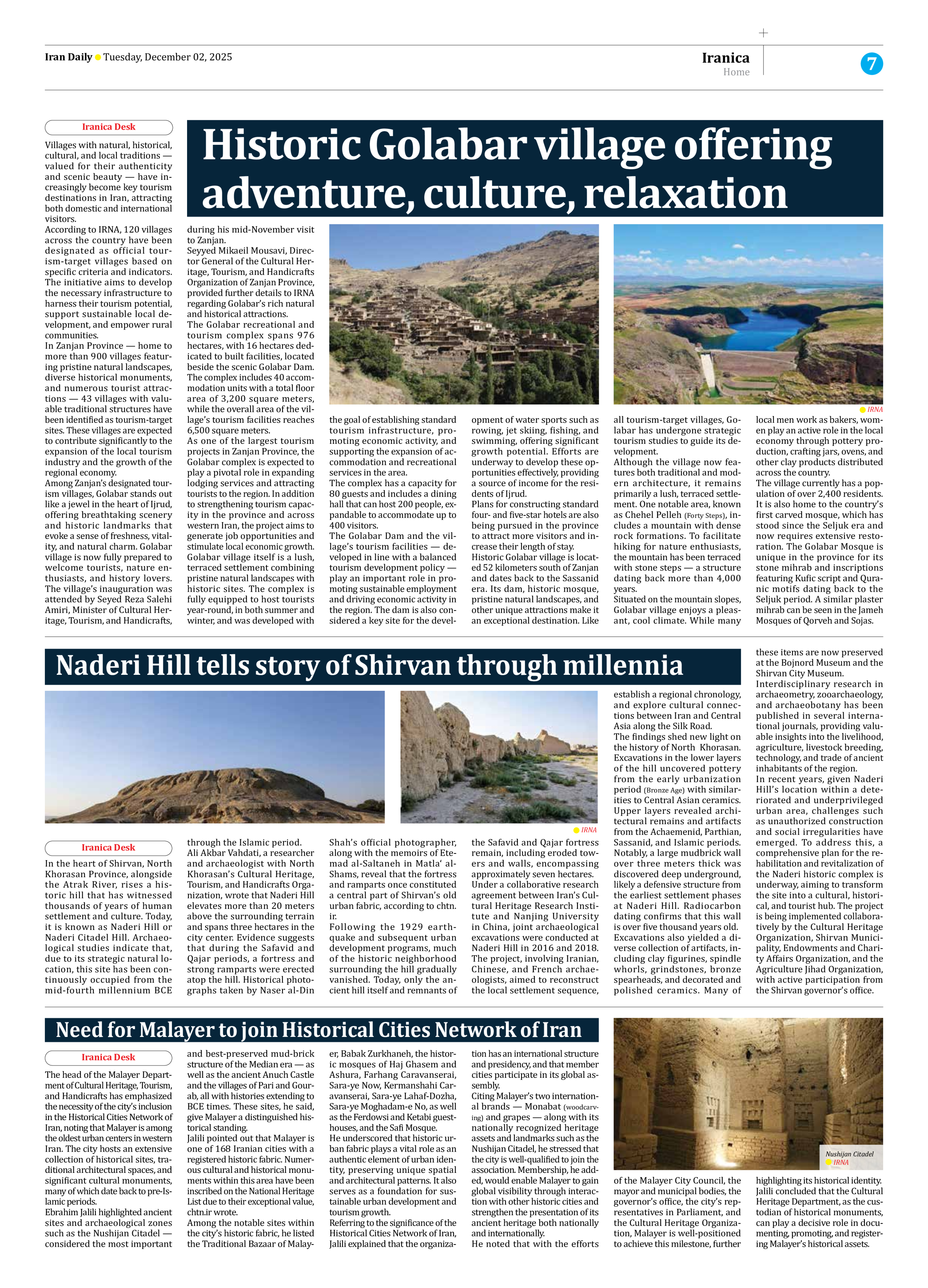
Among Zanjan’s designated tourism villages, Golabar stands out like a jewel in the heart of Ijrud, offering breathtaking scenery and historic landmarks that evoke a sense of freshness, vitality, and natural charm. Golabar village is now fully prepared to welcome tourists, nature enthusiasts, and history lovers. The village’s inauguration was attended by Seyed Reza Salehi Amiri, Minister of Cultural Heritage, Tourism, and Handicrafts, during his mid-November visit to Zanjan.
Seyyed Mikaeil Mousavi, Director General of the Cultural Heritage, Tourism, and Handicrafts Organization of Zanjan Province, provided further details to IRNA regarding Golabar’s rich natural and historical attractions.
The Golabar recreational and tourism complex spans 976 hectares, with 16 hectares dedicated to built facilities, located beside the scenic Golabar Dam. The complex includes 40 accommodation units with a total floor area of 3,200 square meters, while the overall area of the village’s tourism facilities reaches 6,500 square meters.
As one of the largest tourism projects in Zanjan Province, the Golabar complex is expected to play a pivotal role in expanding lodging services and attracting tourists to the region. In addition to strengthening tourism capacity in the province and across western Iran, the project aims to generate job opportunities and stimulate local economic growth.
Golabar village itself is a lush, terraced settlement combining pristine natural landscapes with historic sites. The complex is fully equipped to host tourists year-round, in both summer and winter, and was developed with the goal of establishing standard tourism infrastructure, promoting economic activity, and supporting the expansion of accommodation and recreational services in the area.
The complex has a capacity for 80 guests and includes a dining hall that can host 200 people, expandable to accommodate up to 400 visitors.
The Golabar Dam and the village’s tourism facilities — developed in line with a balanced tourism development policy — play an important role in promoting sustainable employment and driving economic activity in the region. The dam is also considered a key site for the development of water sports such as rowing, jet skiing, fishing, and swimming, offering significant growth potential. Efforts are underway to develop these opportunities effectively, providing a source of income for the residents of Ijrud.
Plans for constructing standard four- and five-star hotels are also being pursued in the province to attract more visitors and increase their length of stay.
Historic Golabar village is located 52 kilometers south of Zanjan and dates back to the Sassanid era. Its dam, historic mosque, pristine natural landscapes, and other unique attractions make it an exceptional destination. Like all tourism-target villages, Golabar has undergone strategic tourism studies to guide its development.
Although the village now features both traditional and modern architecture, it remains primarily a lush, terraced settlement. One notable area, known as Chehel Pelleh (Forty Steps), includes a mountain with dense rock formations. To facilitate hiking for nature enthusiasts, the mountain has been terraced with stone steps — a structure dating back more than 4,000 years.
Situated on the mountain slopes, Golabar village enjoys a pleasant, cool climate. While many local men work as bakers, women play an active role in the local economy through pottery production, crafting jars, ovens, and other clay products distributed across the country.
The village currently has a population of over 2,400 residents. It is also home to the country’s first carved mosque, which has stood since the Seljuk era and now requires extensive restoration. The Golabar Mosque is unique in the province for its stone mihrab and inscriptions featuring Kufic script and Quranic motifs dating back to the Seljuk period. A similar plaster mihrab can be seen in the Jameh Mosques of Qorveh and Sojas.