







Notes on artificial intelligence in Persian Gulf
By Arshin
Adib-Moghaddam
Professor at SOAS
University of London
Artificial Intelligence (AI) has become a central force in shaping the future of industries, economies, and governance systems around the world. The Persian Gulf, a region known for its vast oil reserves and geopolitical importance, is increasingly embracing AI as part of its broader efforts to diversify economies and prepare for the post-oil future. While the region has traditionally relied on energy exports to fuel its growth, the rapid advancement of AI technologies, if screened for ethical blind spots, may present new opportunities. From government initiatives and smart city projects to the integration of AI in healthcare and finance, the Persian Gulf is undergoing a technological transformation that could reshape its future. A critical approach to these emergent AI industries couched in a human-centric and inclusive approach may open up a new foray of the region into the current debates about ethical application of AI systems.
The Persian Gulf’s reliance on oil and gas exports has made it vulnerable to global energy market fluctuations. As such, AI has already been recognized as a key component in economic diversification efforts across the region. Countries such as Saudi Arabia, the United Arab Emirates (UAE), and Qatar have been actively investing in AI to reduce their dependency on fossil fuels and build knowledge-based economies.
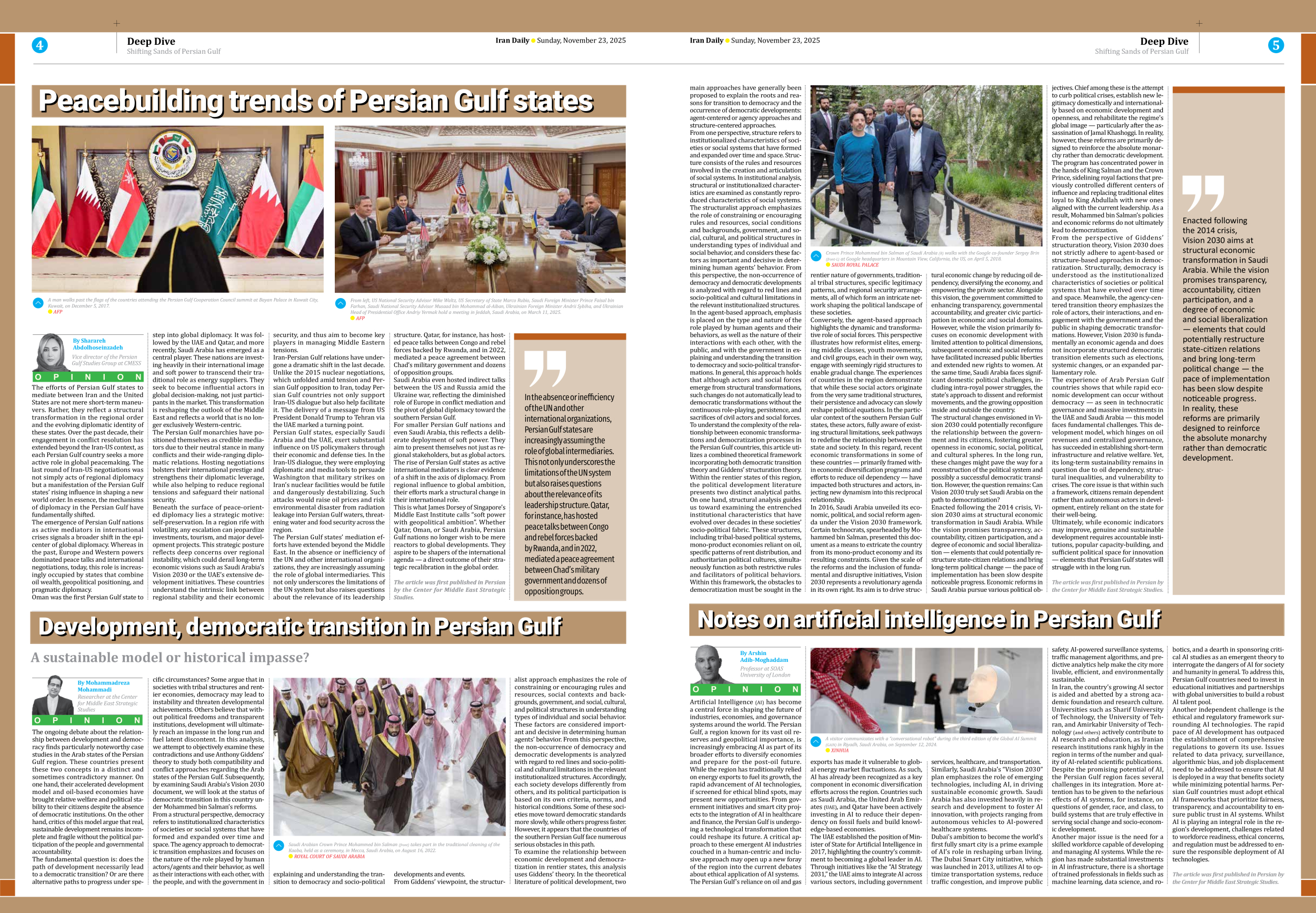
The UAE established the position of Minister of State for Artificial Intelligence in 2017, highlighting the country’s commitment to becoming a global leader in AI. Through initiatives like the “AI Strategy 2031,” the UAE aims to integrate AI across various sectors, including government services, healthcare, and transportation.
Similarly, Saudi Arabia’s “Vision 2030” plan emphasizes the role of emerging technologies, including AI, in driving sustainable economic growth. Saudi Arabia has also invested heavily in research and development to foster AI innovation, with projects ranging from autonomous vehicles to AI-powered healthcare systems.
Dubai’s ambition to become the world’s first fully smart city is a prime example of AI’s role in reshaping urban living. The Dubai Smart City initiative, which was launched in 2013, utilizes AI to optimize transportation systems, reduce traffic congestion, and improve public safety. AI-powered surveillance systems, traffic management algorithms, and predictive analytics help make the city more livable, efficient, and environmentally sustainable.
In Iran, the country’s growing AI sector is aided and abetted by a strong academic foundation and research culture. Universities such as Sharif University of Technology, the University of Tehran, and Amirkabir University of Technology (and others) actively contribute to AI research and education, as Iranian research institutions rank highly in the region in terms of the number and quality of AI-related scientific publications.
Despite the promising potential of AI, the Persian Gulf region faces several challenges in its integration. More attention has to be given to the nefarious effects of AI systems, for instance, on questions of gender, race, and class, to build systems that are truly effective in serving social change and socio-economic development.
Another major issue is the need for a skilled workforce capable of developing and managing AI systems. While the region has made substantial investments in AI infrastructure, there is a shortage of trained professionals in fields such as machine learning, data science, and robotics, and a dearth in sponsoring critical AI studies as an emergent theory to interrogate the dangers of AI for society and humanity in general. To address this, Persian Gulf countries need to invest in educational initiatives and partnerships with global universities to build a robust AI talent pool.
Another independent challenge is the ethical and regulatory framework surrounding AI technologies. The rapid pace of AI development has outpaced the establishment of comprehensive regulations to govern its use. Issues related to data privacy, surveillance, algorithmic bias, and job displacement need to be addressed to ensure that AI is deployed in a way that benefits society while minimizing potential harms. Persian Gulf countries must adopt ethical AI frameworks that prioritize fairness, transparency, and accountability to ensure public trust in AI systems. Whilst AI is playing an integral role in the region’s development, challenges related to workforce readiness, ethical concerns, and regulation must be addressed to ensure the responsible deployment of AI technologies.
The article was first published in Persian by the Center for Middle East Strategic Studies.