







Development, democratic transition in Persian Gulf
A sustainable model or historical impasse?
By Mohammadreza Mohammadi
Researcher at the Center for Middle East Strategic Studies
The ongoing debate about the relationship between development and democracy finds particularly noteworthy case studies in the Arab states of the Persian Gulf region. These countries present these two concepts in a distinct and sometimes contradictory manner. On one hand, their accelerated development model and oil-based economies have brought relative welfare and political stability to their citizens despite the absence of democratic institutions. On the other hand, critics of this model argue that real, sustainable development remains incomplete and fragile without the political participation of the people and governmental accountability.
The fundamental question is: does the path of development necessarily lead to a democratic transition? Or are there alternative paths to progress under specific circumstances? Some argue that in societies with tribal structures and rentier economies, democracy may lead to instability and threaten developmental achievements. Others believe that without political freedoms and transparent institutions, development will ultimately reach an impasse in the long run and fuel latent discontent. In this analysis, we attempt to objectively examine these contradictions and use Anthony Giddens’ theory to study both compatibility and conflict approaches regarding the Arab states of the Persian Gulf. Subsequently, by examining Saudi Arabia’s Vision 2030 document, we will look at the status of democratic transition in this country under Mohammed bin Salman’s reforms.
From a structural perspective, democracy refers to institutionalized characteristics of societies or social systems that have formed and expanded over time and space. The agency approach to democratic transition emphasizes and focuses on the nature of the role played by human actors/agents and their behavior, as well as their interactions with each other, with the people, and with the government in explaining and understanding the transition to democracy and socio-political developments and events.
From Giddens’ viewpoint, the structuralist approach emphasizes the role of constraining or encouraging rules and resources, social contexts and backgrounds, government, and social, cultural, and political structures in understanding types of individual and social behavior. These factors are considered important and decisive in determining human agents’ behavior. From this perspective, the non-occurrence of democracy and democratic developments is analyzed with regard to red lines and socio-political and cultural limitations in the relevant institutionalized structures. Accordingly, each society develops differently from others, and its political participation is based on its own criteria, norms, and historical conditions. Some of these societies move toward democratic standards more slowly, while others progress faster. However, it appears that the countries of the southern Persian Gulf face numerous serious obstacles in this path.
To examine the relationship between economic development and democratization in rentier states, this analysis uses Giddens’ theory. In the theoretical literature of political development, two main approaches have generally been proposed to explain the roots and reasons for transition to democracy and the occurrence of democratic developments: agent-centered or agency approaches and structure-centered approaches.
From one perspective, structure refers to institutionalized characteristics of societies or social systems that have formed and expanded over time and space. Structure consists of the rules and resources involved in the creation and articulation of social systems. In institutional analysis, structural or institutionalized characteristics are examined as constantly reproduced characteristics of social systems. The structuralist approach emphasizes the role of constraining or encouraging rules and resources, social conditions and backgrounds, government, and social, cultural, and political structures in understanding types of individual and social behavior, and considers these factors as important and decisive in determining human agents’ behavior. From this perspective, the non-occurrence of democracy and democratic developments is analyzed with regard to red lines and socio-political and cultural limitations in the relevant institutionalized structures.
In the agent-based approach, emphasis is placed on the type and nature of the role played by human agents and their behaviors, as well as the nature of their interactions with each other, with the public, and with the government in explaining and understanding the transition to democracy and socio-political transformations. In general, this approach holds that although actors and social forces emerge from structural transformations, such changes do not automatically lead to democratic transformations without the continuous role-playing, persistence, and sacrifices of civil actors and social forces.
To understand the complexity of the relationship between economic transformations and democratization processes in the Persian Gulf countries, this article utilizes a combined theoretical framework incorporating both democratic transition theory and Giddens’ structuration theory.
Within the rentier states of this region, the political development literature presents two distinct analytical paths. On one hand, structural analysis guides us toward examining the entrenched institutional characteristics that have evolved over decades in these societies’ socio-political fabric. These structures, including tribal-based political systems, mono-product economies reliant on oil, specific patterns of rent distribution, and authoritarian political cultures, simultaneously function as both restrictive rules and facilitators of political behaviors. Within this framework, the obstacles to democratization must be sought in the rentier nature of governments, traditional tribal structures, specific legitimacy patterns, and regional security arrangements, all of which form an intricate network shaping the political landscape of these societies.
Conversely, the agent-based approach highlights the dynamic and transformative role of social forces. This perspective illustrates how reformist elites, emerging middle classes, youth movements, and civil groups, each in their own way, engage with seemingly rigid structures to enable gradual change. The experiences of countries in the region demonstrate that while these social actors originate from the very same traditional structures, their persistence and advocacy can slowly reshape political equations. In the particular context of the southern Persian Gulf states, these actors, fully aware of existing structural limitations, seek pathways to redefine the relationship between the state and society. In this regard, recent economic transformations in some of these countries — primarily framed within economic diversification programs and efforts to reduce oil dependency — have impacted both structures and actors, injecting new dynamism into this reciprocal relationship.
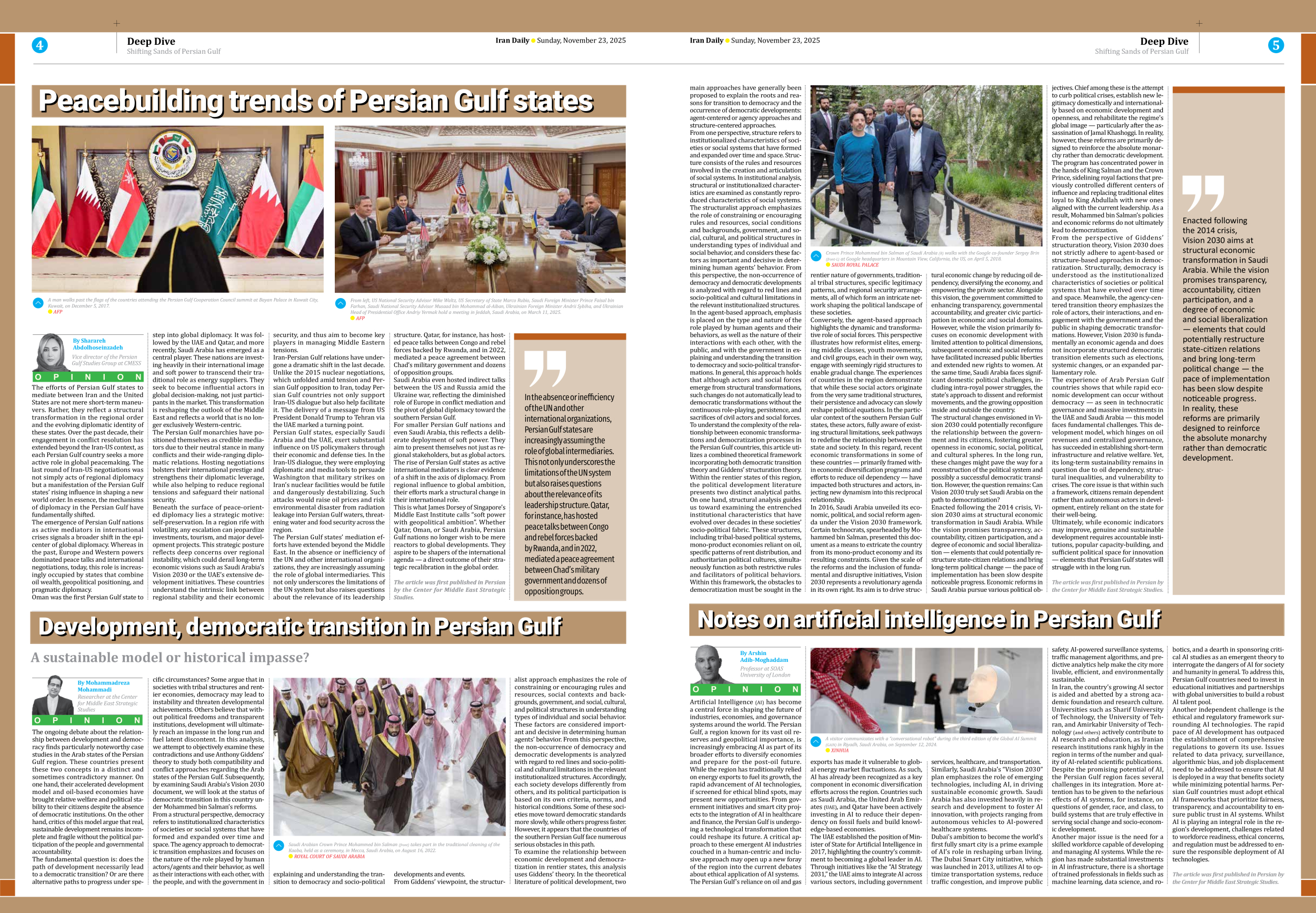
In 2016, Saudi Arabia unveiled its economic, political, and social reform agenda under the Vision 2030 framework. Certain technocrats, spearheaded by Mohammed bin Salman, presented this document as a means to extricate the country from its mono-product economy and its resulting constraints. Given the scale of the reforms and the inclusion of fundamental and disruptive initiatives, Vision 2030 represents a revolutionary agenda in its own right. Its aim is to drive structural economic change by reducing oil dependency, diversifying the economy, and empowering the private sector. Alongside this vision, the government committed to enhancing transparency, governmental accountability, and greater civic participation in economic and social domains. However, while the vision primarily focuses on economic development with limited attention to political dimensions, subsequent economic and social reforms have facilitated increased public liberties and extended new rights to women. At the same time, Saudi Arabia faces significant domestic political challenges, including intra-royal power struggles, the state’s approach to dissent and reformist movements, and the growing opposition inside and outside the country.
The structural changes envisioned in Vision 2030 could potentially reconfigure the relationship between the government and its citizens, fostering greater openness in economic, social, political, and cultural spheres. In the long run, these changes might pave the way for a reconstruction of the political system and possibly a successful democratic transition. However, the question remains: Can Vision 2030 truly set Saudi Arabia on the path to democratization?
Enacted following the 2014 crisis, Vision 2030 aims at structural economic transformation in Saudi Arabia. While the vision promises transparency, accountability, citizen participation, and a degree of economic and social liberalization — elements that could potentially restructure state-citizen relations and bring long-term political change — the pace of implementation has been slow despite noticeable progress. Economic reforms in Saudi Arabia pursue various political objectives. Chief among these is the attempt to curb political crises, establish new legitimacy domestically and internationally based on economic development and openness, and rehabilitate the regime’s global image — particularly after the assassination of Jamal Khashoggi. In reality, however, these reforms are primarily designed to reinforce the absolute monarchy rather than democratic development. The program has concentrated power in the hands of King Salman and the Crown Prince, sidelining royal factions that previously controlled different centers of influence and replacing traditional elites loyal to King Abdullah with new ones aligned with the current leadership. As a result, Mohammed bin Salman’s policies and economic reforms do not ultimately lead to democratization.
From the perspective of Giddens’ structuration theory, Vision 2030 does not strictly adhere to agent-based or structure-based approaches in democratization. Structurally, democracy is understood as the institutionalized characteristics of societies or political systems that have evolved over time and space. Meanwhile, the agency-centered transition theory emphasizes the role of actors, their interactions, and engagement with the government and the public in shaping democratic transformations. However, Vision 2030 is fundamentally an economic agenda and does not incorporate structured democratic transition elements such as elections, systemic changes, or an expanded parliamentary role.
The experience of Arab Persian Gulf countries shows that while rapid economic development can occur without democracy — as seen in technocratic governance and massive investments in the UAE and Saudi Arabia — this model faces fundamental challenges. This development model, which hinges on oil revenues and centralized governance, has succeeded in establishing short-term infrastructure and relative welfare. Yet, its long-term sustainability remains in question due to oil dependency, structural inequalities, and vulnerability to crises. The core issue is that within such a framework, citizens remain dependent rather than autonomous actors in development, entirely reliant on the state for their well-being.
Ultimately, while economic indicators may improve, genuine and sustainable development requires accountable institutions, popular capacity-building, and sufficient political space for innovation — elements that Persian Gulf states will struggle with in the long run.
The article was first published in Persian by the Center for Middle East Strategic Studies.