





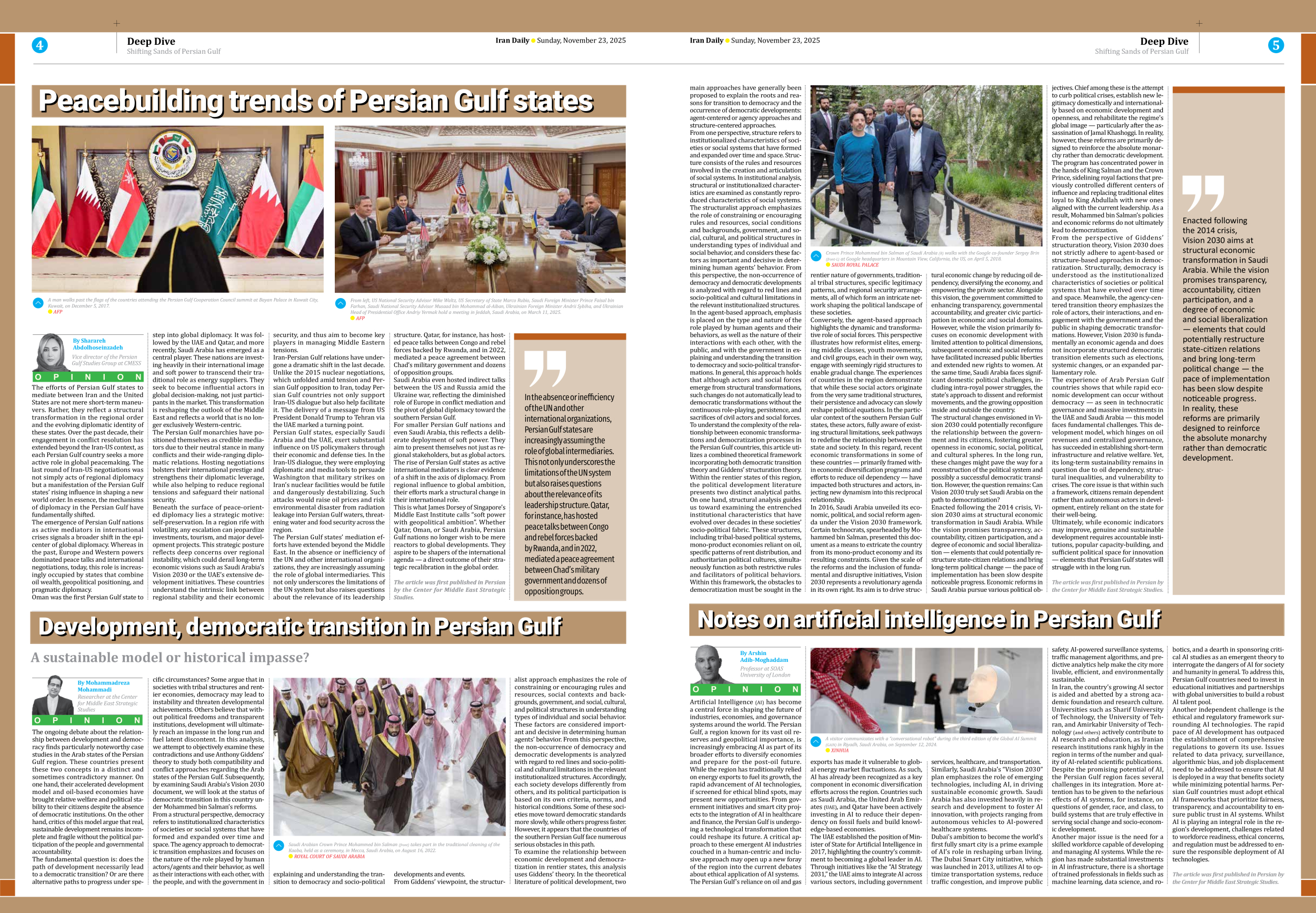


Peacebuilding trends of Persian Gulf states
By Sharareh Abdolhoseinzadeh
Vice director of the Persian Gulf Studies Group at CMESS
The efforts of Persian Gulf states to mediate between Iran and the United States are not mere short-term maneuvers. Rather, they reflect a structural transformation in the regional order and the evolving diplomatic identity of these states. Over the past decade, their engagement in conflict resolution has extended beyond the Iran-US context, as each Persian Gulf country seeks a more active role in global peacemaking. The last round of Iran-US negotiations was not simply acts of regional diplomacy but a manifestation of the Persian Gulf states’ rising influence in shaping a new world order. In essence, the mechanisms of diplomacy in the Persian Gulf have fundamentally shifted.
The emergence of Persian Gulf nations as active mediators in international crises signals a broader shift in the epicenter of global diplomacy. Whereas in the past, Europe and Western powers dominated peace talks and international negotiations, today, this role is increasingly occupied by states that combine oil wealth, geopolitical positioning, and pragmatic diplomacy.
Oman was the first Persian Gulf state to step into global diplomacy. It was followed by the UAE and Qatar, and more recently, Saudi Arabia has emerged as a central player. These nations are investing heavily in their international image and soft power to transcend their traditional role as energy suppliers. They seek to become influential actors in global decision-making, not just participants in the market. This transformation is reshaping the outlook of the Middle East and reflects a world that is no longer exclusively Western-centric.
The Persian Gulf monarchies have positioned themselves as credible mediators due to their neutral stance in many conflicts and their wide-ranging diplomatic relations. Hosting negotiations bolsters their international prestige and strengthens their diplomatic leverage, while also helping to reduce regional tensions and safeguard their national security.
Beneath the surface of peace-oriented diplomacy lies a strategic motive: self-preservation. In a region rife with volatility, any escalation can jeopardize investments, tourism, and major development projects. This strategic posture reflects deep concerns over regional instability, which could derail long-term economic visions such as Saudi Arabia’s Vision 2030 or the UAE’s extensive development initiatives. These countries understand the intrinsic link between regional stability and their economic security, and thus aim to become key players in managing Middle Eastern tensions.
Iran-Persian Gulf relations have undergone a dramatic shift in the last decade. Unlike the 2015 nuclear negotiations, which unfolded amid tension and Persian Gulf opposition to Iran, today Persian Gulf countries not only support Iran-US dialogue but also help facilitate it. The delivery of a message from US President Donald Trump to Tehran via the UAE marked a turning point.
Persian Gulf states, especially Saudi Arabia and the UAE, exert substantial influence on US policymakers through their economic and defense ties. In the Iran-US dialogue, they were employing diplomatic and media tools to persuade Washington that military strikes on Iran’s nuclear facilities would be futile and dangerously destabilizing. Such attacks would raise oil prices and risk environmental disaster from radiation leakage into Persian Gulf waters, threatening water and food security across the region.
The Persian Gulf states’ mediation efforts have extended beyond the Middle East. In the absence or inefficiency of the UN and other international organizations, they are increasingly assuming the role of global intermediaries. This not only underscores the limitations of the UN system but also raises questions about the relevance of its leadership structure. Qatar, for instance, has hosted peace talks between Congo and rebel forces backed by Rwanda, and in 2022, mediated a peace agreement between Chad’s military government and dozens of opposition groups.
Saudi Arabia even hosted indirect talks between the US and Russia amid the Ukraine war, reflecting the diminished role of Europe in conflict mediation and the pivot of global diplomacy toward the southern Persian Gulf.
For smaller Persian Gulf nations and even Saudi Arabia, this reflects a deliberate deployment of soft power. They aim to present themselves not just as regional stakeholders, but as global actors. The rise of Persian Gulf states as active international mediators is clear evidence of a shift in the axis of diplomacy. From regional influence to global ambition, their efforts mark a structural change in their international role.
This is what James Dorsey of Singapore’s Middle East Institute calls “soft power with geopolitical ambition”. Whether Qatar, Oman, or Saudi Arabia, Persian Gulf nations no longer wish to be mere reactors to global developments. They aspire to be shapers of the international agenda — a direct outcome of their strategic recalibration in the global order.
The article was first published in Persian by the Center for Middle East Strategic Studies.