







Where music meets Persian legends
By Neda Sijani
Guest contributor
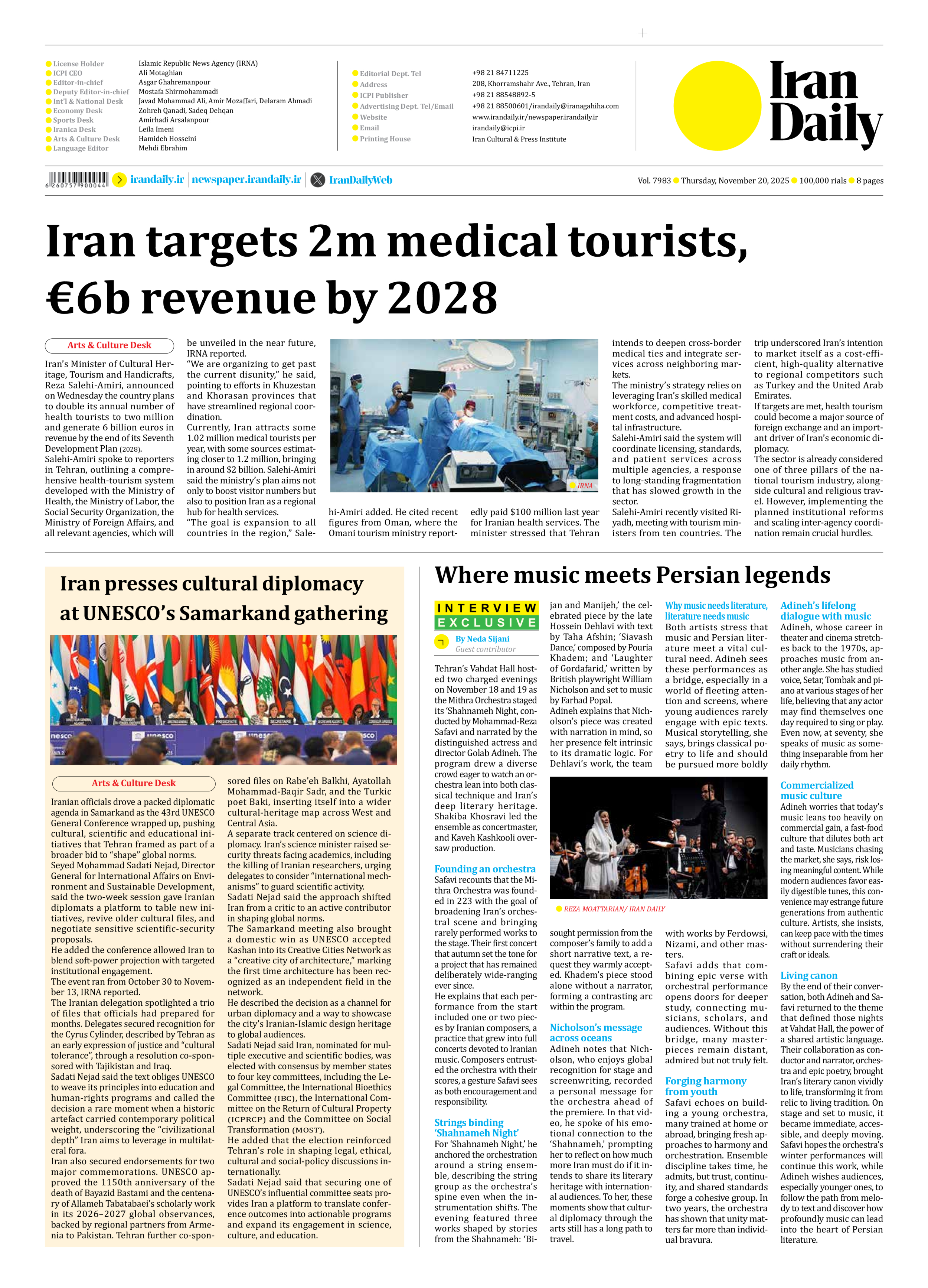
Tehran’s Vahdat Hall hosted two charged evenings on November 18 and 19 as the Mithra Orchestra staged its ‘Shahnameh Night, conducted by Mohammad-Reza Safavi and narrated by the distinguished actress and director Golab Adineh. The program drew a diverse crowd eager to watch an orchestra lean into both classical technique and Iran’s deep literary heritage. Shakiba Khosravi led the ensemble as concertmaster, and Kaveh Kashkooli oversaw production.
Founding an orchestra
Safavi recounts that the Mithra Orchestra was founded in 223 with the goal of broadening Iran’s orchestral scene and bringing rarely performed works to the stage. Their first concert that autumn set the tone for a project that has remained deliberately wide-ranging ever since.
He explains that each performance from the start included one or two pieces by Iranian composers, a practice that grew into full concerts devoted to Iranian music. Composers entrusted the orchestra with their scores, a gesture Safavi sees as both encouragement and responsibility.
Strings binding ‘Shahnameh Night’
For ‘Shahnameh Night,’ he anchored the orchestration around a string ensemble, describing the string group as the orchestra’s spine even when the instrumentation shifts. The evening featured three works shaped by stories from the Shahnameh: ‘Bijan and Manijeh,’ the celebrated piece by the late Hossein Dehlavi with text by Taha Afshin; ‘Siavash Dance,’ composed by Pouria Khadem; and ‘Laughter of Gordafarid,’ written by British playwright William Nicholson and set to music by Farhad Popal.
Adineh explains that Nicholson’s piece was created with narration in mind, so her presence felt intrinsic to its dramatic logic. For Dehlavi’s work, the team sought permission from the composer’s family to add a short narrative text, a request they warmly accepted. Khadem’s piece stood alone without a narrator, forming a contrasting arc within the program.
Nicholson’s message across oceans
Adineh notes that Nicholson, who enjoys global recognition for stage and screenwriting, recorded a personal message for the orchestra ahead of the premiere. In that video, he spoke of his emotional connection to the ‘Shahnameh,’ prompting her to reflect on how much more Iran must do if it intends to share its literary heritage with international audiences. To her, these moments show that cultural diplomacy through the arts still has a long path to travel.
Why music needs literature, literature needs music
Both artists stress that music and Persian literature meet a vital cultural need. Adineh sees these performances as a bridge, especially in a world of fleeting attention and screens, where young audiences rarely engage with epic texts. Musical storytelling, she says, brings classical poetry to life and should be pursued more boldly with works by Ferdowsi, Nizami, and other masters.
Safavi adds that combining epic verse with orchestral performance opens doors for deeper study, connecting musicians, scholars, and audiences. Without this bridge, many masterpieces remain distant, admired but not truly felt.
Forging harmony from youth
Safavi echoes on building a young orchestra, many trained at home or abroad, bringing fresh approaches to harmony and orchestration. Ensemble discipline takes time, he admits, but trust, continuity, and shared standards forge a cohesive group. In two years, the orchestra has shown that unity matters far more than individual bravura.
Adineh’s lifelong
dialogue with music
Adineh, whose career in theater and cinema stretches back to the 1970s, approaches music from another angle. She has studied voice, Setar, Tombak and piano at various stages of her life, believing that any actor may find themselves one day required to sing or play. Even now, at seventy, she speaks of music as something inseparable from her daily rhythm.
Commercialized
music culture
Adineh worries that today’s music leans too heavily on commercial gain, a fast-food culture that dilutes both art and taste. Musicians chasing the market, she says, risk losing meaningful content. While modern audiences favor easily digestible tunes, this convenience may estrange future generations from authentic culture. Artists, she insists, can keep pace with the times without surrendering their craft or ideals.
Living canon
By the end of their conversation, both Adineh and Safavi returned to the theme that defined those nights at Vahdat Hall, the power of a shared artistic language. Their collaboration as conductor and narrator, orchestra and epic poetry, brought Iran’s literary canon vividly to life, transforming it from relic to living tradition. On stage and set to music, it became immediate, accessible, and deeply moving. Safavi hopes the orchestra’s winter performances will continue this work, while Adineh wishes audiences, especially younger ones, to follow the path from melody to text and discover how profoundly music can lead into the heart of Persian literature.