







Iran targets 2m medical tourists, €6b revenue by 2028
Iran’s Minister of Cultural Heritage, Tourism and Handicrafts, Reza Salehi-Amiri, announced on Wednesday the country plans to double its annual number of health tourists to two million and generate 6 billion euros in revenue by the end of its Seventh Development Plan (2028).
Salehi-Amiri spoke to reporters in Tehran, outlining a comprehensive health‑tourism system developed with the Ministry of Health, the Ministry of Labor, the Social Security Organization, the Ministry of Foreign Affairs, and all relevant agencies, which will be unveiled in the near future, IRNA reported.
“We are organizing to get past the current disunity,” he said, pointing to efforts in Khuzestan and Khorasan provinces that have streamlined regional coordination.
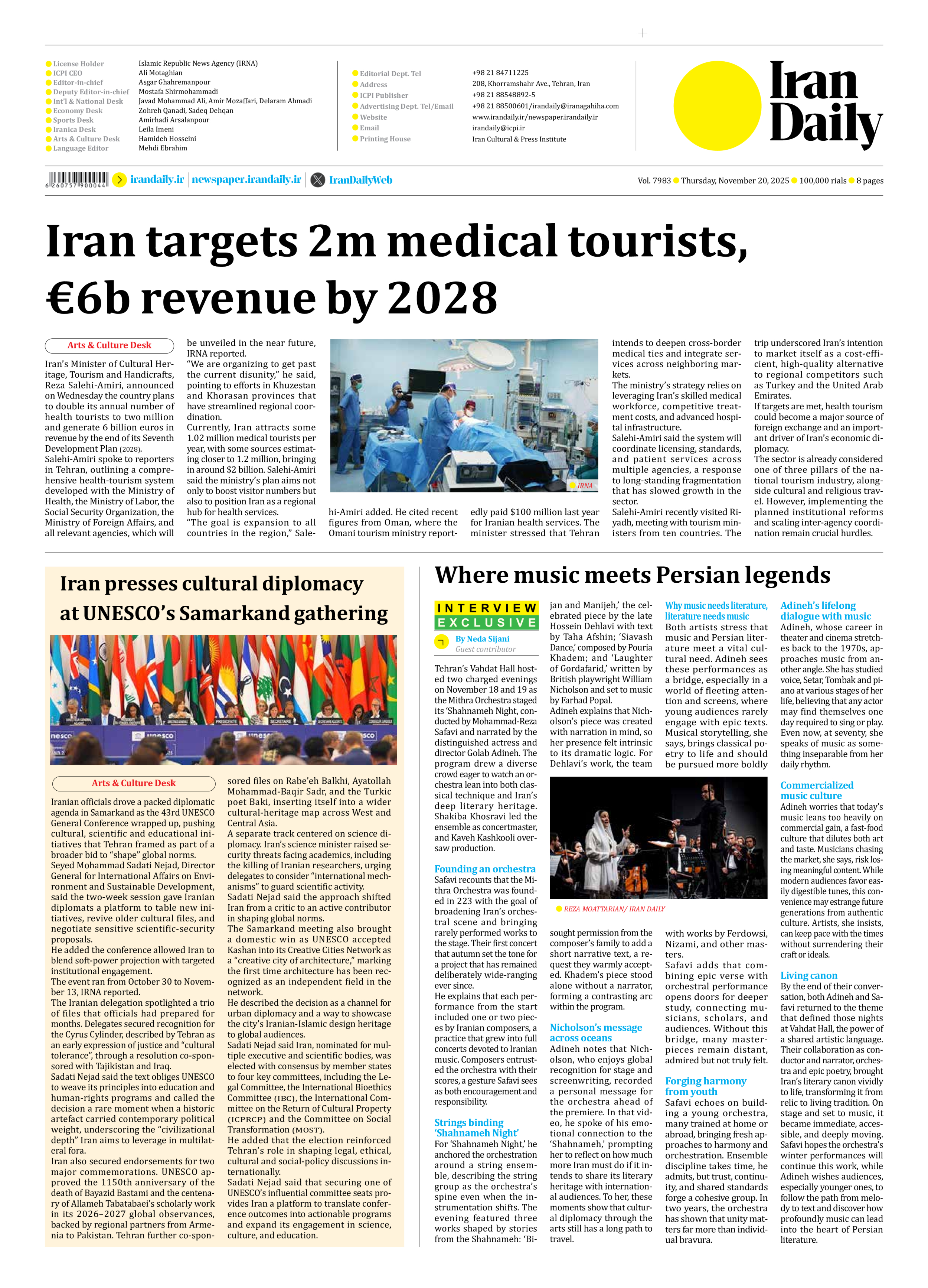
Currently, Iran attracts some 1.02 million medical tourists per year, with some sources estimating closer to 1.2 million, bringing in around $2 billion. Salehi-Amiri said the ministry’s plan aims not only to boost visitor numbers but also to position Iran as a regional hub for health services.
“The goal is expansion to all countries in the region,” Salehi-Amiri added. He cited recent figures from Oman, where the Omani tourism ministry reportedly paid $100 million last year for Iranian health services. The minister stressed that Tehran intends to deepen cross-border medical ties and integrate services across neighboring markets.
The ministry’s strategy relies on leveraging Iran’s skilled medical workforce, competitive treatment costs, and advanced hospital infrastructure.
Salehi-Amiri said the system will coordinate licensing, standards, and patient services across multiple agencies, a response to long-standing fragmentation that has slowed growth in the sector.
Salehi-Amiri recently visited Riyadh, meeting with tourism ministers from ten countries. The trip underscored Iran’s intention to market itself as a cost-efficient, high-quality alternative to regional competitors such as Turkey and the United Arab Emirates.
If targets are met, health tourism could become a major source of foreign exchange and an important driver of Iran’s economic diplomacy.
The sector is already considered one of three pillars of the national tourism industry, alongside cultural and religious travel. However, implementing the planned institutional reforms and scaling inter-agency coordination remain crucial hurdles.