







Copy in clipboard...
Iran stays course on climate goals despite sanctions, cuts 10b m³ emissions
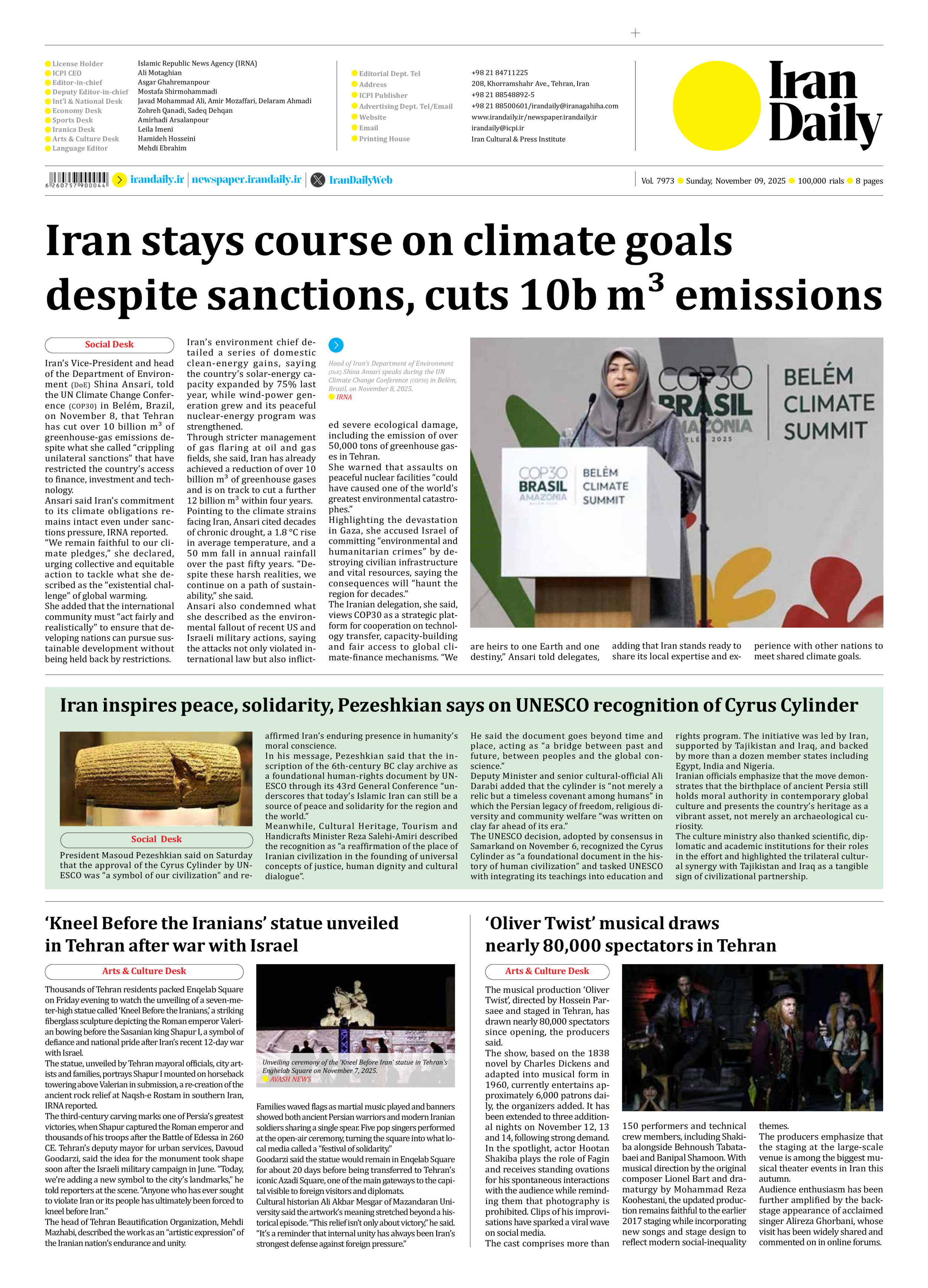
Iran’s Vice-President and head of the Department of Environment (DoE) Shina Ansari, told the UN Climate Change Conference (COP30) in Belém, Brazil, on November 8, that Tehran has cut over 10 billion m³ of greenhouse-gas emissions despite what she called “crippling unilateral sanctions” that have restricted the country’s access to finance, investment and technology.
Ansari said Iran’s commitment to its climate obligations remains intact even under sanctions pressure, IRNA reported.
“We remain faithful to our climate pledges,” she declared, urging collective and equitable action to tackle what she described as the “existential challenge” of global warming.
She added that the international community must “act fairly and realistically” to ensure that developing nations can pursue sustainable development without being held back by restrictions.
Iran’s environment chief detailed a series of domestic clean-energy gains, saying the country’s solar-energy capacity expanded by 75% last year, while wind-power generation grew and its peaceful nuclear-energy program was strengthened.
Through stricter management of gas flaring at oil and gas fields, she said, Iran has already achieved a reduction of over 10 billion m³ of greenhouse gases and is on track to cut a further 12 billion m³ within four years.
Pointing to the climate strains facing Iran, Ansari cited decades of chronic drought, a 1.8 °C rise in average temperature, and a 50 mm fall in annual rainfall over the past fifty years. “Despite these harsh realities, we continue on a path of sustainability,” she said.
Ansari also condemned what she described as the environmental fallout of recent US and Israeli military actions, saying the attacks not only violated international law but also inflicted severe ecological damage, including the emission of over 50,000 tons of greenhouse gases in Tehran.
She warned that assaults on peaceful nuclear facilities “could have caused one of the world’s greatest environmental catastrophes.”
Highlighting the devastation in Gaza, she accused Israel of committing “environmental and humanitarian crimes” by destroying civilian infrastructure and vital resources, saying the consequences will “haunt the region for decades.”
The Iranian delegation, she said, views COP30 as a strategic platform for cooperation on technology transfer, capacity-building and fair access to global climate-finance mechanisms. “We are heirs to one Earth and one destiny,” Ansari told delegates, adding that Iran stands ready to share its local expertise and experience with other nations to meet shared climate goals.