







‘Iranian Garden’ reveals through watercolor dreams
By Sadeq Dehqan
Staff writer
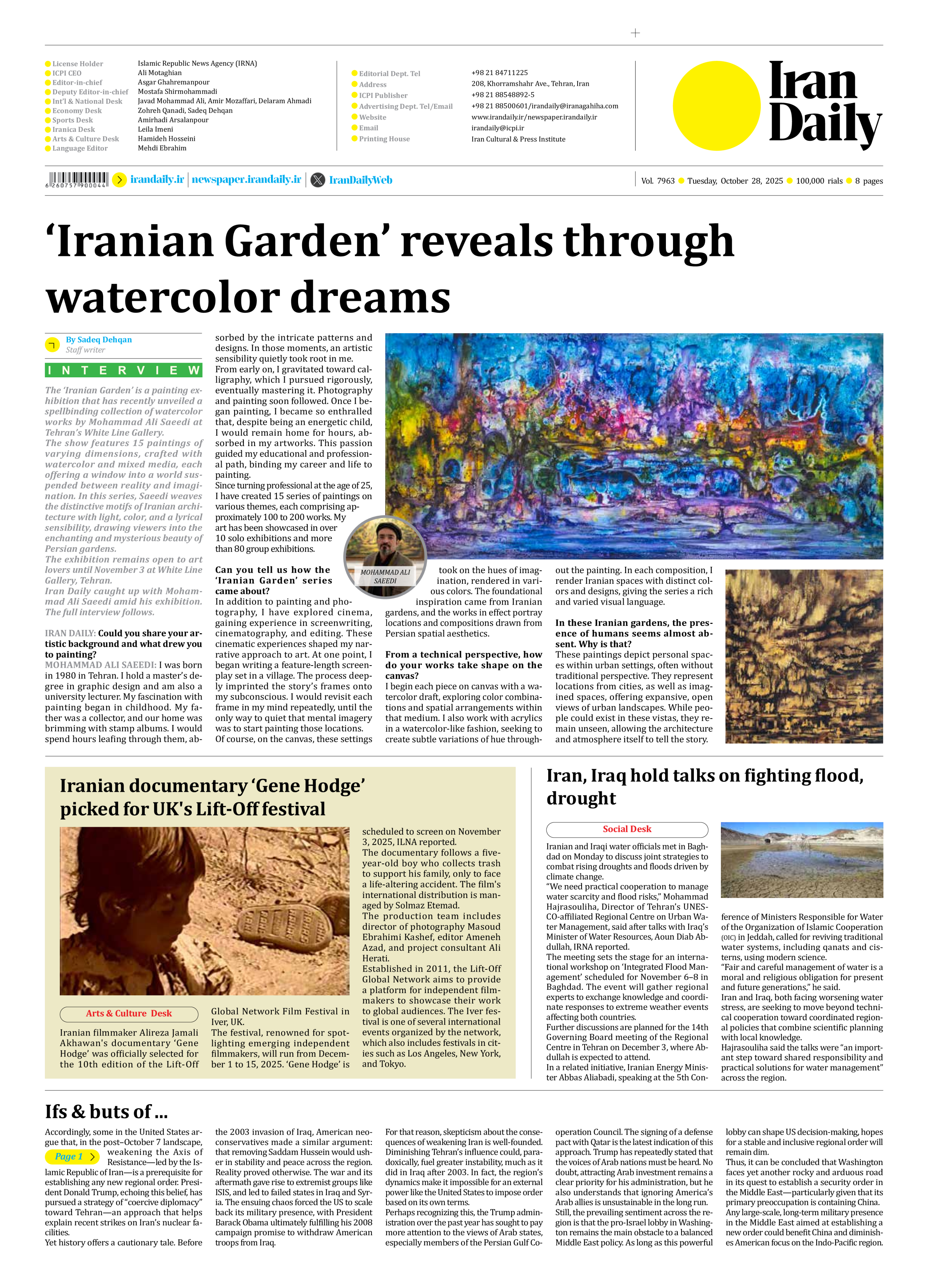
The ‘Iranian Garden’ is a painting exhibition that has recently unveiled a spellbinding collection of watercolor works by Mohammad Ali Saeedi at Tehran’s White Line Gallery.
The show features 15 paintings of varying dimensions, crafted with watercolor and mixed media, each offering a window into a world suspended between reality and imagination. In this series, Saeedi weaves the distinctive motifs of Iranian architecture with light, color, and a lyrical sensibility, drawing viewers into the enchanting and mysterious beauty of Persian gardens.
The exhibition remains open to art lovers until November 3 at White Line Gallery, Tehran.
Iran Daily caught up with Mohammad Ali Saeedi amid his exhibition. The full interview follows.
IRAN DAILY: Could you share your artistic background and what drew you to painting?
MOHAMMAD ALI SAEEDI: I was born in 1980 in Tehran. I hold a master’s degree in graphic design and am also a university lecturer. My fascination with painting began in childhood. My father was a collector, and our home was brimming with stamp albums. I would spend hours leafing through them, absorbed by the intricate patterns and designs. In those moments, an artistic sensibility quietly took root in me.
From early on, I gravitated toward calligraphy, which I pursued rigorously, eventually mastering it. Photography and painting soon followed. Once I began painting, I became so enthralled that, despite being an energetic child, I would remain home for hours, absorbed in my artworks. This passion guided my educational and professional path, binding my career and life to painting.
Since turning professional at the age of 25, I have created 15 series of paintings on various themes, each comprising approximately 100 to 200 works. My art has been showcased in over 10 solo exhibitions and more than 80 group exhibitions.
Can you tell us how the ‘Iranian Garden’ series came about?
In addition to painting and photography, I have explored cinema, gaining experience in screenwriting, cinematography, and editing. These cinematic experiences shaped my narrative approach to art. At one point, I began writing a feature-length screenplay set in a village. The process deeply imprinted the story’s frames onto my subconscious. I would revisit each frame in my mind repeatedly, until the only way to quiet that mental imagery was to start painting those locations.
Of course, on the canvas, these settings took on the hues of imagination, rendered in various colors. The foundational inspiration came from Iranian gardens, and the works in effect portray locations and compositions drawn from Persian spatial aesthetics.
From a technical perspective, how do your works take shape on the canvas?
I begin each piece on canvas with a watercolor draft, exploring color combinations and spatial arrangements within that medium. I also work with acrylics in a watercolor-like fashion, seeking to create subtle variations of hue throughout the painting. In each composition, I render Iranian spaces with distinct colors and designs, giving the series a rich and varied visual language.
In these Iranian gardens, the presence of humans seems almost absent. Why is that?
These paintings depict personal spaces within urban settings, often without traditional perspective. They represent locations from cities, as well as imagined spaces, offering expansive, open views of urban landscapes. While people could exist in these vistas, they remain unseen, allowing the architecture and atmosphere itself to tell the story.