





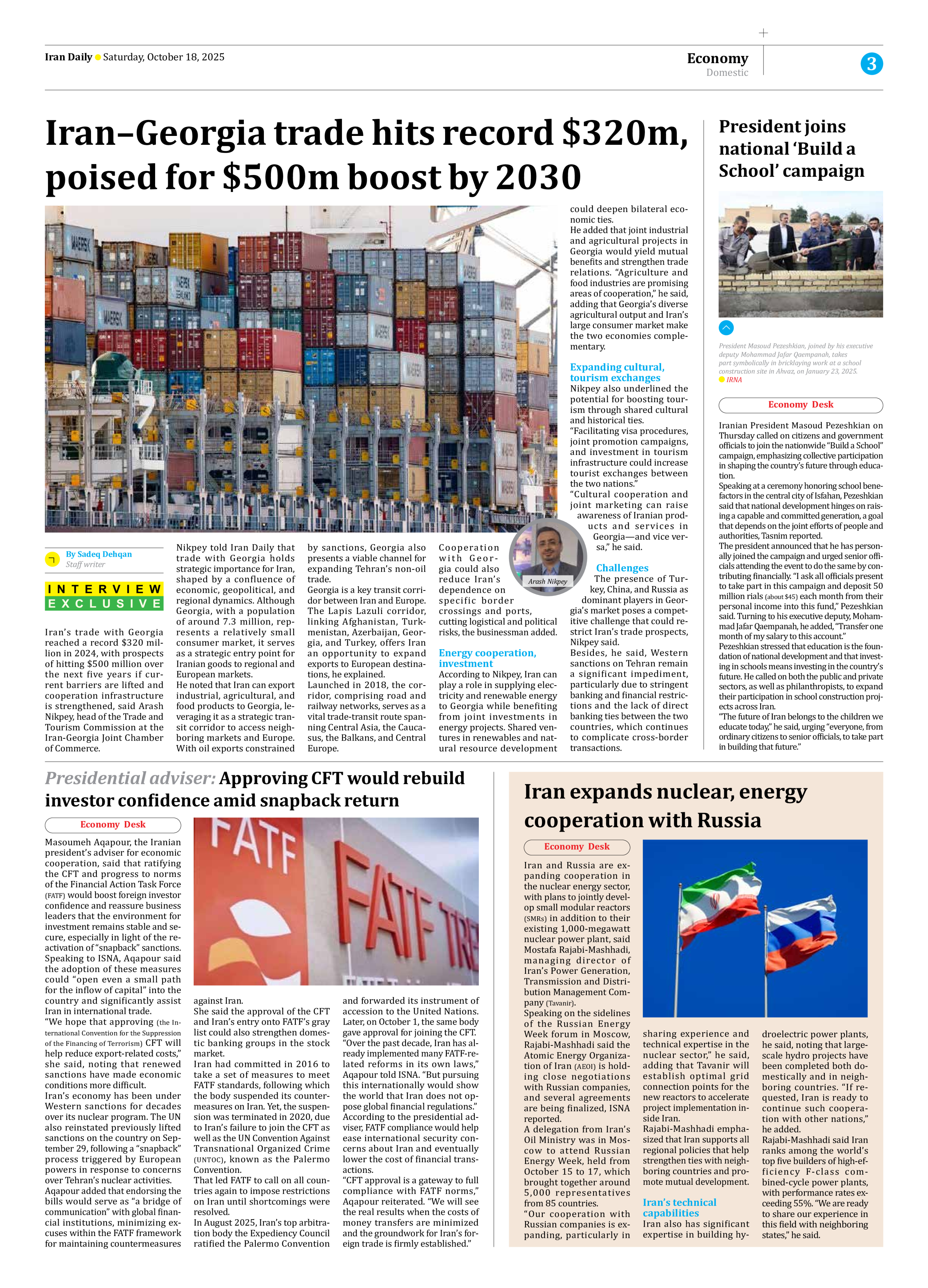


Presidential adviser: Approving CFT would rebuild investor confidence amid snapback return
Masoumeh Aqapour, the Iranian president’s adviser for economic cooperation, said that ratifying the CFT and progress to norms of the Financial Action Task Force (FATF) would boost foreign investor confidence and reassure business leaders that the environment for investment remains stable and secure, especially in light of the reactivation of “snapback” sanctions.
Speaking to ISNA, Aqapour said the adoption of these measures could “open even a small path for the inflow of capital” into the country and significantly assist Iran in international trade.
“We hope that approving (the International Convention for the Suppression of the Financing of Terrorism) CFT will help reduce export-related costs,” she said, noting that renewed sanctions have made economic conditions more difficult.
Iran’s economy has been under Western sanctions for decades over its nuclear program. The UN also reinstated previously lifted sanctions on the country on September 29, following a “snapback” process triggered by European powers in response to concerns over Tehran’s nuclear activities.
Aqapour added that endorsing the bills would serve as “a bridge of communication” with global financial institutions, minimizing excuses within the FATF framework for maintaining countermeasures against Iran.
She said the approval of the CFT and Iran’s entry onto FATF’s gray list could also strengthen domestic banking groups in the stock market.
Iran had committed in 2016 to take a set of measures to meet FATF standards, following which the body suspended its countermeasures on Iran. Yet, the suspension was terminated in 2020, due to Iran’s failure to join the CFT as well as the UN Convention Against Transnational Organized Crime (UNTOC), known as the Palermo Convention.
That led FATF to call on all countries again to impose restrictions on Iran until shortcomings were resolved.
In August 2025, Iran’s top arbitration body the Expediency Council ratified the Palermo Convention and forwarded its instrument of accession to the United Nations. Later, on October 1, the same body gave approval for joining the CFT.
“Over the past decade, Iran has already implemented many FATF-related reforms in its own laws,” Aqapour told ISNA. “But pursuing this internationally would show the world that Iran does not oppose global financial regulations.”
According to the presidential adviser, FATF compliance would help ease international security concerns about Iran and eventually lower the cost of financial transactions.
“CFT approval is a gateway to full compliance with FATF norms,” Aqapour reiterated. “We will see the real results when the costs of money transfers are minimized and the groundwork for Iran’s foreign trade is firmly established.”