





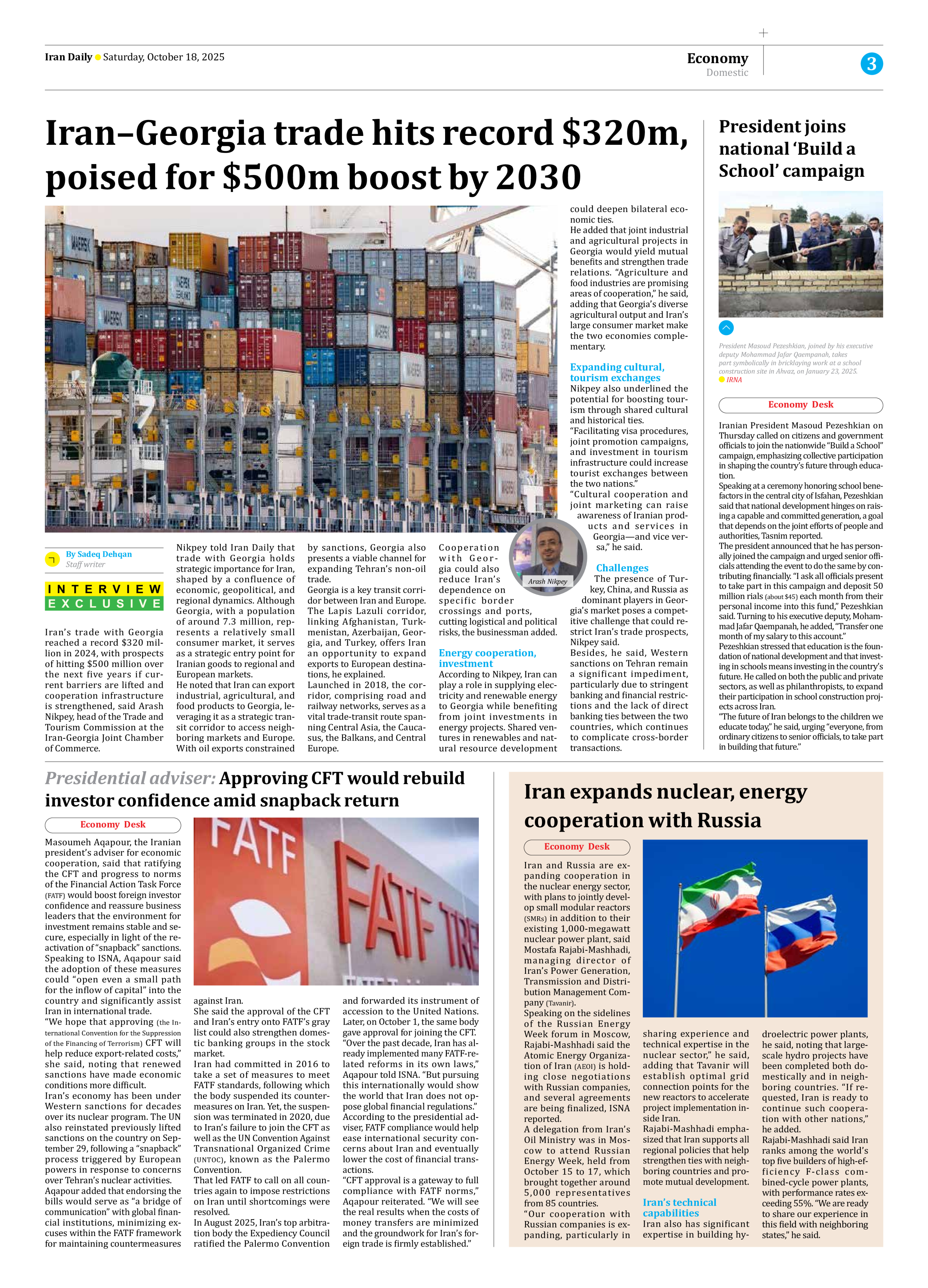


Iran–Georgia trade hits record $320m, poised for $500m boost by 2030
By Sadeq Dehqan
Staff writer
Iran’s trade with Georgia reached a record $320 million in 2024, with prospects of hitting $500 million over the next five years if current barriers are lifted and cooperation infrastructure is strengthened, said Arash Nikpey, head of the Trade and Tourism Commission at the Iran-Georgia Joint Chamber of Commerce.
Nikpey told Iran Daily that trade with Georgia holds strategic importance for Iran, shaped by a confluence of economic, geopolitical, and regional dynamics. Although Georgia, with a population of around 7.3 million, represents a relatively small consumer market, it serves as a strategic entry point for Iranian goods to regional and European markets.
He noted that Iran can export industrial, agricultural, and food products to Georgia, leveraging it as a strategic transit corridor to access neighboring markets and Europe. With oil exports constrained by sanctions, Georgia also presents a viable channel for expanding Tehran’s non-oil trade.
Georgia is a key transit corridor between Iran and Europe. The Lapis Lazuli corridor, linking Afghanistan, Turkmenistan, Azerbaijan, Georgia, and Turkey, offers Iran an opportunity to expand exports to European destinations, he explained.
Launched in 2018, the corridor, comprising road and railway networks, serves as a vital trade-transit route spanning Central Asia, the Caucasus, the Balkans, and Central Europe.
Cooperation with Georgia could also reduce Iran’s dependence on specific border crossings and ports, cutting logistical and political risks, the businessman added.
Energy cooperation, investment
According to Nikpey, Iran can play a role in supplying electricity and renewable energy to Georgia while benefiting from joint investments in energy projects. Shared ventures in renewables and natural resource development could deepen bilateral economic ties.
He added that joint industrial and agricultural projects in Georgia would yield mutual benefits and strengthen trade relations. “Agriculture and food industries are promising areas of cooperation,” he said, adding that Georgia’s diverse agricultural output and Iran’s large consumer market make the two economies complementary.
Expanding cultural, tourism exchanges
Nikpey also underlined the potential for boosting tourism through shared cultural and historical ties.
“Facilitating visa procedures, joint promotion campaigns, and investment in tourism infrastructure could increase tourist exchanges between the two nations.”
“Cultural cooperation and joint marketing can raise awareness of Iranian products and services in Georgia—and vice versa,” he said.
Challenges
The presence of Turkey, China, and Russia as dominant players in Georgia’s market poses a competitive challenge that could restrict Iran’s trade prospects, Nikpey said.
Besides, he said, Western sanctions on Tehran remain a significant impediment, particularly due to stringent banking and financial restrictions and the lack of direct banking ties between the two countries, which continues to complicate cross-border transactions.