





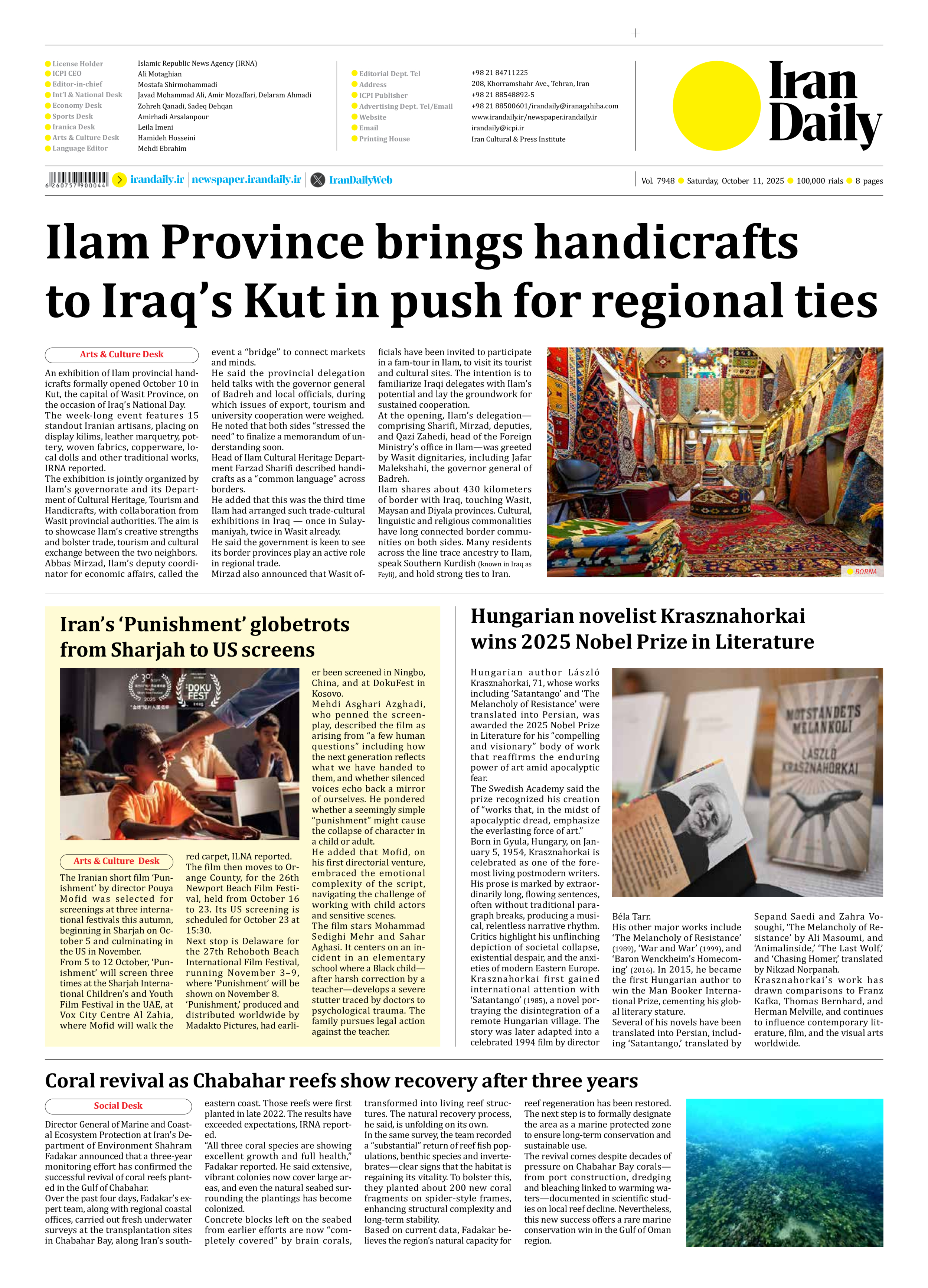


Hungarian novelist Krasznahorkai wins 2025 Nobel Prize in Literature
Hungarian author László Krasznahorkai, 71, whose works including ‘Satantango’ and ‘The Melancholy of Resistance’ were translated into Persian, was awarded the 2025 Nobel Prize in Literature for his “compelling and visionary” body of work that reaffirms the enduring power of art amid apocalyptic fear.
The Swedish Academy said the prize recognized his creation of “works that, in the midst of apocalyptic dread, emphasize the everlasting force of art.”
Born in Gyula, Hungary, on January 5, 1954, Krasznahorkai is celebrated as one of the foremost living postmodern writers. His prose is marked by extraordinarily long, flowing sentences, often without traditional paragraph breaks, producing a musical, relentless narrative rhythm. Critics highlight his unflinching depiction of societal collapse, existential despair, and the anxieties of modern Eastern Europe.
Krasznahorkai first gained international attention with ‘Satantango’ (1985), a novel portraying the disintegration of a remote Hungarian village. The story was later adapted into a celebrated 1994 film by director Béla Tarr.
His other major works include ‘The Melancholy of Resistance’ (1989), ‘War and War’ (1999), and ‘Baron Wenckheim’s Homecoming’ (2016). In 2015, he became the first Hungarian author to win the Man Booker International Prize, cementing his global literary stature.
Several of his novels have been translated into Persian, including ‘Satantango,’ translated by Sepand Saedi and Zahra Vosoughi, ‘The Melancholy of Resistance’ by Ali Masoumi, and ‘Animalinside,’ ‘The Last Wolf,’ and ‘Chasing Homer,’ translated by Nikzad Norpanah.
Krasznahorkai’s work has drawn comparisons to Franz Kafka, Thomas Bernhard, and Herman Melville, and continues to influence contemporary literature, film, and the visual arts worldwide.