







Ilam Province brings handicrafts to Iraq’s Kut in push for regional ties
An exhibition of Ilam provincial handicrafts formally opened October 10 in Kut, the capital of Wasit Province, on the occasion of Iraq’s National Day.
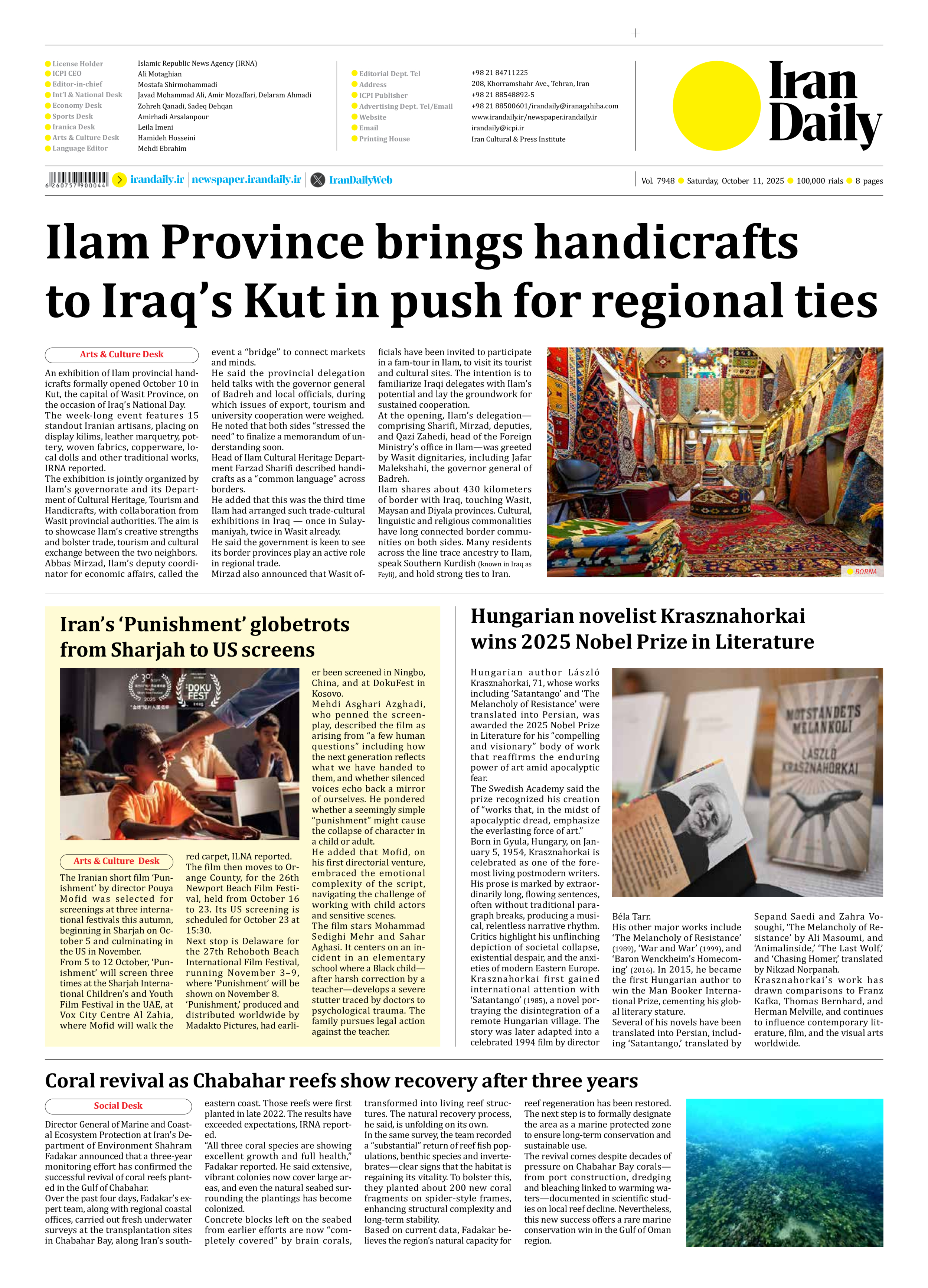
The week-long event features 15 standout Iranian artisans, placing on display kilims, leather marquetry, pottery, woven fabrics, copperware, local dolls and other traditional works, IRNA reported.
The exhibition is jointly organized by Ilam’s governorate and its Department of Cultural Heritage, Tourism and Handicrafts, with collaboration from Wasit provincial authorities. The aim is to showcase Ilam’s creative strengths and bolster trade, tourism and cultural exchange between the two neighbors.
Abbas Mirzad, Ilam’s deputy coordinator for economic affairs, called the event a “bridge” to connect markets and minds.
He said the provincial delegation held talks with the governor general of Badreh and local officials, during which issues of export, tourism and university cooperation were weighed.
He noted that both sides “stressed the need” to finalize a memorandum of understanding soon.
Head of Ilam Cultural Heritage Department Farzad Sharifi described handicrafts as a “common language” across borders.
He added that this was the third time Ilam had arranged such trade-cultural exhibitions in Iraq — once in Sulaymaniyah, twice in Wasit already.
He said the government is keen to see its border provinces play an active role in regional trade.
Mirzad also announced that Wasit officials have been invited to participate in a fam-tour in Ilam, to visit its tourist and cultural sites. The intention is to familiarize Iraqi delegates with Ilam’s potential and lay the groundwork for sustained cooperation.
At the opening, Ilam’s delegation—comprising Sharifi, Mirzad, deputies, and Qazi Zahedi, head of the Foreign Ministry’s office in Ilam—was greeted by Wasit dignitaries, including Jafar Malekshahi, the governor general of Badreh.
Ilam shares about 430 kilometers of border with Iraq, touching Wasit, Maysan and Diyala provinces. Cultural, linguistic and religious commonalities have long connected border communities on both sides. Many residents across the line trace ancestry to Ilam, speak Southern Kurdish (known in Iraq as Feyli), and hold strong ties to Iran.