





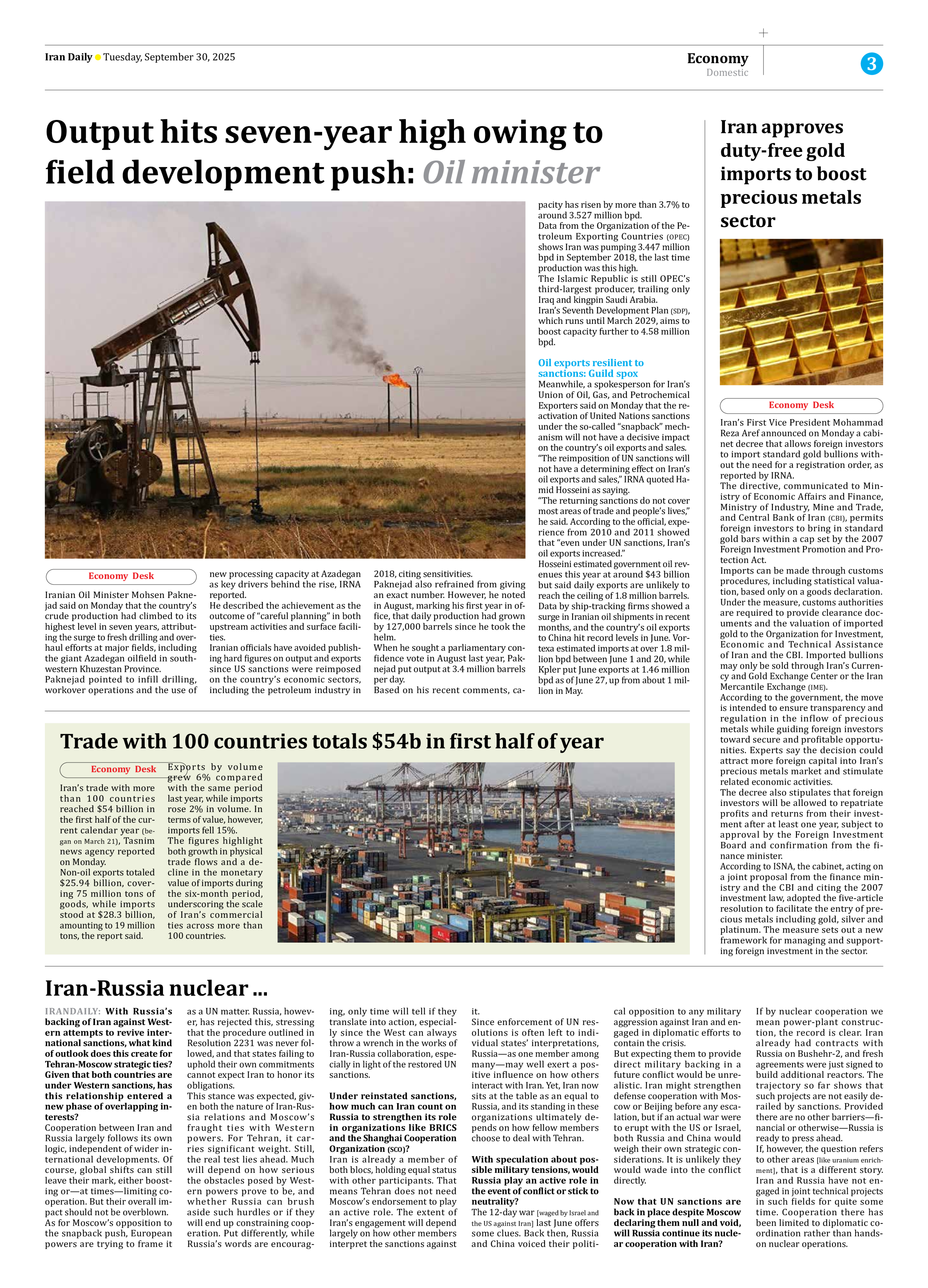


Output hits seven-year high owing to field development push: Oil minister
Iranian Oil Minister Mohsen Paknejad said on Monday that the country’s crude production had climbed to its highest level in seven years, attributing the surge to fresh drilling and overhaul efforts at major fields, including the giant Azadegan oilfield in southwestern Khuzestan Province.
Paknejad pointed to infill drilling, workover operations and the use of new processing capacity at Azadegan as key drivers behind the rise, IRNA reported.
He described the achievement as the outcome of “careful planning” in both upstream activities and surface facilities.
Iranian officials have avoided publishing hard figures on output and exports since US sanctions were reimposed on the country’s economic sectors, including the petroleum industry in 2018, citing sensitivities.
Paknejad also refrained from giving an exact number. However, he noted in August, marking his first year in office, that daily production had grown by 127,000 barrels since he took the helm.
When he sought a parliamentary confidence vote in August last year, Paknejad put output at 3.4 million barrels per day.
Based on his recent comments, capacity has risen by more than 3.7% to around 3.527 million bpd.
Data from the Organization of the Petroleum Exporting Countries (OPEC) shows Iran was pumping 3.447 million bpd in September 2018, the last time production was this high.
The Islamic Republic is still OPEC’s third-largest producer, trailing only Iraq and kingpin Saudi Arabia.
Iran’s Seventh Development Plan (SDP), which runs until March 2029, aims to boost capacity further to 4.58 million bpd.
Oil exports resilient to sanctions: Guild spox
Meanwhile, a spokesperson for Iran’s Union of Oil, Gas, and Petrochemical Exporters said on Monday that the reactivation of United Nations sanctions under the so-called “snapback” mechanism will not have a decisive impact on the country’s oil exports and sales.
“The reimposition of UN sanctions will not have a determining effect on Iran’s oil exports and sales,” IRNA quoted Hamid Hosseini as saying.
“The returning sanctions do not cover most areas of trade and people’s lives,” he said. According to the official, experience from 2010 and 2011 showed that “even under UN sanctions, Iran’s oil exports increased.”
Hosseini estimated government oil revenues this year at around $43 billion but said daily exports are unlikely to reach the ceiling of 1.8 million barrels.
Data by ship-tracking firms showed a surge in Iranian oil shipments in recent months, and the country’s oil exports to China hit record levels in June. Vortexa estimated imports at over 1.8 million bpd between June 1 and 20, while Kpler put June exports at 1.46 million bpd as of June 27, up from about 1 million in May.