





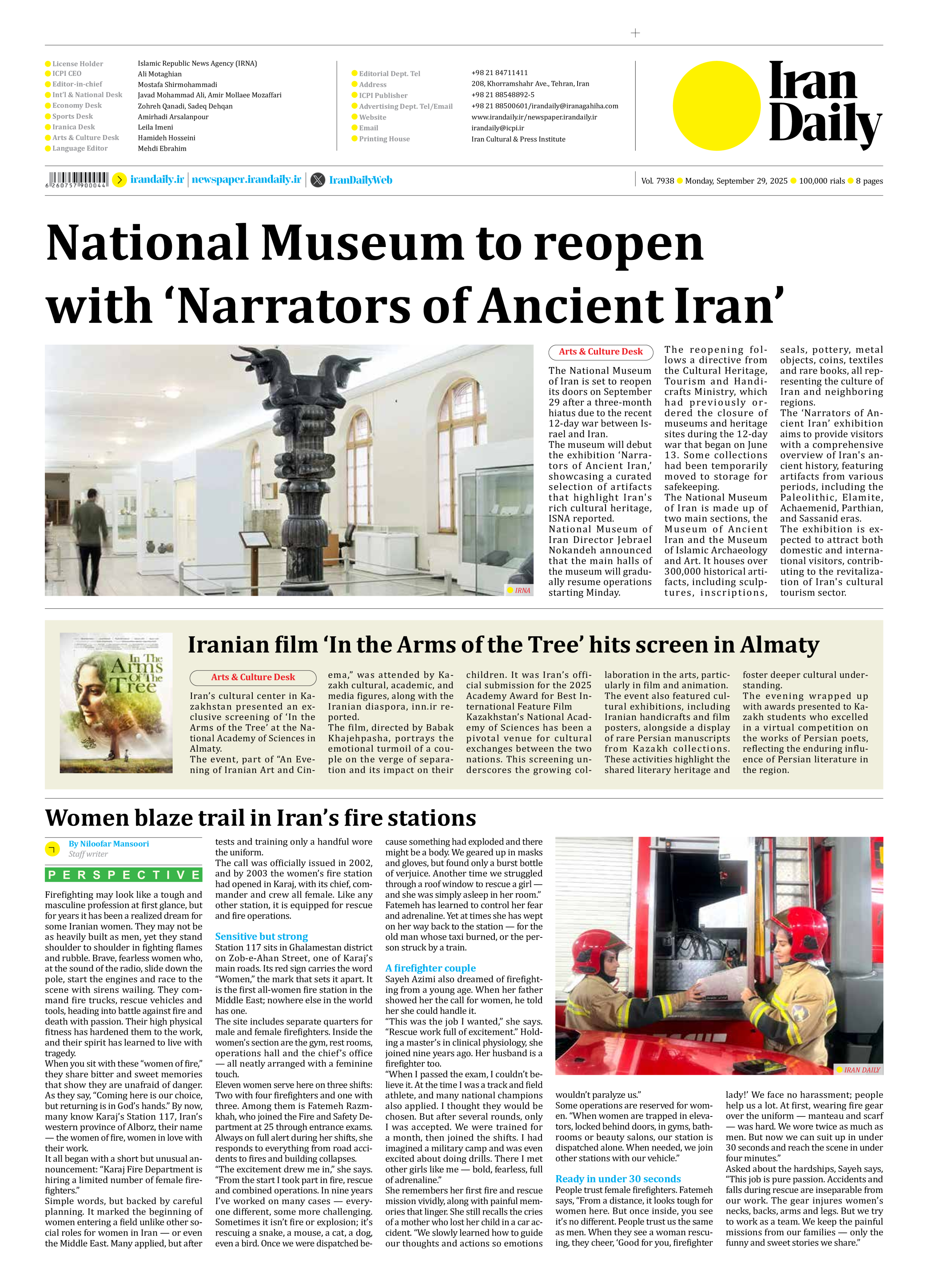


Women blaze trail in Iran’s fire stations
By Niloofar Mansoori
Staff writer
Firefighting may look like a tough and masculine profession at first glance, but for years it has been a realized dream for some Iranian women. They may not be as heavily built as men, yet they stand shoulder to shoulder in fighting flames and rubble. Brave, fearless women who, at the sound of the radio, slide down the pole, start the engines and race to the scene with sirens wailing. They command fire trucks, rescue vehicles and tools, heading into battle against fire and death with passion. Their high physical fitness has hardened them to the work, and their spirit has learned to live with tragedy.
When you sit with these “women of fire,” they share bitter and sweet memories that show they are unafraid of danger. As they say, “Coming here is our choice, but returning is in God’s hands.” By now, many know Karaj’s Station 117, Iran’s western province of Alborz, their name — the women of fire, women in love with their work.
It all began with a short but unusual announcement: “Karaj Fire Department is hiring a limited number of female firefighters.”
Simple words, but backed by careful planning. It marked the beginning of women entering a field unlike other social roles for women in Iran — or even the Middle East. Many applied, but after tests and training only a handful wore the uniform.
The call was officially issued in 2002, and by 2003 the women’s fire station had opened in Karaj, with its chief, commander and crew all female. Like any other station, it is equipped for rescue and fire operations.
Sensitive but strong
Station 117 sits in Ghalamestan district on Zob-e-Ahan Street, one of Karaj’s main roads. Its red sign carries the word “Women,” the mark that sets it apart. It is the first all-women fire station in the Middle East; nowhere else in the world has one.
The site includes separate quarters for male and female firefighters. Inside the women’s section are the gym, rest rooms, operations hall and the chief’s office — all neatly arranged with a feminine touch.
Eleven women serve here on three shifts: Two with four firefighters and one with three. Among them is Fatemeh Razmkhah, who joined the Fire and Safety Department at 25 through entrance exams. Always on full alert during her shifts, she responds to everything from road accidents to fires and building collapses.
“The excitement drew me in,” she says. “From the start I took part in fire, rescue and combined operations. In nine years I’ve worked on many cases — everyone different, some more challenging. Sometimes it isn’t fire or explosion; it’s rescuing a snake, a mouse, a cat, a dog, even a bird. Once we were dispatched because something had exploded and there might be a body. We geared up in masks and gloves, but found only a burst bottle of verjuice. Another time we struggled through a roof window to rescue a girl — and she was simply asleep in her room.”
Fatemeh has learned to control her fear and adrenaline. Yet at times she has wept on her way back to the station — for the old man whose taxi burned, or the person struck by a train.
A firefighter couple
Sayeh Azimi also dreamed of firefighting from a young age. When her father showed her the call for women, he told her she could handle it.
“This was the job I wanted,” she says. “Rescue work full of excitement.” Holding a master’s in clinical physiology, she joined nine years ago. Her husband is a firefighter too.
“When I passed the exam, I couldn’t believe it. At the time I was a track and field athlete, and many national champions also applied. I thought they would be chosen. But after several rounds, only I was accepted. We were trained for a month, then joined the shifts. I had imagined a military camp and was even excited about doing drills. There I met other girls like me — bold, fearless, full of adrenaline.”
She remembers her first fire and rescue mission vividly, along with painful memories that linger. She still recalls the cries of a mother who lost her child in a car accident. “We slowly learned how to guide our thoughts and actions so emotions wouldn’t paralyze us.”
Some operations are reserved for women. “When women are trapped in elevators, locked behind doors, in gyms, bathrooms or beauty salons, our station is dispatched alone. When needed, we join other stations with our vehicle.”
Ready in under 30 seconds
People trust female firefighters. Fatemeh says, “From a distance, it looks tough for women here. But once inside, you see it’s no different. People trust us the same as men. When they see a woman rescuing, they cheer, ‘Good for you, firefighter lady!’ We face no harassment; people help us a lot. At first, wearing fire gear over the uniform — manteau and scarf — was hard. We wore twice as much as men. But now we can suit up in under 30 seconds and reach the scene in under four minutes.”
Asked about the hardships, Sayeh says, “This job is pure passion. Accidents and falls during rescue are inseparable from our work. The gear injures women’s necks, backs, arms and legs. But we try to work as a team. We keep the painful missions from our families — only the funny and sweet stories we share.”