





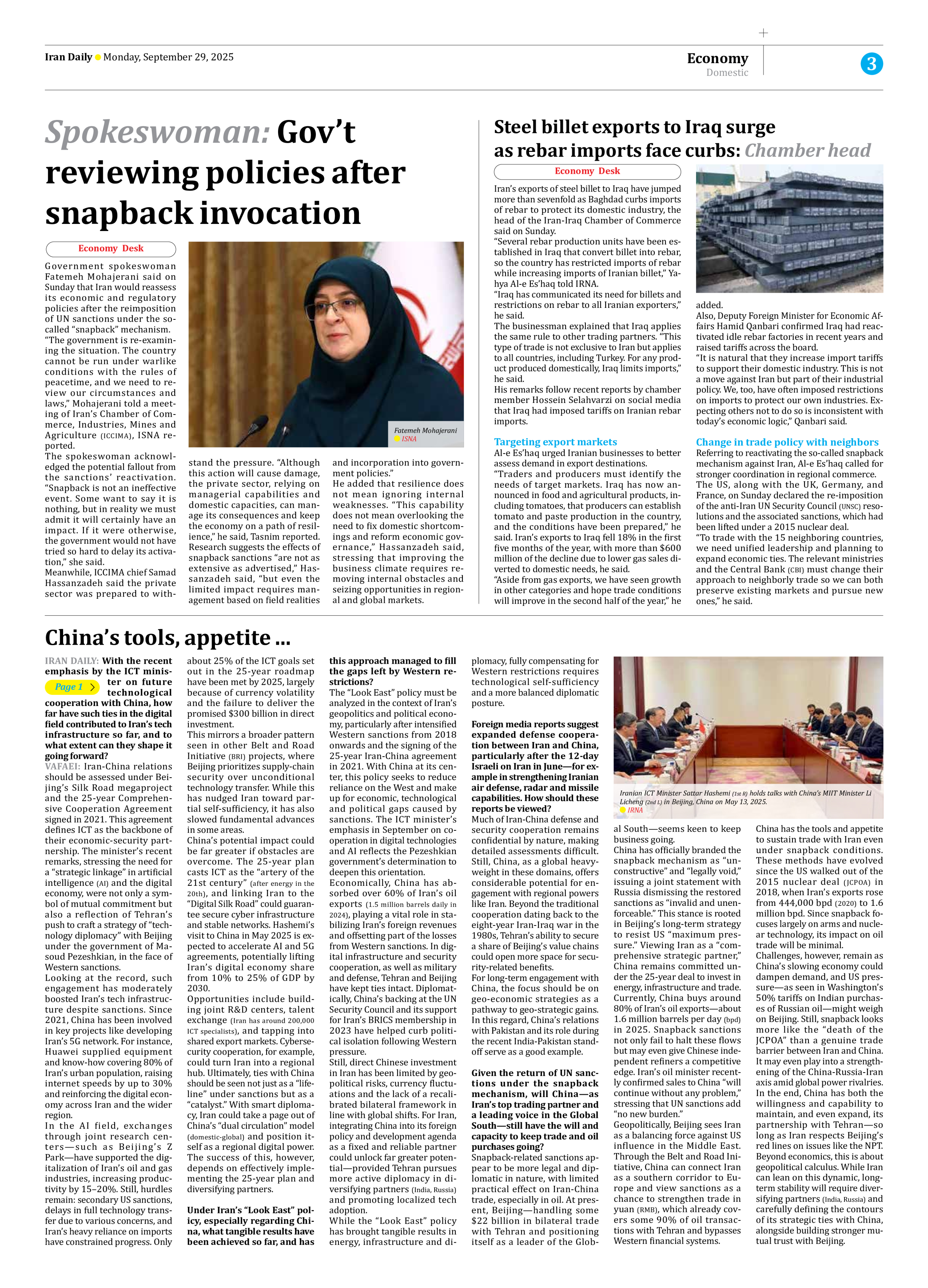


China’s tools, appetite ...
Page 1
IRAN DAILY: With the recent emphasis by the ICT minister on future technological cooperation with China, how far have such ties in the digital field contributed to Iran’s tech infrastructure so far, and to what extent can they shape it going forward?
VAFAEI: Iran-China relations should be assessed under Beijing’s Silk Road megaproject and the 25-year Comprehensive Cooperation Agreement signed in 2021. This agreement defines ICT as the backbone of their economic-security partnership. The minister’s recent remarks, stressing the need for a “strategic linkage” in artificial intelligence (AI) and the digital economy, were not only a symbol of mutual commitment but also a reflection of Tehran’s push to craft a strategy of “technology diplomacy” with Beijing under the government of Masoud Pezeshkian, in the face of Western sanctions.
Looking at the record, such engagement has moderately boosted Iran’s tech infrastructure despite sanctions. Since 2021, China has been involved in key projects like developing Iran’s 5G network. For instance, Huawei supplied equipment and know-how covering 80% of Iran’s urban population, raising internet speeds by up to 30% and reinforcing the digital economy across Iran and the wider region.
In the AI field, exchanges through joint research centers—such as Beijing’s Z Park—have supported the digitalization of Iran’s oil and gas industries, increasing productivity by 15–20%. Still, hurdles remain: secondary US sanctions, delays in full technology transfer due to various concerns, and Iran’s heavy reliance on imports have constrained progress. Only about 25% of the ICT goals set out in the 25-year roadmap have been met by 2025, largely because of currency volatility and the failure to deliver the promised $300 billion in direct investment.
This mirrors a broader pattern seen in other Belt and Road Initiative (BRI) projects, where Beijing prioritizes supply-chain security over unconditional technology transfer. While this has nudged Iran toward partial self-sufficiency, it has also slowed fundamental advances in some areas.
China’s potential impact could be far greater if obstacles are overcome. The 25-year plan casts ICT as the “artery of the 21st century” (after energy in the 20th), and linking Iran to the “Digital Silk Road” could guarantee secure cyber infrastructure and stable networks. Hashemi’s visit to China in May 2025 is expected to accelerate AI and 5G agreements, potentially lifting Iran’s digital economy share from 10% to 25% of GDP by 2030.
Opportunities include building joint R&D centers, talent exchange (Iran has around 200,000 ICT specialists), and tapping into shared export markets. Cybersecurity cooperation, for example, could turn Iran into a regional hub. Ultimately, ties with China should be seen not just as a “lifeline” under sanctions but as a “catalyst.” With smart diplomacy, Iran could take a page out of China’s “dual circulation” model (domestic-global) and position itself as a regional digital power. The success of this, however, depends on effectively implementing the 25-year plan and diversifying partners.
Under Iran’s “Look East” policy, especially regarding China, what tangible results have been achieved so far, and has this approach managed to fill the gaps left by Western restrictions?
The “Look East” policy must be analyzed in the context of Iran’s geopolitics and political economy, particularly after intensified Western sanctions from 2018 onwards and the signing of the 25-year Iran-China agreement in 2021. With China at its center, this policy seeks to reduce reliance on the West and make up for economic, technological and political gaps caused by sanctions. The ICT minister’s emphasis in September on cooperation in digital technologies and AI reflects the Pezeshkian government’s determination to deepen this orientation.
Economically, China has absorbed over 60% of Iran’s oil exports (1.5 million barrels daily in 2024), playing a vital role in stabilizing Iran’s foreign revenues and offsetting part of the losses from Western sanctions. In digital infrastructure and security cooperation, as well as military and defense, Tehran and Beijing have kept ties intact. Diplomatically, China’s backing at the UN Security Council and its support for Iran’s BRICS membership in 2023 have helped curb political isolation following Western pressure.
Still, direct Chinese investment in Iran has been limited by geopolitical risks, currency fluctuations and the lack of a recalibrated bilateral framework in line with global shifts. For Iran, integrating China into its foreign policy and development agenda as a fixed and reliable partner could unlock far greater potential—provided Tehran pursues more active diplomacy in diversifying partners (India, Russia) and promoting localized tech adoption.
While the “Look East” policy has brought tangible results in energy, infrastructure and diplomacy, fully compensating for Western restrictions requires technological self-sufficiency and a more balanced diplomatic posture.
Foreign media reports suggest expanded defense cooperation between Iran and China, particularly after the 12-day Israeli on Iran in June—for example in strengthening Iranian air defense, radar and missile capabilities. How should these reports be viewed?
Much of Iran-China defense and security cooperation remains confidential by nature, making detailed assessments difficult. Still, China, as a global heavyweight in these domains, offers considerable potential for engagement with regional powers like Iran. Beyond the traditional cooperation dating back to the eight-year Iran-Iraq war in the 1980s, Tehran’s ability to secure a share of Beijing’s value chains could open more space for security-related benefits.
For long-term engagement with China, the focus should be on geo-economic strategies as a pathway to geo-strategic gains. In this regard, China’s relations with Pakistan and its role during the recent India-Pakistan standoff serve as a good example.
Given the return of UN sanctions under the snapback mechanism, will China—as Iran’s top trading partner and a leading voice in the Global South—still have the will and capacity to keep trade and oil purchases going?
Snapback-related sanctions appear to be more legal and diplomatic in nature, with limited practical effect on Iran-China trade, especially in oil. At present, Beijing—handling some $22 billion in bilateral trade with Tehran and positioning itself as a leader of the Global South—seems keen to keep business going.
China has officially branded the snapback mechanism as “unconstructive” and “legally void,” issuing a joint statement with Russia dismissing the restored sanctions as “invalid and unenforceable.” This stance is rooted in Beijing’s long-term strategy to resist US “maximum pressure.” Viewing Iran as a “comprehensive strategic partner,” China remains committed under the 25-year deal to invest in energy, infrastructure and trade.
Currently, China buys around 80% of Iran’s oil exports—about 1.6 million barrels per day (bpd) in 2025. Snapback sanctions not only fail to halt these flows but may even give Chinese independent refiners a competitive edge. Iran’s oil minister recently confirmed sales to China “will continue without any problem,” stressing that UN sanctions add “no new burden.”
Geopolitically, Beijing sees Iran as a balancing force against US influence in the Middle East. Through the Belt and Road Initiative, China can connect Iran as a southern corridor to Europe and view sanctions as a chance to strengthen trade in yuan (RMB), which already covers some 90% of oil transactions with Tehran and bypasses Western financial systems.
China has the tools and appetite to sustain trade with Iran even under snapback conditions. These methods have evolved since the US walked out of the 2015 nuclear deal (JCPOA) in 2018, when Iran’s exports rose from 444,000 bpd (2020) to 1.6 million bpd. Since snapback focuses largely on arms and nuclear technology, its impact on oil trade will be minimal.
Challenges, however, remain as China’s slowing economy could dampen demand, and US pressure—as seen in Washington’s 50% tariffs on Indian purchases of Russian oil—might weigh on Beijing. Still, snapback looks more like the “death of the JCPOA” than a genuine trade barrier between Iran and China. It may even play into a strengthening of the China-Russia-Iran axis amid global power rivalries.
In the end, China has both the willingness and capability to maintain, and even expand, its partnership with Tehran—so long as Iran respects Beijing’s red lines on issues like the NPT. Beyond economics, this is about geopolitical calculus. While Iran can lean on this dynamic, long-term stability will require diversifying partners (India, Russia) and carefully defining the contours of its strategic ties with China, alongside building stronger mutual trust with Beijing.