





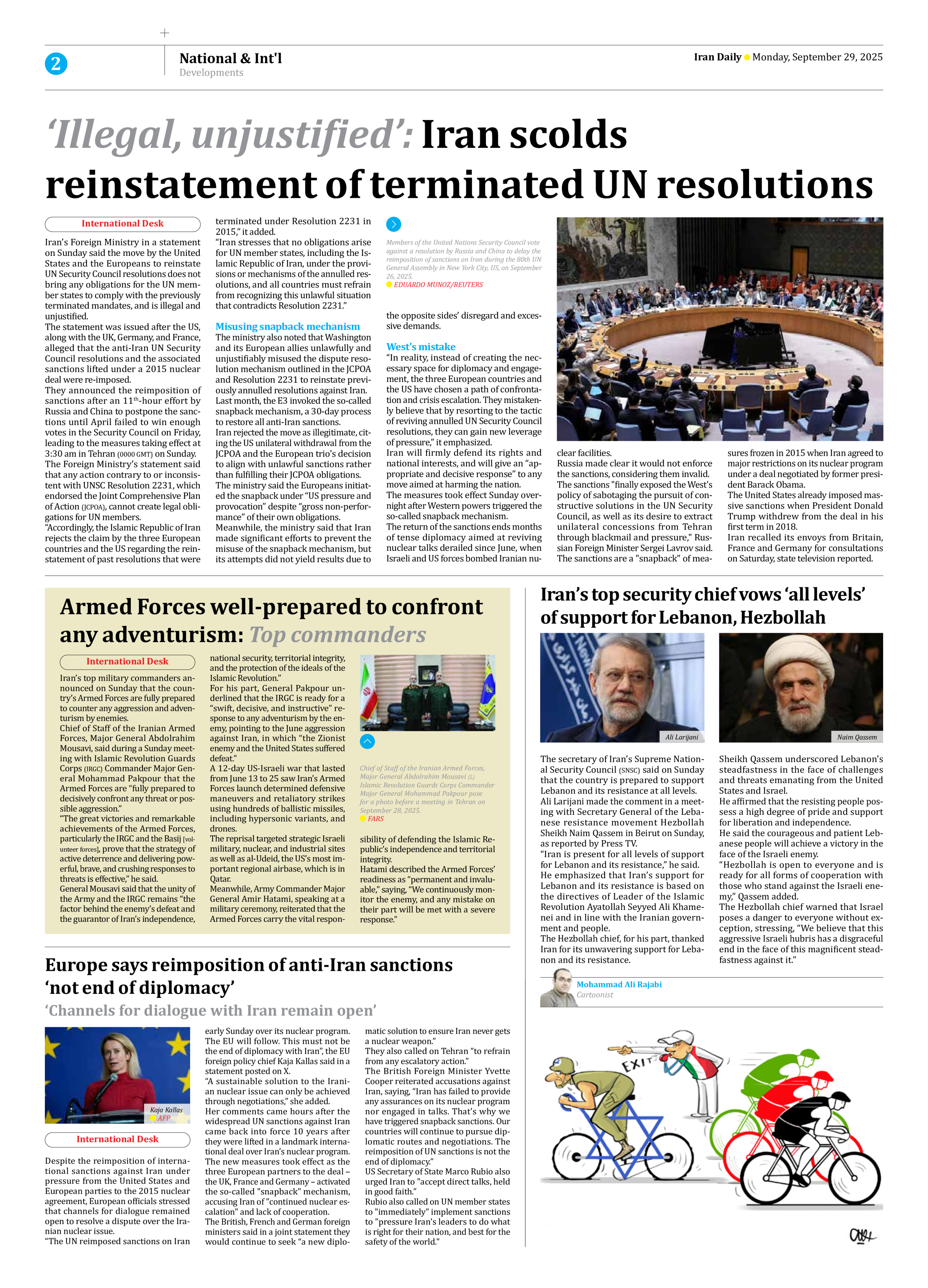


‘Illegal, unjustified’: Iran scolds reinstatement of terminated UN resolutions
Iran’s Foreign Ministry in a statement on Sunday said the move by the United States and the Europeans to reinstate UN Security Council resolutions does not bring any obligations for the UN member states to comply with the previously terminated mandates, and is illegal and unjustified.
The statement was issued after the US, along with the UK, Germany, and France, alleged that the anti-Iran UN Security Council resolutions and the associated sanctions lifted under a 2015 nuclear deal were re-imposed.
They announced the reimposition of sanctions after an 11th-hour effort by Russia and China to postpone the sanctions until April failed to win enough votes in the Security Council on Friday, leading to the measures taking effect at 3:30 am in Tehran (0000 GMT) on Sunday.
The Foreign Ministry’s statement said that any action contrary to or inconsistent with UNSC Resolution 2231, which endorsed the Joint Comprehensive Plan of Action (JCPOA), cannot create legal obligations for UN members.
“Accordingly, the Islamic Republic of Iran rejects the claim by the three European countries and the US regarding the reinstatement of past resolutions that were terminated under Resolution 2231 in 2015,” it added.
“Iran stresses that no obligations arise for UN member states, including the Islamic Republic of Iran, under the provisions or mechanisms of the annulled resolutions, and all countries must refrain from recognizing this unlawful situation that contradicts Resolution 2231.”
Misusing snapback mechanism
The ministry also noted that Washington and its European allies unlawfully and unjustifiably misused the dispute resolution mechanism outlined in the JCPOA and Resolution 2231 to reinstate previously annulled resolutions against Iran.
Last month, the E3 invoked the so-called snapback mechanism, a 30-day process to restore all anti-Iran sanctions.
Iran rejected the move as illegitimate, citing the US unilateral withdrawal from the JCPOA and the European trio's decision to align with unlawful sanctions rather than fulfilling their JCPOA obligations.
The ministry said the Europeans initiated the snapback under “US pressure and provocation” despite “gross non-performance” of their own obligations.
Meanwhile, the ministry said that Iran made significant efforts to prevent the misuse of the snapback mechanism, but its attempts did not yield results due to the opposite sides’ disregard and excessive demands.
West’s mistake
“In reality, instead of creating the necessary space for diplomacy and engagement, the three European countries and the US have chosen a path of confrontation and crisis escalation. They mistakenly believe that by resorting to the tactic of reviving annulled UN Security Council resolutions, they can gain new leverage of pressure,” it emphasized.
Iran will firmly defend its rights and national interests, and will give an “appropriate and decisive response” to any move aimed at harming the nation.
The measures took effect Sunday overnight after Western powers triggered the so-called snapback mechanism.
The return of the sanctions ends months of tense diplomacy aimed at reviving nuclear talks derailed since June, when Israeli and US forces bombed Iranian nuclear facilities.
Russia made clear it would not enforce the sanctions, considering them invalid.
The sanctions "finally exposed the West's policy of sabotaging the pursuit of constructive solutions in the UN Security Council, as well as its desire to extract unilateral concessions from Tehran through blackmail and pressure," Russian Foreign Minister Sergei Lavrov said.
The sanctions are a "snapback" of measures frozen in 2015 when Iran agreed to major restrictions on its nuclear program under a deal negotiated by former president Barack Obama.
The United States already imposed massive sanctions when President Donald Trump withdrew from the deal in his first term in 2018.
Iran recalled its envoys from Britain, France and Germany for consultations on Saturday, state television reported.