







Minister: Iran-Russia ties lay groundwork for multipolar world
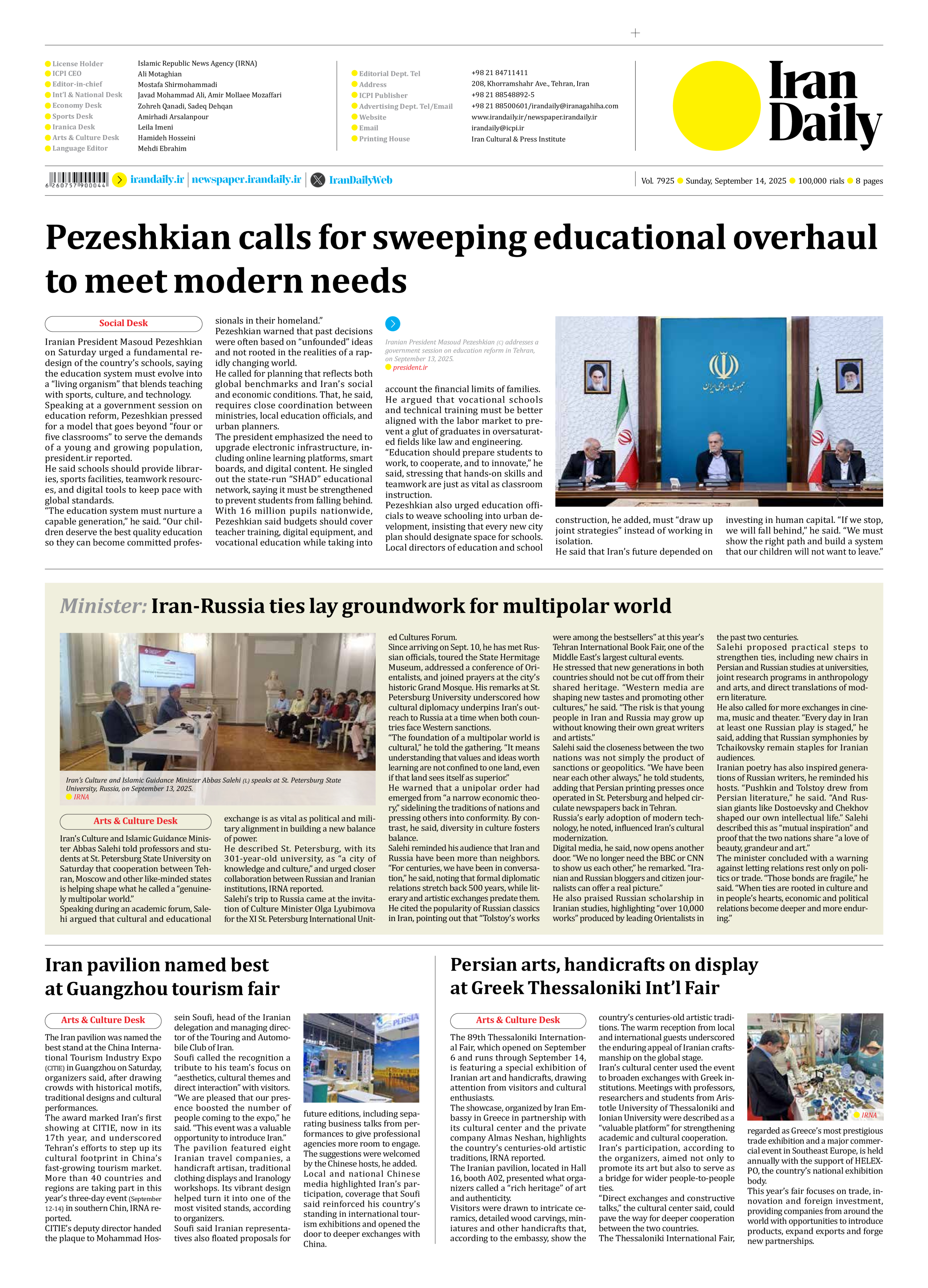
Iran’s Culture and Islamic Guidance Minister Abbas Salehi told professors and students at St. Petersburg State University on Saturday that cooperation between Tehran, Moscow and other like-minded states is helping shape what he called a “genuinely multipolar world.”
Speaking during an academic forum, Salehi argued that cultural and educational exchange is as vital as political and military alignment in building a new balance of power.
He described St. Petersburg, with its 301-year-old university, as “a city of knowledge and culture,” and urged closer collaboration between Russian and Iranian institutions, IRNA reported.
Salehi’s trip to Russia came at the invitation of Culture Minister Olga Lyubimova for the XI St. Petersburg International United Cultures Forum.
Since arriving on Sept. 10, he has met Russian officials, toured the State Hermitage Museum, addressed a conference of Orientalists, and joined prayers at the city’s historic Grand Mosque. His remarks at St. Petersburg University underscored how cultural diplomacy underpins Iran’s outreach to Russia at a time when both countries face Western sanctions.
“The foundation of a multipolar world is cultural,” he told the gathering. “It means understanding that values and ideas worth learning are not confined to one land, even if that land sees itself as superior.”
He warned that a unipolar order had emerged from “a narrow economic theory,” sidelining the traditions of nations and pressing others into conformity. By contrast, he said, diversity in culture fosters balance.
Salehi reminded his audience that Iran and Russia have been more than neighbors. “For centuries, we have been in conversation,” he said, noting that formal diplomatic relations stretch back 500 years, while literary and artistic exchanges predate them.
He cited the popularity of Russian classics in Iran, pointing out that “Tolstoy’s works were among the bestsellers” at this year’s Tehran International Book Fair, one of the Middle East’s largest cultural events.
He stressed that new generations in both countries should not be cut off from their shared heritage. “Western media are shaping new tastes and promoting other cultures,” he said. “The risk is that young people in Iran and Russia may grow up without knowing their own great writers and artists.”
Salehi said the closeness between the two nations was not simply the product of sanctions or geopolitics. “We have been near each other always,” he told students, adding that Persian printing presses once operated in St. Petersburg and helped circulate newspapers back in Tehran.
Russia’s early adoption of modern technology, he noted, influenced Iran’s cultural modernization.
Digital media, he said, now opens another door. “We no longer need the BBC or CNN to show us each other,” he remarked. “Iranian and Russian bloggers and citizen journalists can offer a real picture.”
He also praised Russian scholarship in Iranian studies, highlighting “over 10,000 works” produced by leading Orientalists in the past two centuries.
Salehi proposed practical steps to strengthen ties, including new chairs in Persian and Russian studies at universities, joint research programs in anthropology and arts, and direct translations of modern literature.
He also called for more exchanges in cinema, music and theater. “Every day in Iran at least one Russian play is staged,” he said, adding that Russian symphonies by Tchaikovsky remain staples for Iranian audiences.
Iranian poetry has also inspired generations of Russian writers, he reminded his hosts. “Pushkin and Tolstoy drew from Persian literature,” he said. “And Russian giants like Dostoevsky and Chekhov shaped our own intellectual life.” Salehi described this as “mutual inspiration” and proof that the two nations share “a love of beauty, grandeur and art.”
The minister concluded with a warning against letting relations rest only on politics or trade. “Those bonds are fragile,” he said. “When ties are rooted in culture and in people’s hearts, economic and political relations become deeper and more enduring.”