





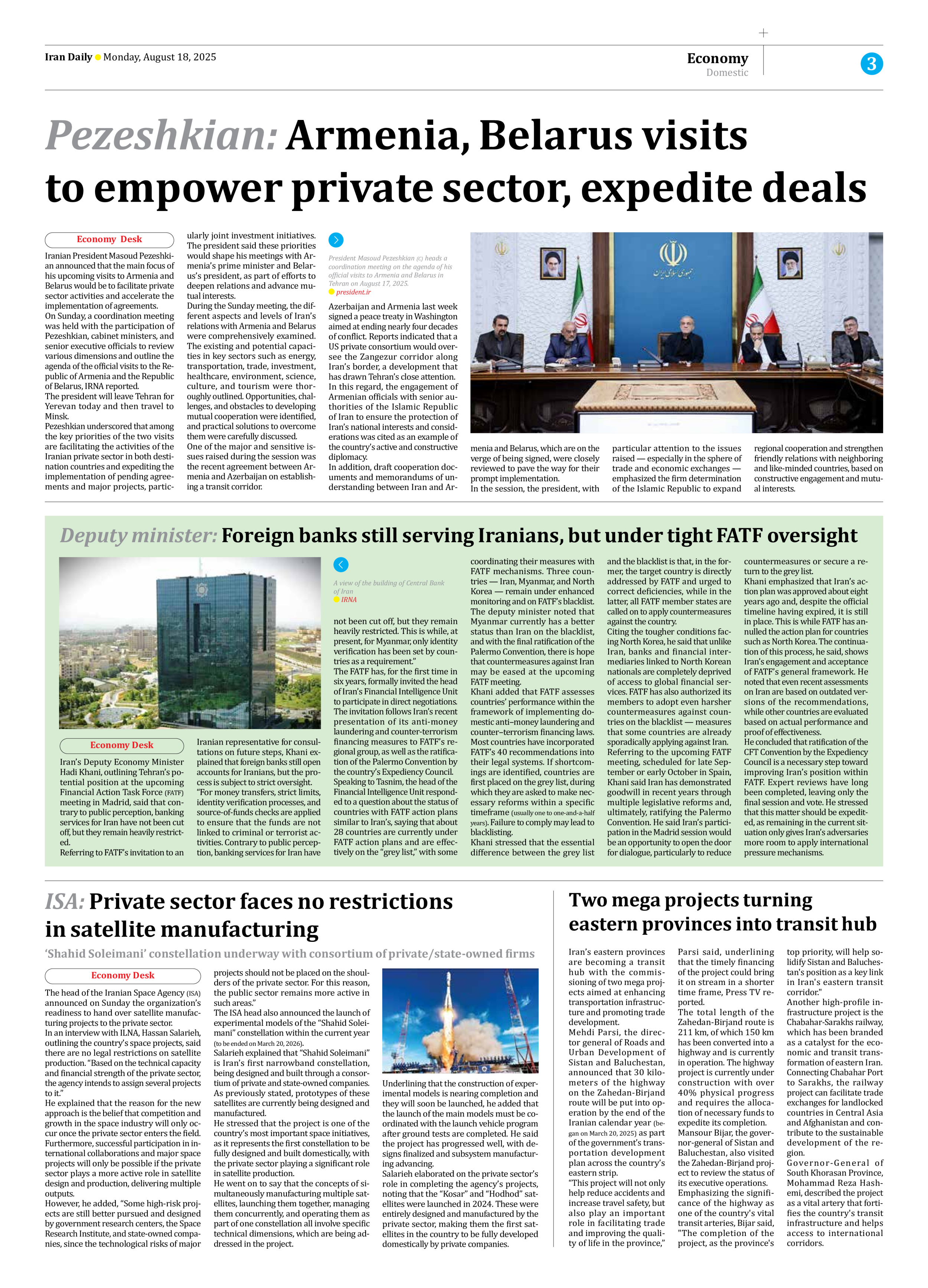


Deputy minister: Foreign banks still serving Iranians, but under tight FATF oversight
Iran’s Deputy Economy Minister Hadi Khani, outlining Tehran’s potential position at the upcoming Financial Action Task Force (FATF) meeting in Madrid, said that contrary to public perception, banking services for Iran have not been cut off, but they remain heavily restricted.
Referring to FATF’s invitation to an Iranian representative for consultations on future steps, Khani explained that foreign banks still open accounts for Iranians, but the process is subject to strict oversight.
“For money transfers, strict limits, identity verification processes, and source-of-funds checks are applied to ensure that the funds are not linked to criminal or terrorist activities. Contrary to public perception, banking services for Iran have not been cut off, but they remain heavily restricted. This is while, at present, for Myanmar, only identity verification has been set by countries as a requirement.”
The FATF has, for the first time in six years, formally invited the head of Iran’s Financial Intelligence Unit to participate in direct negotiations.
The invitation follows Iran’s recent presentation of its anti-money laundering and counter-terrorism financing measures to FATF’s regional group, as well as the ratification of the Palermo Convention by the country’s Expediency Council.
Speaking to Tasnim, the head of the Financial Intelligence Unit responded to a question about the status of countries with FATF action plans similar to Iran’s, saying that about 28 countries are currently under FATF action plans and are effectively on the “grey list,” with some coordinating their measures with FATF mechanisms. Three countries — Iran, Myanmar, and North Korea — remain under enhanced monitoring and on FATF’s blacklist.
The deputy minister noted that Myanmar currently has a better status than Iran on the blacklist, and with the final ratification of the Palermo Convention, there is hope that countermeasures against Iran may be eased at the upcoming FATF meeting.
Khani added that FATF assesses countries’ performance within the framework of implementing domestic anti–money laundering and counter–terrorism financing laws. Most countries have incorporated FATF’s 40 recommendations into their legal systems. If shortcomings are identified, countries are first placed on the grey list, during which they are asked to make necessary reforms within a specific timeframe (usually one to one-and-a-half years). Failure to comply may lead to blacklisting.
Khani stressed that the essential difference between the grey list and the blacklist is that, in the former, the target country is directly addressed by FATF and urged to correct deficiencies, while in the latter, all FATF member states are called on to apply countermeasures against the country.
Citing the tougher conditions facing North Korea, he said that unlike Iran, banks and financial intermediaries linked to North Korean nationals are completely deprived of access to global financial services. FATF has also authorized its members to adopt even harsher countermeasures against countries on the blacklist — measures that some countries are already sporadically applying against Iran.
Referring to the upcoming FATF meeting, scheduled for late September or early October in Spain, Khani said Iran has demonstrated goodwill in recent years through multiple legislative reforms and, ultimately, ratifying the Palermo Convention. He said Iran’s participation in the Madrid session would be an opportunity to open the door for dialogue, particularly to reduce countermeasures or secure a return to the grey list.
Khani emphasized that Iran’s action plan was approved about eight years ago and, despite the official timeline having expired, it is still in place. This is while FATF has annulled the action plan for countries such as North Korea. The continuation of this process, he said, shows Iran’s engagement and acceptance of FATF’s general framework. He noted that even recent assessments on Iran are based on outdated versions of the recommendations, while other countries are evaluated based on actual performance and proof of effectiveness.
He concluded that ratification of the CFT Convention by the Expediency Council is a necessary step toward improving Iran’s position within FATF. Expert reviews have long been completed, leaving only the final session and vote. He stressed that this matter should be expedited, as remaining in the current situation only gives Iran’s adversaries more room to apply international pressure mechanisms.