







Minister: 10,000 MW of industrial electricity entering national grid
Smartization as silver bullet to efficiency enhancement
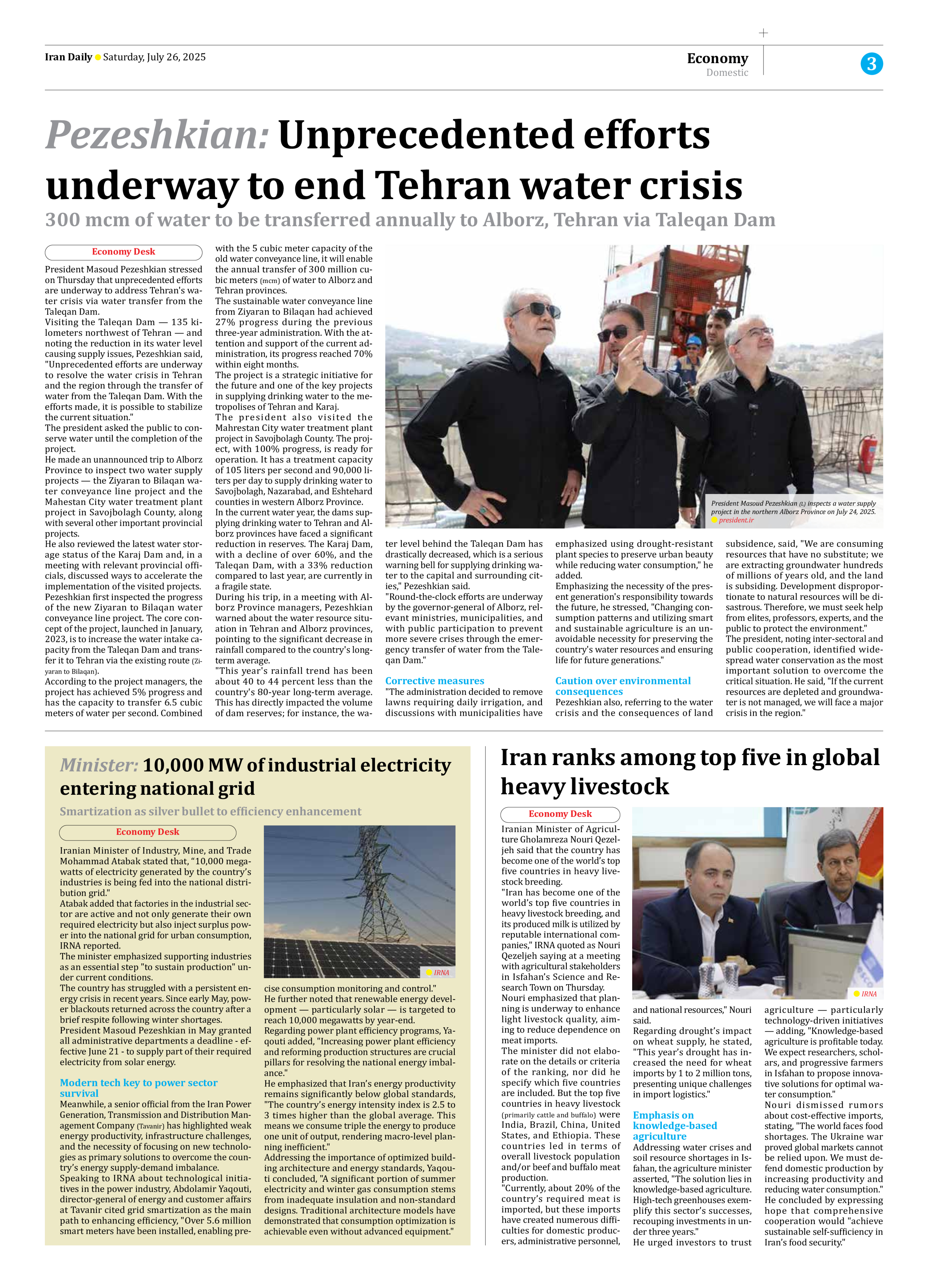
Iranian Minister of Industry, Mine, and Trade Mohammad Atabak stated that, “10,000 megawatts of electricity generated by the country’s industries is being fed into the national distribution grid."
Atabak added that factories in the industrial sector are active and not only generate their own required electricity but also inject surplus power into the national grid for urban consumption, IRNA reported.
The minister emphasized supporting industries as an essential step "to sustain production" under current conditions.
The country has struggled with a persistent energy crisis in recent years. Since early May, power blackouts returned across the country after a brief respite following winter shortages.
President Masoud Pezeshkian in May granted all administrative departments a deadline - effective June 21 - to supply part of their required electricity from solar energy.
Modern tech key to power sector survival
Meanwhile, a senior official from the Iran Power Generation, Transmission and Distribution Management Company (Tavanir) has highlighted weak energy productivity, infrastructure challenges, and the necessity of focusing on new technologies as primary solutions to overcome the country’s energy supply-demand imbalance.
Speaking to IRNA about technological initiatives in the power industry, Abdolamir Yaqouti, director-general of energy and customer affairs at Tavanir cited grid smartization as the main path to enhancing efficiency, "Over 5.6 million smart meters have been installed, enabling precise consumption monitoring and control."
He further noted that renewable energy development — particularly solar — is targeted to reach 10,000 megawatts by year-end.
Regarding power plant efficiency programs, Yaqouti added, "Increasing power plant efficiency and reforming production structures are crucial pillars for resolving the national energy imbalance."
He emphasized that Iran’s energy productivity remains significantly below global standards, "The country’s energy intensity index is 2.5 to 3 times higher than the global average. This means we consume triple the energy to produce one unit of output, rendering macro-level planning inefficient."
Addressing the importance of optimized building architecture and energy standards, Yaqouti concluded, "A significant portion of summer electricity and winter gas consumption stems from inadequate insulation and non-standard designs. Traditional architecture models have demonstrated that consumption optimization is achievable even without advanced equipment."