







Pezeshkian: Unprecedented efforts underway to end Tehran water crisis
300 mcm of water to be transferred annually to Alborz, Tehran via Taleqan Dam
President Masoud Pezeshkian stressed on Thursday that unprecedented efforts are underway to address Tehran's water crisis via water transfer from the Taleqan Dam.
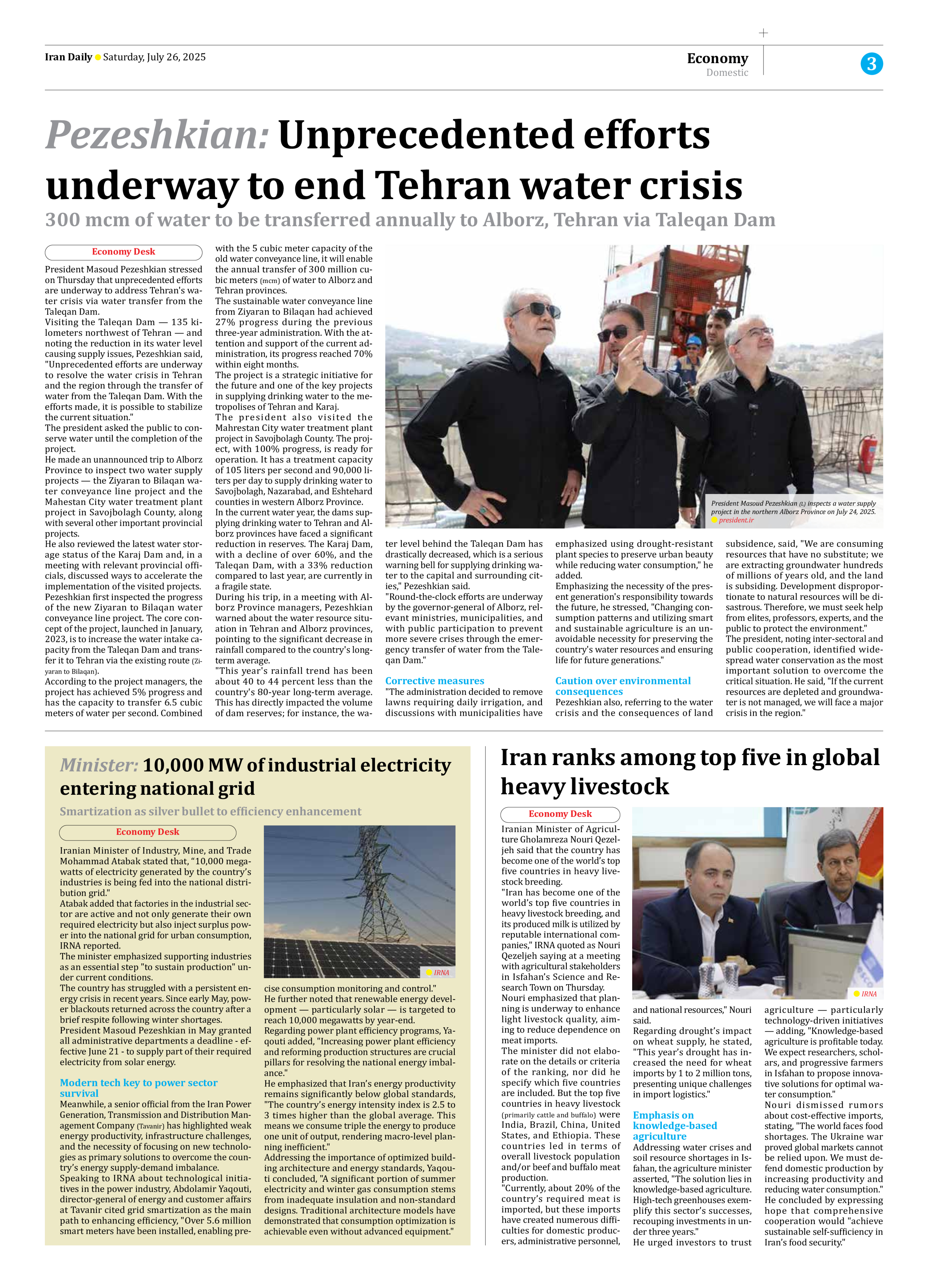
Visiting the Taleqan Dam — 135 kilometers northwest of Tehran — and noting the reduction in its water level causing supply issues, Pezeshkian said, "Unprecedented efforts are underway to resolve the water crisis in Tehran and the region through the transfer of water from the Taleqan Dam. With the efforts made, it is possible to stabilize the current situation."
The president asked the public to conserve water until the completion of the project.
He made an unannounced trip to Alborz Province to inspect two water supply projects — the Ziyaran to Bilaqan water conveyance line project and the Mahestan City water treatment plant project in Savojbolagh County, along with several other important provincial projects.
He also reviewed the latest water storage status of the Karaj Dam and, in a meeting with relevant provincial officials, discussed ways to accelerate the implementation of the visited projects.
Pezeshkian first inspected the progress of the new Ziyaran to Bilaqan water conveyance line project. The core concept of the project, launched in January, 2023, is to increase the water intake capacity from the Taleqan Dam and transfer it to Tehran via the existing route (Ziyaran to Bilaqan).
According to the project managers, the project has achieved 5% progress and has the capacity to transfer 6.5 cubic meters of water per second. Combined with the 5 cubic meter capacity of the old water conveyance line, it will enable the annual transfer of 300 million cubic meters (mcm) of water to Alborz and Tehran provinces.
The sustainable water conveyance line from Ziyaran to Bilaqan had achieved 27% progress during the previous three-year administration. With the attention and support of the current administration, its progress reached 70% within eight months.
The project is a strategic initiative for the future and one of the key projects in supplying drinking water to the metropolises of Tehran and Karaj.
The president also visited the Mahrestan City water treatment plant project in Savojbolagh County. The project, with 100% progress, is ready for operation. It has a treatment capacity of 105 liters per second and 90,000 liters per day to supply drinking water to Savojbolagh, Nazarabad, and Eshtehard counties in western Alborz Province.
In the current water year, the dams supplying drinking water to Tehran and Alborz provinces have faced a significant reduction in reserves. The Karaj Dam, with a decline of over 60%, and the Taleqan Dam, with a 33% reduction compared to last year, are currently in a fragile state.
During his trip, in a meeting with Alborz Province managers, Pezeshkian warned about the water resource situation in Tehran and Alborz provinces, pointing to the significant decrease in rainfall compared to the country's long-term average.
"This year's rainfall trend has been about 40 to 44 percent less than the country's 80-year long-term average. This has directly impacted the volume of dam reserves; for instance, the water level behind the Taleqan Dam has drastically decreased, which is a serious warning bell for supplying drinking water to the capital and surrounding cities," Pezeshkian said.
"Round-the-clock efforts are underway by the governor-general of Alborz, relevant ministries, municipalities, and with public participation to prevent more severe crises through the emergency transfer of water from the Taleqan Dam."
Corrective measures
"The administration decided to remove lawns requiring daily irrigation, and discussions with municipalities have emphasized using drought-resistant plant species to preserve urban beauty while reducing water consumption," he added.
Emphasizing the necessity of the present generation's responsibility towards the future, he stressed, "Changing consumption patterns and utilizing smart and sustainable agriculture is an unavoidable necessity for preserving the country's water resources and ensuring life for future generations."
Caution over environmental consequences
Pezeshkian also, referring to the water crisis and the consequences of land subsidence, said, "We are consuming resources that have no substitute; we are extracting groundwater hundreds of millions of years old, and the land is subsiding. Development disproportionate to natural resources will be disastrous. Therefore, we must seek help from elites, professors, experts, and the public to protect the environment."
The president, noting inter-sectoral and public cooperation, identified widespread water conservation as the most important solution to overcome the critical situation. He said, "If the current resources are depleted and groundwater is not managed, we will face a major crisis in the region."