







Copy in clipboard...
ISO renames Arabic transliteration standard to ‘Perso-Arabic’
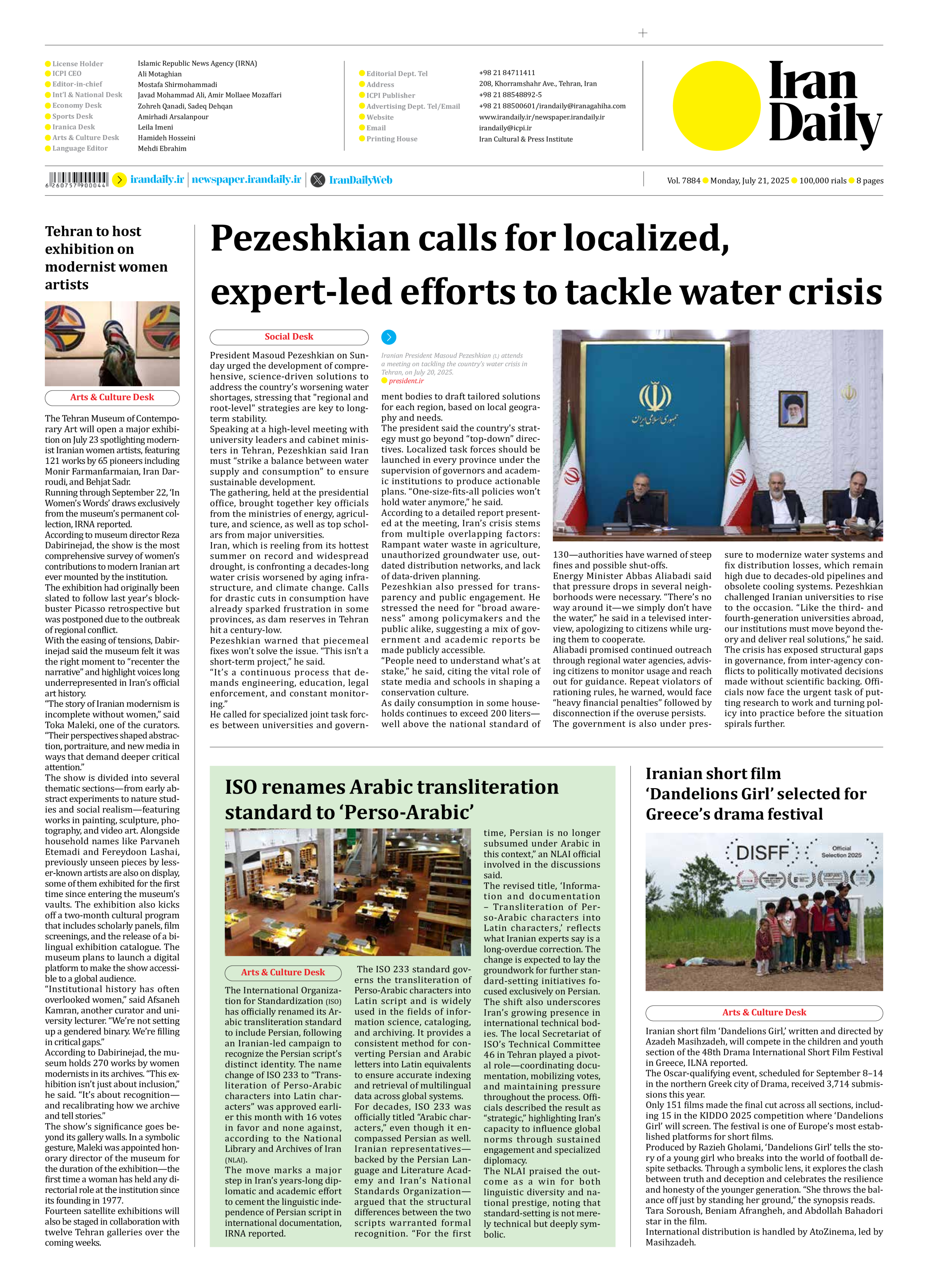
The International Organization for Standardization (ISO) has officially renamed its Arabic transliteration standard to include Persian, following an Iranian-led campaign to recognize the Persian script’s distinct identity. The name change of ISO 233 to “Transliteration of Perso-Arabic characters into Latin characters” was approved earlier this month with 16 votes in favor and none against, according to the National Library and Archives of Iran (NLAI).
The move marks a major step in Iran’s years-long diplomatic and academic effort to cement the linguistic independence of Persian script in international documentation, IRNA reported.
The ISO 233 standard governs the transliteration of Perso-Arabic characters into Latin script and is widely used in the fields of information science, cataloging, and archiving. It provides a consistent method for converting Persian and Arabic letters into Latin equivalents to ensure accurate indexing and retrieval of multilingual data across global systems.
For decades, ISO 233 was officially titled “Arabic characters,” even though it encompassed Persian as well. Iranian representatives—backed by the Persian Language and Literature Academy and Iran’s National Standards Organization—argued that the structural differences between the two scripts warranted formal recognition. “For the first time, Persian is no longer subsumed under Arabic in this context,” an NLAI official involved in the discussions said.
The revised title, ‘Information and documentation – Transliteration of Perso-Arabic characters into Latin characters,’ reflects what Iranian experts say is a long-overdue correction. The change is expected to lay the groundwork for further standard-setting initiatives focused exclusively on Persian.
The shift also underscores Iran’s growing presence in international technical bodies. The local Secretariat of ISO’s Technical Committee 46 in Tehran played a pivotal role—coordinating documentation, mobilizing votes, and maintaining pressure throughout the process. Officials described the result as “strategic,” highlighting Iran’s capacity to influence global norms through sustained engagement and specialized diplomacy.
The NLAI praised the outcome as a win for both linguistic diversity and national prestige, noting that standard-setting is not merely technical but deeply symbolic.