





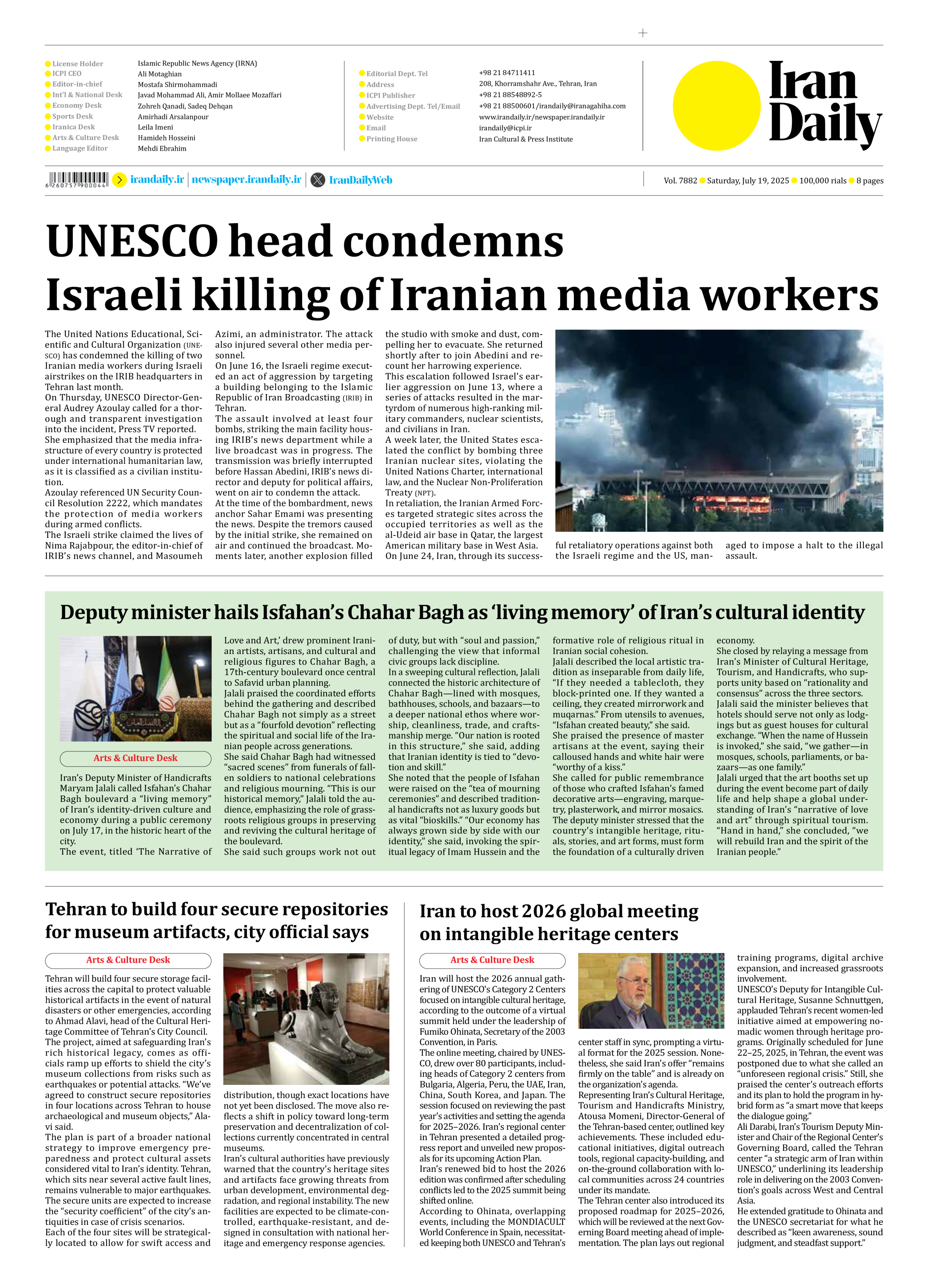


Iran to host 2026 global meeting on intangible heritage centers
Iran will host the 2026 annual gathering of UNESCO's Category 2 Centers focused on intangible cultural heritage, according to the outcome of a virtual summit held under the leadership of Fumiko Ohinata, Secretary of the 2003 Convention, in Paris.
The online meeting, chaired by UNESCO, drew over 80 participants, including heads of Category 2 centers from Bulgaria, Algeria, Peru, the UAE, Iran, China, South Korea, and Japan. The session focused on reviewing the past year’s activities and setting the agenda for 2025–2026. Iran’s regional center in Tehran presented a detailed progress report and unveiled new proposals for its upcoming Action Plan.
Iran’s renewed bid to host the 2026 edition was confirmed after scheduling conflicts led to the 2025 summit being shifted online.
According to Ohinata, overlapping events, including the MONDIACULT World Conference in Spain, necessitated keeping both UNESCO and Tehran’s center staff in sync, prompting a virtual format for the 2025 session. Nonetheless, she said Iran's offer “remains firmly on the table” and is already on the organization’s agenda.
Representing Iran’s Cultural Heritage, Tourism and Handicrafts Ministry, Atousa Momeni, Director-General of the Tehran-based center, outlined key achievements. These included educational initiatives, digital outreach tools, regional capacity-building, and on-the-ground collaboration with local communities across 24 countries under its mandate.
The Tehran center also introduced its proposed roadmap for 2025–2026, which will be reviewed at the next Governing Board meeting ahead of implementation. The plan lays out regional training programs, digital archive expansion, and increased grassroots involvement.
UNESCO’s Deputy for Intangible Cultural Heritage, Susanne Schnuttgen, applauded Tehran’s recent women-led initiative aimed at empowering nomadic women through heritage programs. Originally scheduled for June 22–25, 2025, in Tehran, the event was postponed due to what she called an “unforeseen regional crisis.” Still, she praised the center's outreach efforts and its plan to hold the program in hybrid form as “a smart move that keeps the dialogue going.”
Ali Darabi, Iran’s Tourism Deputy Minister and Chair of the Regional Center’s Governing Board, called the Tehran center “a strategic arm of Iran within UNESCO,” underlining its leadership role in delivering on the 2003 Convention’s goals across West and Central Asia.
He extended gratitude to Ohinata and the UNESCO secretariat for what he described as “keen awareness, sound judgment, and steadfast support.”