







Copy in clipboard...
Deputy minister hails Isfahan’s Chahar Bagh as ‘living memory’ of Iran’s cultural identity
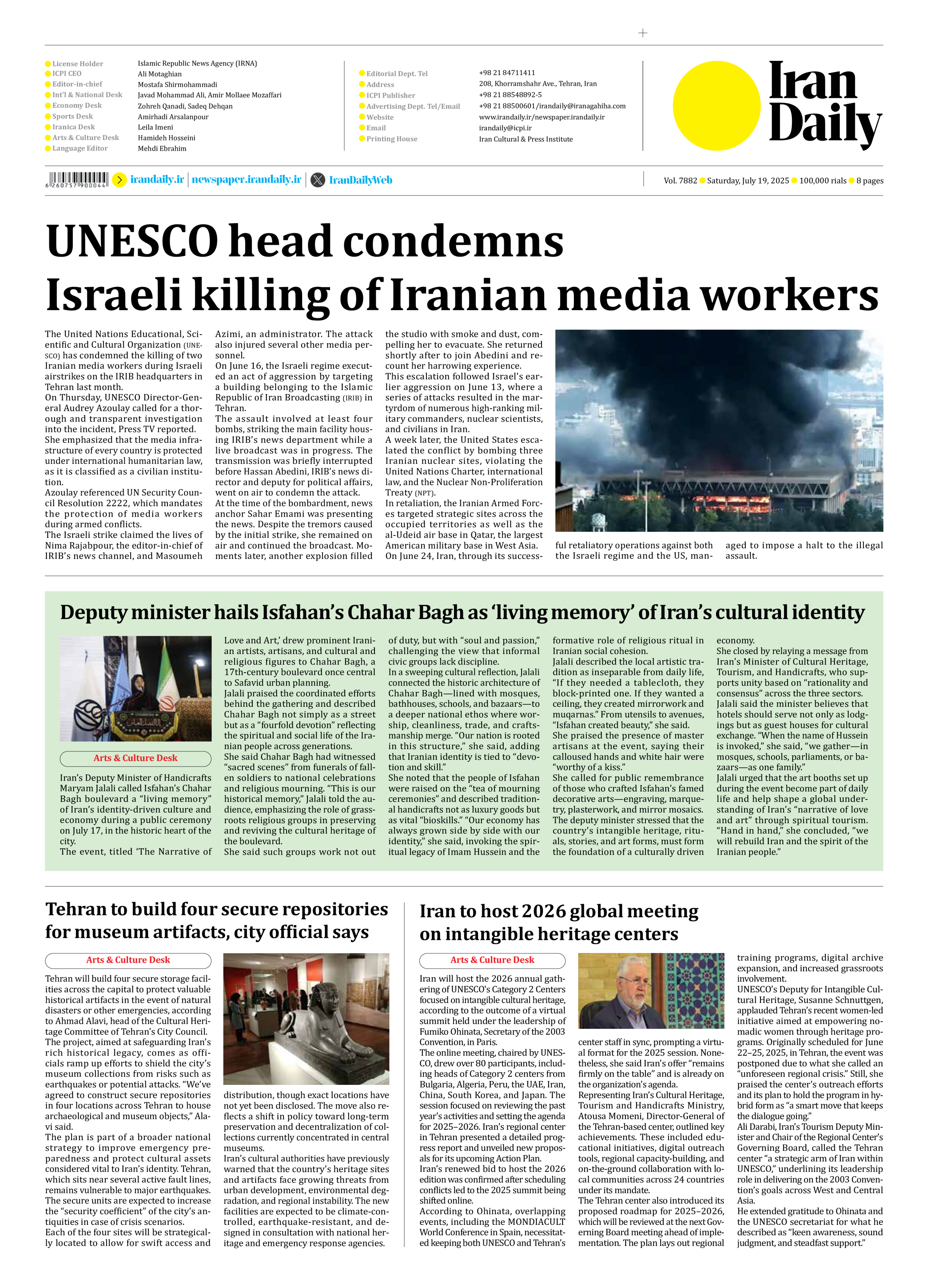
Iran’s Deputy Minister of Handicrafts Maryam Jalali called Isfahan’s Chahar Bagh boulevard a “living memory” of Iran’s identity-driven culture and economy during a public ceremony on July 17, in the historic heart of the city.
The event, titled ‘The Narrative of Love and Art,’ drew prominent Iranian artists, artisans, and cultural and religious figures to Chahar Bagh, a 17th-century boulevard once central to Safavid urban planning.
Jalali praised the coordinated efforts behind the gathering and described Chahar Bagh not simply as a street but as a “fourfold devotion” reflecting the spiritual and social life of the Iranian people across generations.
She said Chahar Bagh had witnessed “sacred scenes” from funerals of fallen soldiers to national celebrations and religious mourning. “This is our historical memory,” Jalali told the audience, emphasizing the role of grassroots religious groups in preserving and reviving the cultural heritage of the boulevard.
She said such groups work not out of duty, but with “soul and passion,” challenging the view that informal civic groups lack discipline.
In a sweeping cultural reflection, Jalali connected the historic architecture of Chahar Bagh—lined with mosques, bathhouses, schools, and bazaars—to a deeper national ethos where worship, cleanliness, trade, and craftsmanship merge. “Our nation is rooted in this structure,” she said, adding that Iranian identity is tied to “devotion and skill.”
She noted that the people of Isfahan were raised on the “tea of mourning ceremonies” and described traditional handicrafts not as luxury goods but as vital “bioskills.” “Our economy has always grown side by side with our identity,” she said, invoking the spiritual legacy of Imam Hussein and the formative role of religious ritual in Iranian social cohesion.
Jalali described the local artistic tradition as inseparable from daily life, “If they needed a tablecloth, they block-printed one. If they wanted a ceiling, they created mirrorwork and muqarnas.” From utensils to avenues, “Isfahan created beauty,” she said.
She praised the presence of master artisans at the event, saying their calloused hands and white hair were “worthy of a kiss.”
She called for public remembrance of those who crafted Isfahan’s famed decorative arts—engraving, marquetry, plasterwork, and mirror mosaics.
The deputy minister stressed that the country's intangible heritage, rituals, stories, and art forms, must form the foundation of a culturally driven economy.
She closed by relaying a message from Iran’s Minister of Cultural Heritage, Tourism, and Handicrafts, who supports unity based on “rationality and consensus” across the three sectors.
Jalali said the minister believes that hotels should serve not only as lodgings but as guest houses for cultural exchange. “When the name of Hussein is invoked,” she said, “we gather—in mosques, schools, parliaments, or bazaars—as one family.”
Jalali urged that the art booths set up during the event become part of daily life and help shape a global understanding of Iran’s “narrative of love and art” through spiritual tourism. “Hand in hand,” she concluded, “we will rebuild Iran and the spirit of the Iranian people.”