







Copy in clipboard...
Top EU diplomat: Return to diplomacy on Iran’s nuclear file to benefit bloc
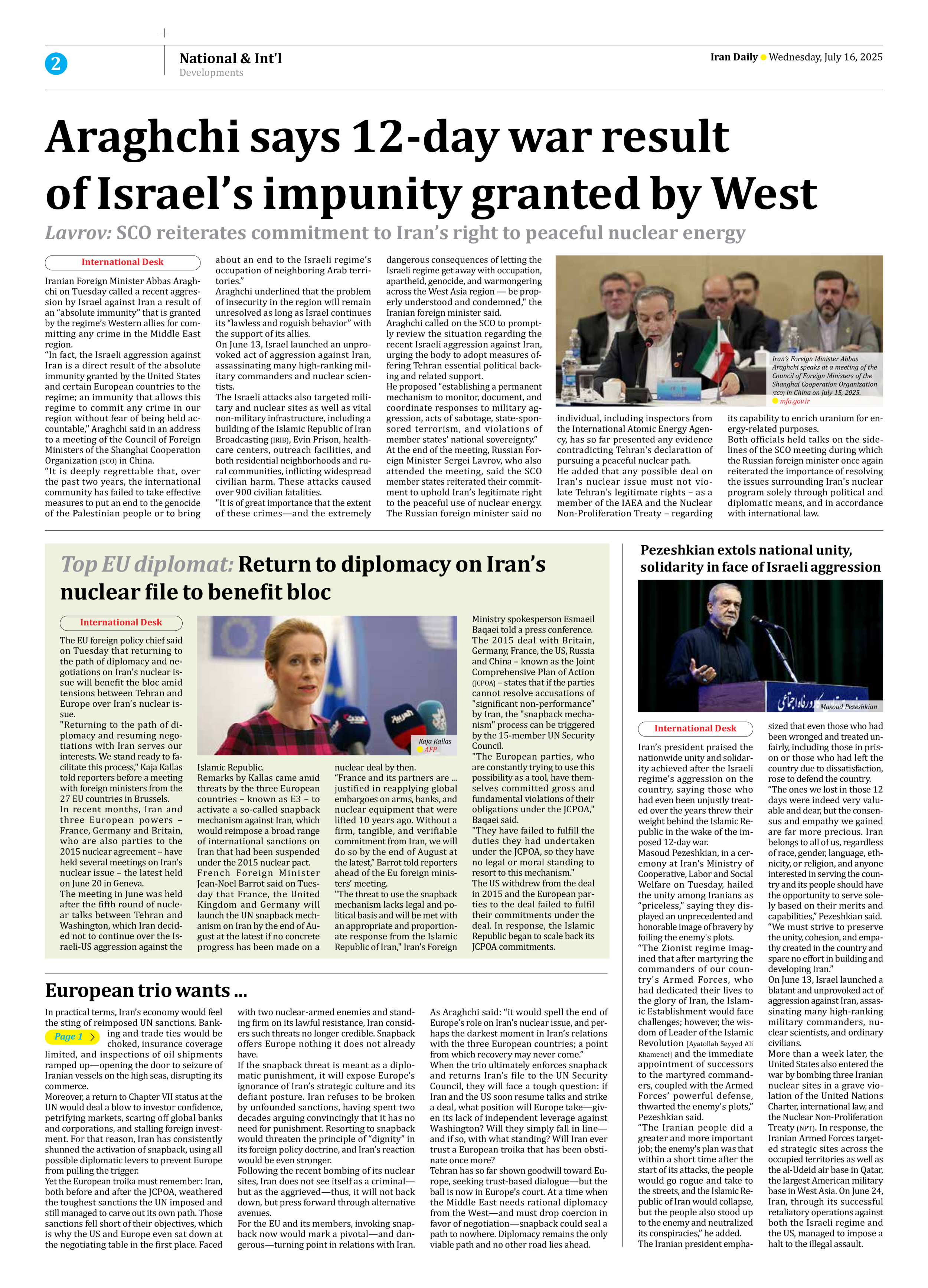
The EU foreign policy chief said on Tuesday that returning to the path of diplomacy and negotiations on Iran's nuclear issue will benefit the bloc amid tensions between Tehran and Europe over Iran’s nuclear issue.
"Returning to the path of diplomacy and resuming negotiations with Iran serves our interests. We stand ready to facilitate this process," Kaja Kallas told reporters before a meeting with foreign ministers from the 27 EU countries in Brussels.
In recent months, Iran and three European powers – France, Germany and Britain, who are also parties to the 2015 nuclear agreement – have held several meetings on Iran’s nuclear issue – the latest held on June 20 in Geneva.
The meeting in June was held after the fifth round of nuclear talks between Tehran and Washington, which Iran decided not to continue over the Israeli-US aggression against the Islamic Republic.
Remarks by Kallas came amid threats by the three European countries – known as E3 – to activate a so-called snapback mechanism against Iran, which would reimpose a broad range of international sanctions on Iran that had been suspended under the 2015 nuclear pact.
French Foreign Minister Jean-Noel Barrot said on Tuesday that France, the United Kingdom and Germany will launch the UN snapback mechanism on Iran by the end of August at the latest if no concrete progress has been made on a nuclear deal by then.
“France and its partners are ... justified in reapplying global embargoes on arms, banks, and nuclear equipment that were lifted 10 years ago. Without a firm, tangible, and verifiable commitment from Iran, we will do so by the end of August at the latest,” Barrot told reporters ahead of the Eu foreign ministers’ meeting.
"The threat to use the snapback mechanism lacks legal and political basis and will be met with an appropriate and proportionate response from the Islamic Republic of Iran," Iran’s Foreign Ministry spokesperson Esmaeil Baqaei told a press conference.
The 2015 deal with Britain, Germany, France, the US, Russia and China – known as the Joint Comprehensive Plan of Action (JCPOA) – states that if the parties cannot resolve accusations of "significant non-performance" by Iran, the "snapback mechanism" process can be triggered by the 15-member UN Security Council.
"The European parties, who are constantly trying to use this possibility as a tool, have themselves committed gross and fundamental violations of their obligations under the JCPOA," Baqaei said.
"They have failed to fulfill the duties they had undertaken under the JCPOA, so they have no legal or moral standing to resort to this mechanism."
The US withdrew from the deal in 2015 and the European parties to the deal failed to fulfil their commitments under the deal. In response, the Islamic Republic began to scale back its JCPOA commitments.