







Araghchi says 12-day war result of Israel’s impunity granted by West
Lavrov: SCO reiterates commitment to Iran’s right to peaceful nuclear energy
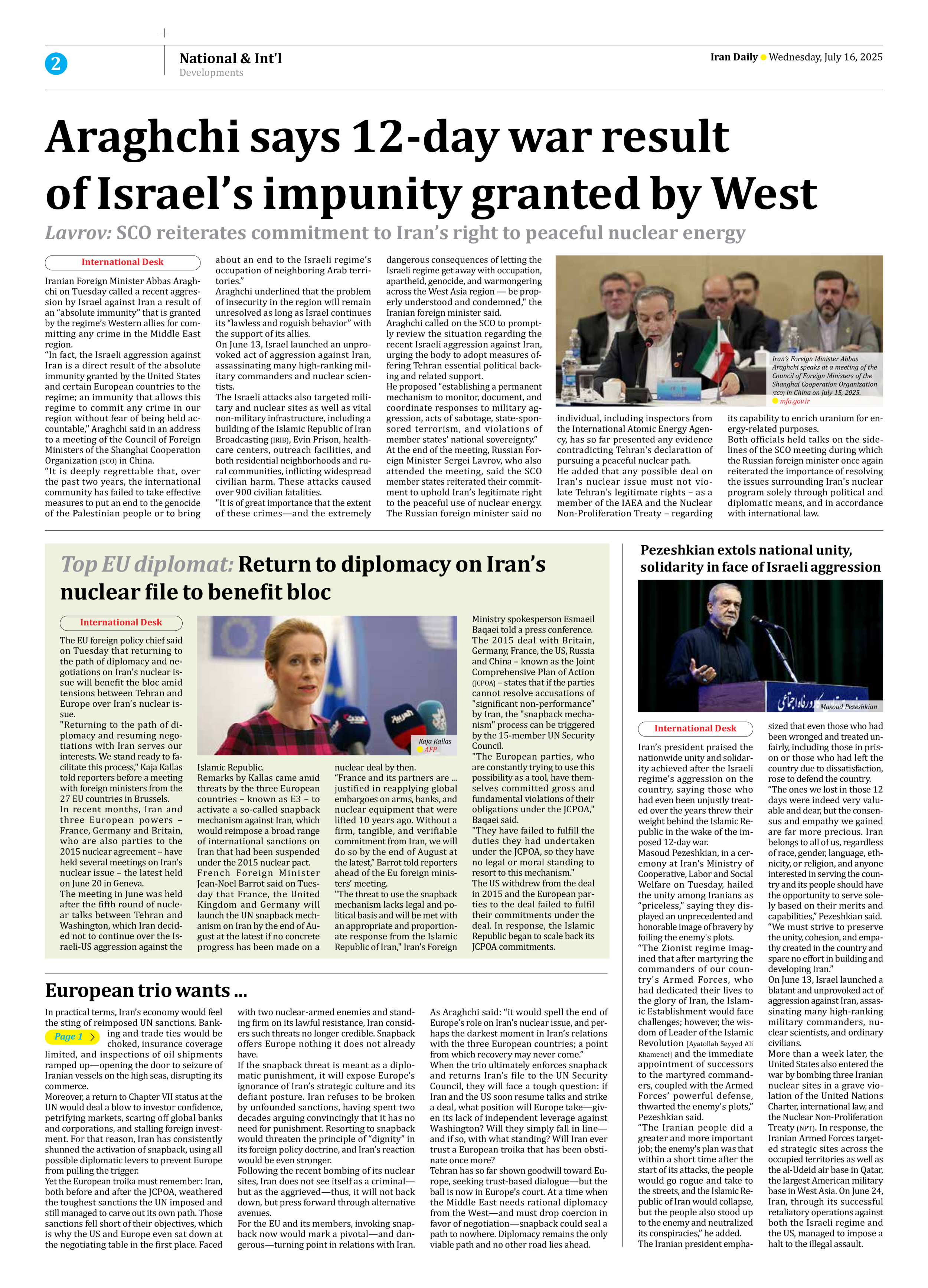
Iranian Foreign Minister Abbas Araghchi on Tuesday called a recent aggression by Israel against Iran a result of an “absolute immunity” that is granted by the regime’s Western allies for committing any crime in the Middle East region.
“In fact, the Israeli aggression against Iran is a direct result of the absolute immunity granted by the United States and certain European countries to the regime; an immunity that allows this regime to commit any crime in our region without fear of being held accountable," Araghchi said in an address to a meeting of the Council of Foreign Ministers of the Shanghai Cooperation Organization (SCO) in China.
“It is deeply regrettable that, over the past two years, the international community has failed to take effective measures to put an end to the genocide of the Palestinian people or to bring about an end to the Israeli regime’s occupation of neighboring Arab territories.”
Araghchi underlined that the problem of insecurity in the region will remain unresolved as long as Israel continues its “lawless and roguish behavior” with the support of its allies.
On June 13, Israel launched an unprovoked act of aggression against Iran, assassinating many high-ranking military commanders and nuclear scientists.
The Israeli attacks also targeted military and nuclear sites as well as vital non-military infrastructure, including a building of the Islamic Republic of Iran Broadcasting (IRIB), Evin Prison, healthcare centers, outreach facilities, and both residential neighborhoods and rural communities, inflicting widespread civilian harm. These attacks caused over 900 civilian fatalities.
"It is of great importance that the extent of these crimes—and the extremely dangerous consequences of letting the Israeli regime get away with occupation, apartheid, genocide, and warmongering across the West Asia region — be properly understood and condemned," the Iranian foreign minister said.
Araghchi called on the SCO to promptly review the situation regarding the recent Israeli aggression against Iran, urging the body to adopt measures offering Tehran essential political backing and related support.
He proposed “establishing a permanent mechanism to monitor, document, and coordinate responses to military aggression, acts of sabotage, state-sponsored terrorism, and violations of member states' national sovereignty.”
At the end of the meeting, Russian Foreign Minister Sergei Lavrov, who also attended the meeting, said the SCO member states reiterated their commitment to uphold Iran’s legitimate right to the peaceful use of nuclear energy. The Russian foreign minister said no individual, including inspectors from the International Atomic Energy Agency, has so far presented any evidence contradicting Tehran's declaration of pursuing a peaceful nuclear path.
He added that any possible deal on Iran's nuclear issue must not violate Tehran's legitimate rights – as a member of the IAEA and the Nuclear Non-Proliferation Treaty – regarding its capability to enrich uranium for energy-related purposes.
Both officials held talks on the sidelines of the SCO meeting during which the Russian foreign minister once again reiterated the importance of resolving the issues surrounding Iran's nuclear program solely through political and diplomatic means, and in accordance with international law.