







Iran warns aggression on OPEC states violates law, threatens global energy supply
Iranian Oil Minister Mohsen Paknejad told an OPEC seminar that aggression against energy producers violates international law and threatens global stability, emphasizing that the global energy industry—especially oil—requires peace and stability to fulfill its role in safeguarding welfare at national, regional, and global levels in modern world.
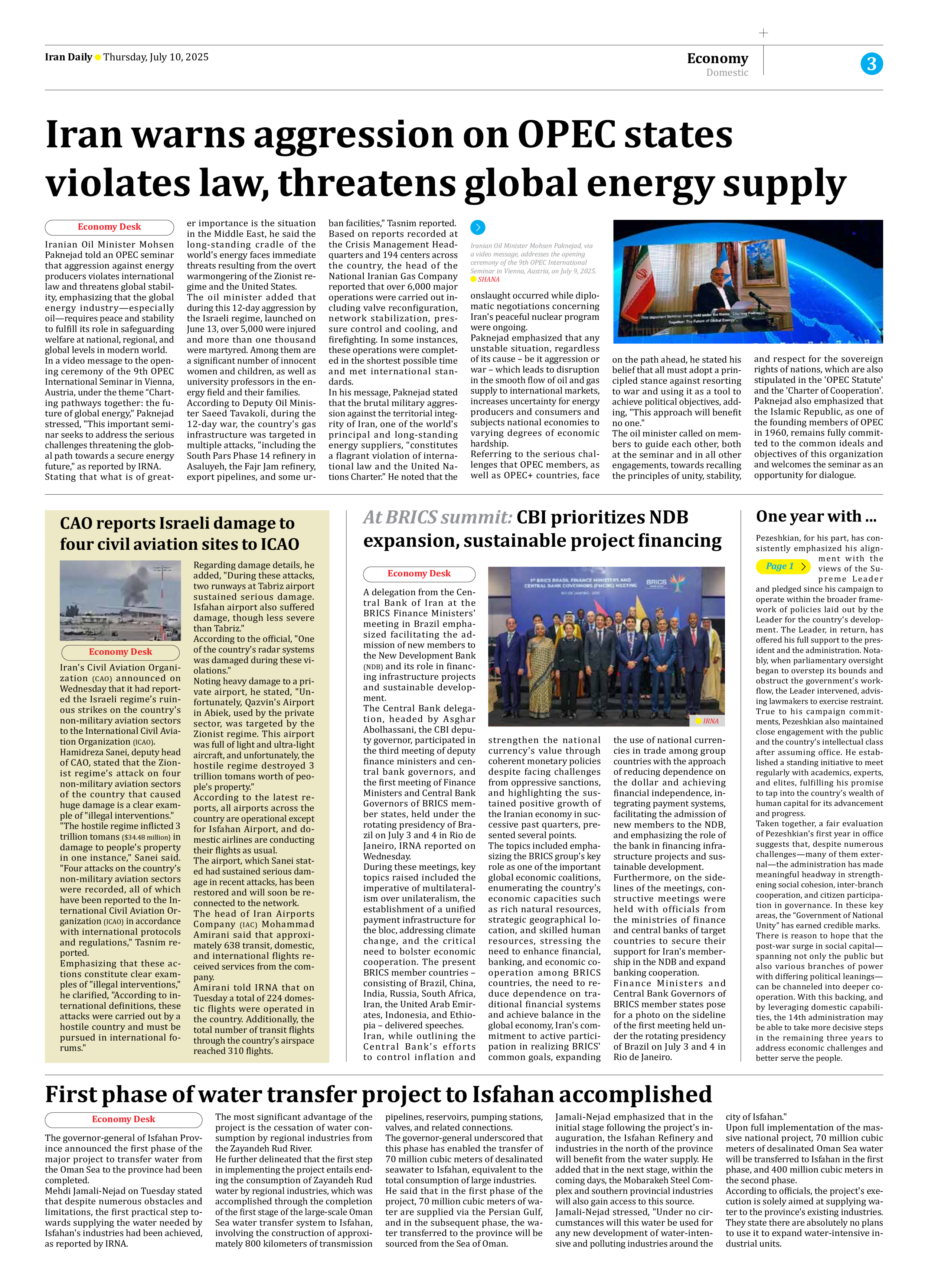
In a video message to the opening ceremony of the 9th OPEC International Seminar in Vienna, Austria, under the theme “Charting pathways together: the future of global energy,” Paknejad stressed, "This important seminar seeks to address the serious challenges threatening the global path towards a secure energy future," as reported by IRNA.
Stating that what is of greater importance is the situation in the Middle East, he said the long-standing cradle of the world's energy faces immediate threats resulting from the overt warmongering of the Zionist regime and the United States.
The oil minister added that during this 12-day aggression by the Israeli regime, launched on June 13, over 5,000 were injured and more than one thousand were martyred. Among them are a significant number of innocent women and children, as well as university professors in the energy field and their families.
According to Deputy Oil Minister Saeed Tavakoli, during the 12-day war, the country's gas infrastructure was targeted in multiple attacks, "including the South Pars Phase 14 refinery in Asaluyeh, the Fajr Jam refinery, export pipelines, and some urban facilities," Tasnim reported.
Based on reports recorded at the Crisis Management Headquarters and 194 centers across the country, the head of the National Iranian Gas Company reported that over 6,000 major operations were carried out including valve reconfiguration, network stabilization, pressure control and cooling, and firefighting. In some instances, these operations were completed in the shortest possible time and met international standards.
In his message, Paknejad stated that the brutal military aggression against the territorial integrity of Iran, one of the world's principal and long-standing energy suppliers, “constitutes a flagrant violation of international law and the United Nations Charter." He noted that the onslaught occurred while diplomatic negotiations concerning Iran's peaceful nuclear program were ongoing.
Paknejad emphasized that any unstable situation, regardless of its cause – be it aggression or war – which leads to disruption in the smooth flow of oil and gas supply to international markets, increases uncertainty for energy producers and consumers and subjects national economies to varying degrees of economic hardship.
Referring to the serious challenges that OPEC members, as well as OPEC+ countries, face on the path ahead, he stated his belief that all must adopt a principled stance against resorting to war and using it as a tool to achieve political objectives, adding, "This approach will benefit no one."
The oil minister called on members to guide each other, both at the seminar and in all other engagements, towards recalling the principles of unity, stability, and respect for the sovereign rights of nations, which are also stipulated in the 'OPEC Statute' and the 'Charter of Cooperation'.
Paknejad also emphasized that the Islamic Republic, as one of the founding members of OPEC in 1960, remains fully committed to the common ideals and objectives of this organization and welcomes the seminar as an opportunity for dialogue.