







VP urges policy revision as public, opposition unite in Iran’s defense
Iran's First Vice President Mohammadreza Aref on Sunday said the unprecedented national unity following Israeli airstrikes earlier, drawing support even from opposition groups, signals the urgent need to “revisit and revise” four decades of domestic policies.
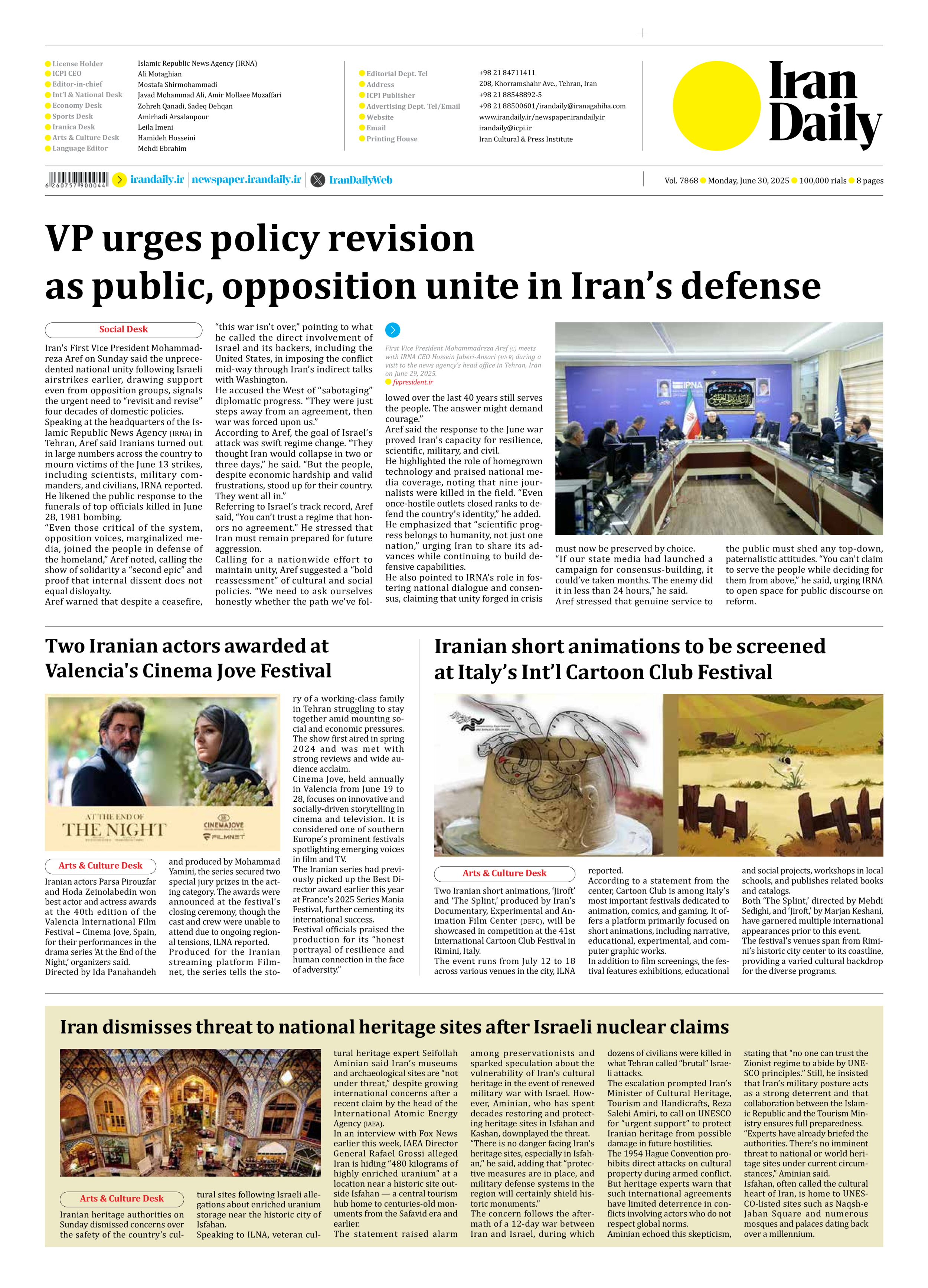
Speaking at the headquarters of the Islamic Republic News Agency (IRNA) in Tehran, Aref said Iranians turned out in large numbers across the country to mourn victims of the June 13 strikes, including scientists, military commanders, and civilians, IRNA reported.
He likened the public response to the funerals of top officials killed in June 28, 1981 bombing.
“Even those critical of the system, opposition voices, marginalized media, joined the people in defense of the homeland,” Aref noted, calling the show of solidarity a “second epic” and proof that internal dissent does not equal disloyalty.
Aref warned that despite a ceasefire, “this war isn’t over,” pointing to what he called the direct involvement of Israel and its backers, including the United States, in imposing the conflict mid-way through Iran’s indirect talks with Washington.
He accused the West of “sabotaging” diplomatic progress. “They were just steps away from an agreement, then war was forced upon us.”
According to Aref, the goal of Israel’s attack was swift regime change. “They thought Iran would collapse in two or three days,” he said. “But the people, despite economic hardship and valid frustrations, stood up for their country. They went all in.”
Referring to Israel’s track record, Aref said, “You can’t trust a regime that honors no agreement.” He stressed that Iran must remain prepared for future aggression.
Calling for a nationwide effort to maintain unity, Aref suggested a “bold reassessment” of cultural and social policies. “We need to ask ourselves honestly whether the path we've followed over the last 40 years still serves the people. The answer might demand courage.”
Aref said the response to the June war proved Iran’s capacity for resilience, scientific, military, and civil.
He highlighted the role of homegrown technology and praised national media coverage, noting that nine journalists were killed in the field. “Even once-hostile outlets closed ranks to defend the country’s identity,” he added.
He emphasized that “scientific progress belongs to humanity, not just one nation,” urging Iran to share its advances while continuing to build defensive capabilities.
He also pointed to IRNA’s role in fostering national dialogue and consensus, claiming that unity forged in crisis must now be preserved by choice.
“If our state media had launched a campaign for consensus-building, it could’ve taken months. The enemy did it in less than 24 hours,” he said.
Aref stressed that genuine service to the public must shed any top-down, paternalistic attitudes. “You can’t claim to serve the people while deciding for them from above,” he said, urging IRNA to open space for public discourse on reform.