







Echoes of faith in bricks, tiles of mosques in Yazd
The old mosques of Yazd Province are among the most fascinating heritage sites left behind by past generations. In addition to their religious and devotional significance, they showcase the distinctive culture and unique architecture of the tasteful and art-loving people of Yazd.
In this region, there are numerous mosques that are historically, artistically, and architecturally important. These places are divided into two types: neighborhood mosques and grand mosques (Jaame). The first type is simple and unadorned, consisting of a dome chamber, a courtyard, a winter hall (Shabestan), and a heated room (Garmkhaneh) for the cold months.
The number of local neighborhood mosques is large, the most important of which include Koushk-e No, Tall, Posht-e Bagh, Sabat, Rig, Bayagh Khan, Zavieh, and Sheikh Dad, according to IRNA.
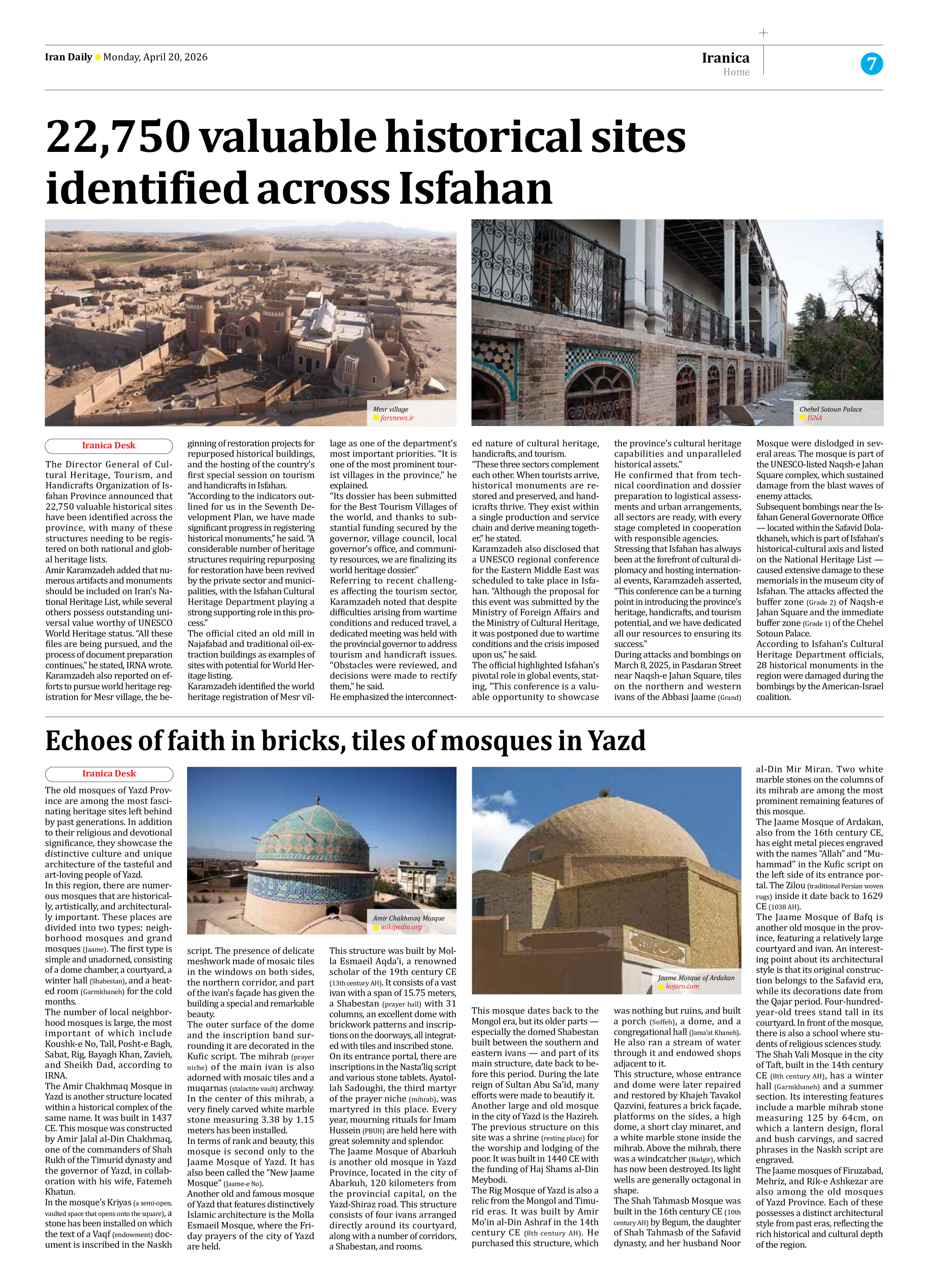
The Amir Chakhmaq Mosque in Yazd is another structure located within a historical complex of the same name. It was built in 1437 CE. This mosque was constructed by Amir Jalal al-Din Chakhmaq, one of the commanders of Shah Rukh of the Timurid dynasty and the governor of Yazd, in collaboration with his wife, Fatemeh Khatun.
In the mosque’s Kriyas (a semi-open, vaulted space that opens onto the square), a stone has been installed on which the text of a Vaqf (endowment) document is inscribed in the Naskh script. The presence of delicate meshwork made of mosaic tiles in the windows on both sides, the northern corridor, and part of the ivan’s façade has given the building a special and remarkable beauty.
The outer surface of the dome and the inscription band surrounding it are decorated in the Kufic script. The mihrab (prayer niche) of the main ivan is also adorned with mosaic tiles and a muqarnas (stalactite vault) archway. In the center of this mihrab, a very finely carved white marble stone measuring 3.38 by 1.15 meters has been installed.
In terms of rank and beauty, this mosque is second only to the Jaame Mosque of Yazd. It has also been called the “New Jaame Mosque” (Jaame-e No).
Another old and famous mosque of Yazd that features distinctively Islamic architecture is the Molla Esmaeil Mosque, where the Friday prayers of the city of Yazd are held.
This structure was built by Molla Esmaeil Aqda’i, a renowned scholar of the 19th century CE (13th century AH). It consists of a vast ivan with a span of 15.75 meters, a Shabestan (prayer hall) with 31 columns, an excellent dome with brickwork patterns and inscriptions on the doorways, all integrated with tiles and inscribed stone.
On its entrance portal, there are inscriptions in the Nasta’liq script and various stone tablets. Ayatollah Sadoughi, the third martyr of the prayer niche (mihrab), was martyred in this place. Every year, mourning rituals for Imam Hussein (PBUH) are held here with great solemnity and splendor.
The Jaame Mosque of Abarkuh is another old mosque in Yazd Province, located in the city of Abarkuh, 120 kilometers from the provincial capital, on the Yazd-Shiraz road. This structure consists of four ivans arranged directly around its courtyard, along with a number of corridors, a Shabestan, and rooms.
This mosque dates back to the Mongol era, but its older parts — especially the domed Shabestan built between the southern and eastern ivans — and part of its main structure, date back to before this period. During the late reign of Sultan Abu Sa’id, many efforts were made to beautify it.
Another large and old mosque in the city of Yazd is the Hazireh. The previous structure on this site was a shrine (resting place) for the worship and lodging of the poor. It was built in 1440 CE with the funding of Haj Shams al-Din Meybodi.
The Rig Mosque of Yazd is also a relic from the Mongol and Timurid eras. It was built by Amir Mo’in al-Din Ashraf in the 14th century CE (8th century AH). He purchased this structure, which was nothing but ruins, and built a porch (Soffeh), a dome, and a congregational hall (Jama’at Khaneh). He also ran a stream of water through it and endowed shops adjacent to it.
This structure, whose entrance and dome were later repaired and restored by Khajeh Tavakol Qazvini, features a brick façade, platforms on the sides, a high dome, a short clay minaret, and a white marble stone inside the mihrab. Above the mihrab, there was a windcatcher (Badgir), which has now been destroyed. Its light wells are generally octagonal in shape.
The Shah Tahmasb Mosque was built in the 16th century CE (10th century AH) by Begum, the daughter of Shah Tahmasb of the Safavid dynasty, and her husband Noor al-Din Mir Miran. Two white marble stones on the columns of its mihrab are among the most prominent remaining features of this mosque.
The Jaame Mosque of Ardakan, also from the 16th century CE, has eight metal pieces engraved with the names “Allah” and “Muhammad” in the Kufic script on the left side of its entrance portal. The Zilou (traditional Persian woven rugs) inside it date back to 1629 CE (1038 AH).
The Jaame Mosque of Bafq is another old mosque in the province, featuring a relatively large courtyard and ivan. An interesting point about its architectural style is that its original construction belongs to the Safavid era, while its decorations date from the Qajar period. Four-hundred-year-old trees stand tall in its courtyard. In front of the mosque, there is also a school where students of religious sciences study.
The Shah Vali Mosque in the city of Taft, built in the 14th century CE (8th century AH), has a winter hall (Garmkhaneh) and a summer section. Its interesting features include a marble mihrab stone measuring 125 by 64cm, on which a lantern design, floral and bush carvings, and sacred phrases in the Naskh script are engraved.
The Jaame mosques of Firuzabad, Mehriz, and Rik-e Ashkezar are also among the old mosques of Yazd Province. Each of these possesses a distinct architectural style from past eras, reflecting the rich historical and cultural depth of the region.