







22,750 valuable historical sites identified across Isfahan
The Director General of Cultural Heritage, Tourism, and Handicrafts Organization of Isfahan Province announced that 22,750 valuable historical sites have been identified across the province, with many of these structures needing to be registered on both national and global heritage lists.
Amir Karamzadeh added that numerous artifacts and monuments should be included on Iran’s National Heritage List, while several others possess outstanding universal value worthy of UNESCO World Heritage status. “All these files are being pursued, and the process of document preparation continues,” he stated, IRNA wrote.
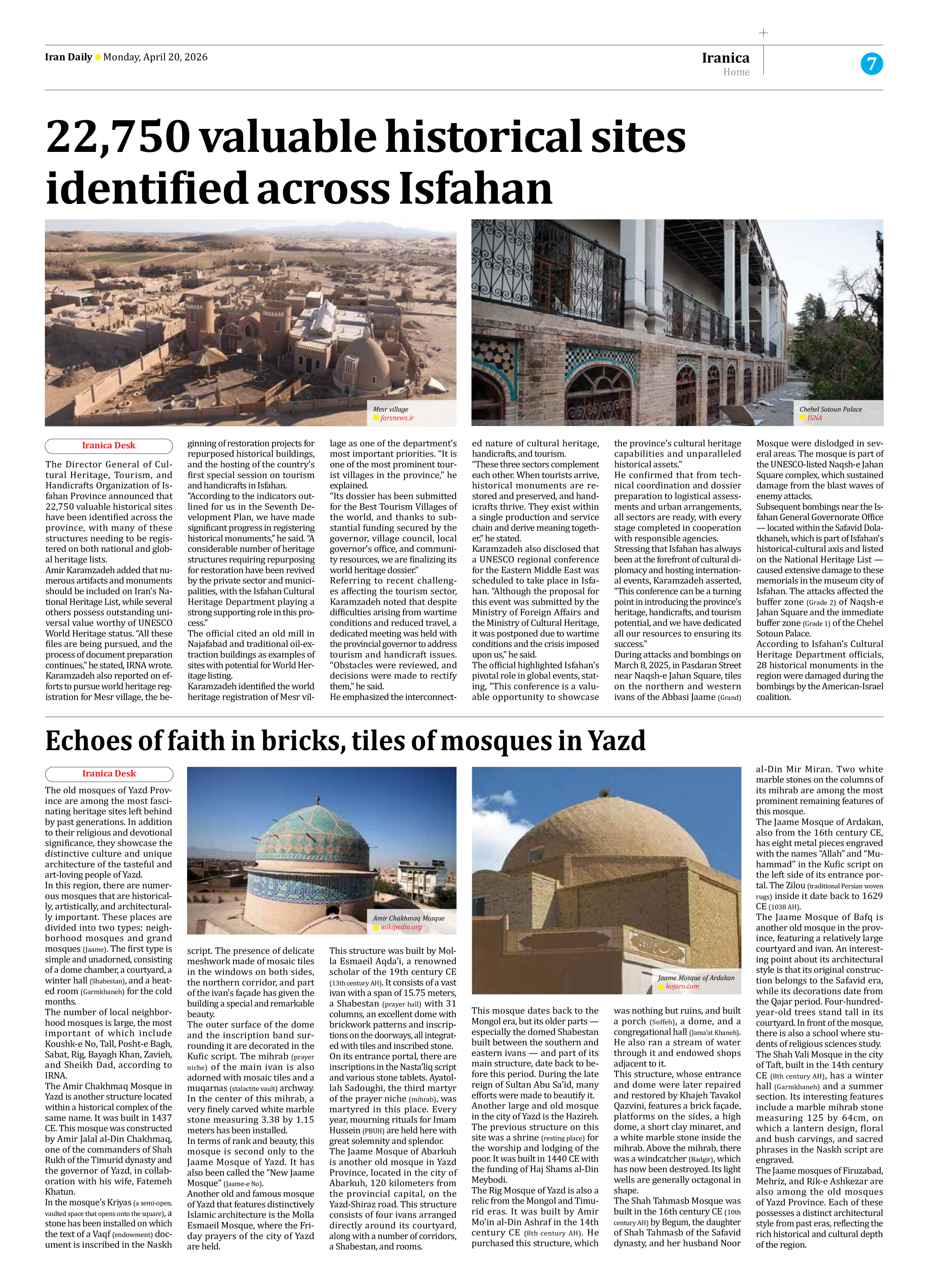
Karamzadeh also reported on efforts to pursue world heritage registration for Mesr village, the beginning of restoration projects for repurposed historical buildings, and the hosting of the country’s first special session on tourism and handicrafts in Isfahan.
“According to the indicators outlined for us in the Seventh Development Plan, we have made significant progress in registering historical monuments,” he said. “A considerable number of heritage structures requiring repurposing for restoration have been revived by the private sector and municipalities, with the Isfahan Cultural Heritage Department playing a strong supporting role in this process.”
The official cited an old mill in Najafabad and traditional oil-extraction buildings as examples of sites with potential for World Heritage listing.
Karamzadeh identified the world heritage registration of Mesr village as one of the department’s most important priorities. “It is one of the most prominent tourist villages in the province,” he explained.
“Its dossier has been submitted for the Best Tourism Villages of the world, and thanks to substantial funding secured by the governor, village council, local governor’s office, and community resources, we are finalizing its world heritage dossier.”
Referring to recent challenges affecting the tourism sector, Karamzadeh noted that despite difficulties arising from wartime conditions and reduced travel, a dedicated meeting was held with the provincial governor to address tourism and handicraft issues. “Obstacles were reviewed, and decisions were made to rectify them,” he said.
He emphasized the interconnected nature of cultural heritage, handicrafts, and tourism.
“These three sectors complement each other. When tourists arrive, historical monuments are restored and preserved, and handicrafts thrive. They exist within a single production and service chain and derive meaning together,” he stated.
Karamzadeh also disclosed that a UNESCO regional conference for the Eastern Middle East was scheduled to take place in Isfahan. “Although the proposal for this event was submitted by the Ministry of Foreign Affairs and the Ministry of Cultural Heritage, it was postponed due to wartime conditions and the crisis imposed upon us,” he said.
The official highlighted Isfahan’s pivotal role in global events, stating, “This conference is a valuable opportunity to showcase the province’s cultural heritage capabilities and unparalleled historical assets.”
He confirmed that from technical coordination and dossier preparation to logistical assessments and urban arrangements, all sectors are ready, with every stage completed in cooperation with responsible agencies.
Stressing that Isfahan has always been at the forefront of cultural diplomacy and hosting international events, Karamzadeh asserted, “This conference can be a turning point in introducing the province’s heritage, handicrafts, and tourism potential, and we have dedicated all our resources to ensuring its success.”
During attacks and bombings on March 8, 2025, in Pasdaran Street near Naqsh-e Jahan Square, tiles on the northern and western ivans of the Abbasi Jaame (Grand) Mosque were dislodged in several areas. The mosque is part of the UNESCO-listed Naqsh-e Jahan Square complex, which sustained damage from the blast waves of enemy attacks.
Subsequent bombings near the Isfahan General Governorate Office — located within the Safavid Dolatkhaneh, which is part of Isfahan’s historical-cultural axis and listed on the National Heritage List — caused extensive damage to these memorials in the museum city of Isfahan. The attacks affected the buffer zone (Grade 2) of Naqsh-e Jahan Square and the immediate buffer zone (Grade 1) of the Chehel Sotoun Palace.
According to Isfahan’s Cultural Heritage Department officials, 28 historical monuments in the region were damaged during the bombings by the American-Israel coalition.