







Khantakhti Bas-Relief draws visitors to northwestern Iran
A historical rock inscription has been discovered carved into the solid heart of Pir-e Chavush Mountain, located near the city of Salmas and close to the village of Khantakhti in northwestern province of West Azaraijan. The very existence of the Khantakhti stone inscription stands as a powerful testament to the authenticity, deep-rooted history, and cultural identity of this region of the country.
Carved during the Sassanid era, the inscription vividly depicts historical events and the conquests achieved by Iranians at that time. Recognized as a national heritage site, the Khantakhti inscription offers visitors a fascinating glimpse into one of the country’s most authentic historical attractions. It symbolizes the glory and pride of ancient Persia, as the engravings clearly represent a victory over Roman domination.
Access to the inscription has been made easy by the construction of a staircase built directly along the path, allowing tourists to view the carving up close and fully enjoy its immense historical significance.
According to detailed research, the Khantakhti inscription in Salmas dates back to the Sassanid period and the third century CE, making it approximately 1,800 years old. Numerous renowned archaeologists — including Carpenter, Flanders, Coste, de Morgan, Lehmann, and Walter Hintz — have studied and introduced these remarkable rock reliefs to the academic world.
The Romans repeatedly attacked this region over the centuries. During one such invasion, Emperor Julianus launched a direct assault on Salmas and brought the city under temporary Roman control. Those who, in their writings, referred to Salmas as “Gilia Kamus,” meaning “land of whole grains,” were among those who had occupied it.
However, in one of the most significant battles of the era, Ardashir I and his successor Shapur I of the Sassanid Empire decisively defeated the Roman armies and succeeded in conquering Armenia. The invaluable stone carving of Khantakhti in Salmas is believed to have been created precisely to commemorate this hard-won victory.
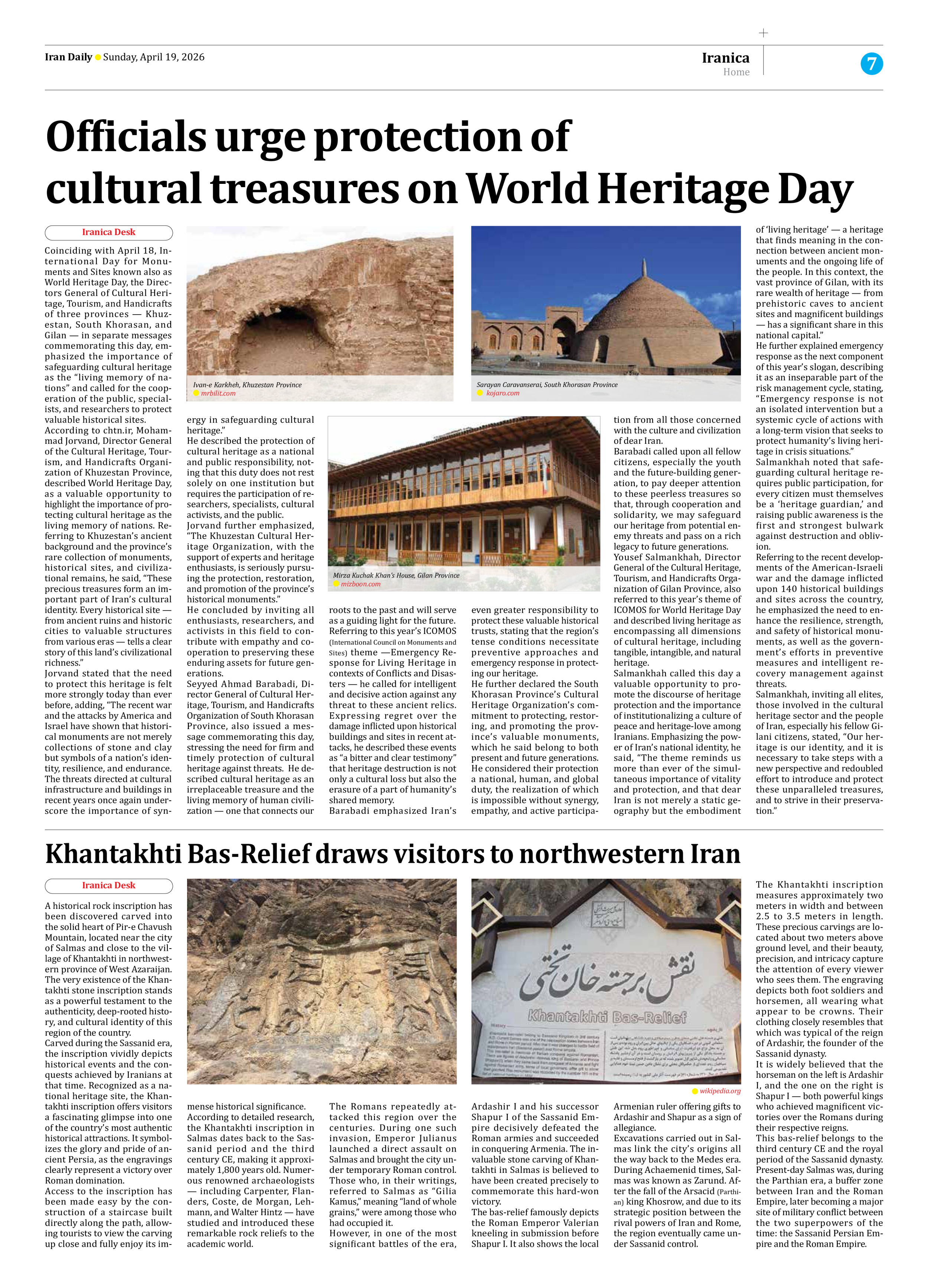
The bas-relief famously depicts the Roman Emperor Valerian kneeling in submission before Shapur I. It also shows the local Armenian ruler offering gifts to Ardashir and Shapur as a sign of allegiance.
Excavations carried out in Salmas link the city’s origins all the way back to the Medes era. During Achaemenid times, Salmas was known as Zarund. After the fall of the Arsacid (Parthian) king Khosrow, and due to its strategic position between the rival powers of Iran and Rome, the region eventually came under Sassanid control.
The Khantakhti inscription measures approximately two meters in width and between 2.5 to 3.5 meters in length. These precious carvings are located about two meters above ground level, and their beauty, precision, and intricacy capture the attention of every viewer who sees them. The engraving depicts both foot soldiers and horsemen, all wearing what appear to be crowns. Their clothing closely resembles that which was typical of the reign of Ardashir, the founder of the Sassanid dynasty.
It is widely believed that the horseman on the left is Ardashir I, and the one on the right is Shapur I — both powerful kings who achieved magnificent victories over the Romans during their respective reigns.
This bas-relief belongs to the third century CE and the royal period of the Sassanid dynasty. Present-day Salmas was, during the Parthian era, a buffer zone between Iran and the Roman Empire, later becoming a major site of military conflict between the two superpowers of the time: the Sassanid Persian Empire and the Roman Empire.