





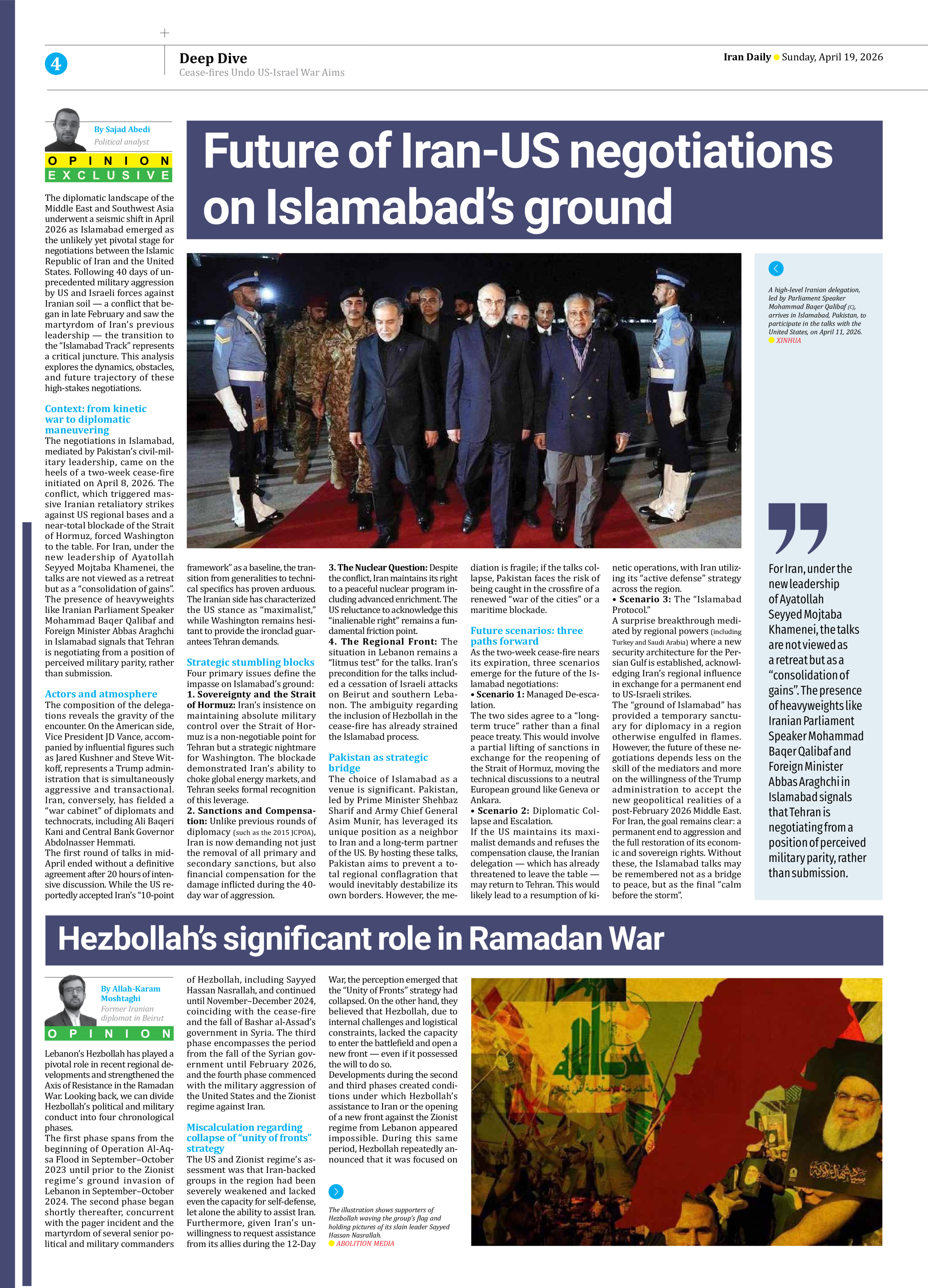


Hezbollah’s significant role in Ramadan War
By Allah-Karam Moshtaghi
Former Iranian diplomat in Beirut
Lebanon’s Hezbollah has played a pivotal role in recent regional developments and strengthened the Axis of Resistance in the Ramadan War. Looking back, we can divide Hezbollah’s political and military conduct into four chronological phases.
The first phase spans from the beginning of Operation Al-Aqsa Flood in September–October 2023 until prior to the Zionist regime’s ground invasion of Lebanon in September–October 2024. The second phase began shortly thereafter, concurrent with the pager incident and the martyrdom of several senior political and military commanders of Hezbollah, including Sayyed Hassan Nasrallah, and continued until November–December 2024, coinciding with the cease-fire and the fall of Bashar al-Assad’s government in Syria. The third phase encompasses the period from the fall of the Syrian government until February 2026, and the fourth phase commenced with the military aggression of the United States and the Zionist regime against Iran.
Miscalculation regarding collapse of “unity of fronts” strategy
The US and Zionist regime’s assessment was that Iran-backed groups in the region had been severely weakened and lacked even the capacity for self-defense, let alone the ability to assist Iran. Furthermore, given Iran’s unwillingness to request assistance from its allies during the 12-Day War, the perception emerged that the “Unity of Fronts” strategy had collapsed. On the other hand, they believed that Hezbollah, due to internal challenges and logistical constraints, lacked the capacity to enter the battlefield and open a new front — even if it possessed the will to do so.
Developments during the second and third phases created conditions under which Hezbollah’s assistance to Iran or the opening of a new front against the Zionist regime from Lebanon appeared impossible. During this same period, Hezbollah repeatedly announced that it was focused on reconstructing damaged areas, resettling the displaced, and politically organizing its internal situation. Moreover, it did not demonstrate any direct military response to Zionist regime attacks during this time — a fact that reinforced the perception that Hezbollah would not engage in future confrontations.
Wisdom of Shia movement in Lebanon and its challenges
The strategic wisdom of the Shia movement in Lebanon enabled Hezbollah to pursue military operations. In this regard, the proposal to suspend Lebanese parliamentary elections for one year — initially put forward by France and Saudi Arabia — was transformed, through the wisdom of Nabih Berri, into a two-year suspension. This decision freed Hezbollah from focusing on electoral competition and internal matters, allowing it to redirect its energy toward other domains.
The suspension of elections also alleviated Hezbollah’s concerns regarding the participation of southern displaced persons in voting as Lebanon’s law requires citizens to vote in their place of birth. On the other hand, Hezbollah endeavored to avoid internal political confrontations and even adopted a conciliatory approach in the face of hostile media and political actions by certain factions. Furthermore, domestic opponents have not yet reached a level of audacity that would enable them to undertake military or security actions against this group.
As a result, Hezbollah is currently concentrating its capabilities and capacities in two domains: social and military-security. In the social sphere, managing the displaced — particularly following the loss of Syria’s geographical support — has become one of its serious challenges.
Additionally, the high number of martyrs and wounded among supporters of the Resistance has exerted significant pressure on this movement. Approximately 1,500 Lebanese citizens who are supporters of the Resistance have been martyred in Lebanon over a 40-day period recently, with over 4,000 wounded, and millions displaced alongside them. Considering that approximately 60 percent of Lebanon’s population supports the Resistance, with Shias constituting 30 percent of this base, social pressure remains extremely high.
Despite these conditions, Hezbollah continued to conduct military operations in Lebanon — operations that, within a geography under constant surveillance and attacks by the Zionist regime, have been exceedingly difficult, yet were being carried out daily, extensively, and with special initiatives.
A significant portion of Lebanese society views this war not as a sign of weakness but as an indication of Hezbollah’s resurgence and demonstration of power; despite certain attacks and damages, public perception of this group has not turned negative.
Lebanon’s political condition favor Hezbollah
If we examine Lebanon’s government through the framework of its army, presidency, and prime ministership, it cannot be said that the dominant approach is anti-Hezbollah. Although some factions seek to constrain this group, conditions do not permit practical action against it.
Anti-Hezbollah actions are primarily undertaken by factions such as the Lebanese Forces band led by Samir Geagea and certain ministers; these actions are often framed as national initiatives since, otherwise, they would not dare to implement them as a direct confrontation with Hezbollah.
Hezbollah is currently part of the Lebanese governmental structure. Together with the Amal Movement, it holds five ministerial portfolios in the government and maintains influence within the army and security apparatuses. Therefore, the Lebanese government cannot be considered absolutely anti-Hezbollah.
Regarding the presidency as well, given the moderate and rational approach of Joseph Aoun, Hezbollah is not regarded as an enemy. Indeed, in certain instances, the hardline positions of the likes of Youssef Raji are moderated. Furthermore, reports indicate that the Prime Minister has, in some cases, sought to avoid provocative actions by Raji against Hezbollah.
The article was first published by the Strategic Council on Foreign Relations.