







Future of Iran-US negotiations on Islamabad’s ground
By Sajad Abedi
Political analyst
The diplomatic landscape of the Middle East and Southwest Asia underwent a seismic shift in April 2026 as Islamabad emerged as the unlikely yet pivotal stage for negotiations between the Islamic Republic of Iran and the United States. Following 40 days of unprecedented military aggression by US and Israeli forces against Iranian soil — a conflict that began in late February and saw the martyrdom of Iran’s previous leadership — the transition to the “Islamabad Track” represents a critical juncture. This analysis explores the dynamics, obstacles, and future trajectory of these high-stakes negotiations.
Context: from kinetic war to diplomatic maneuvering
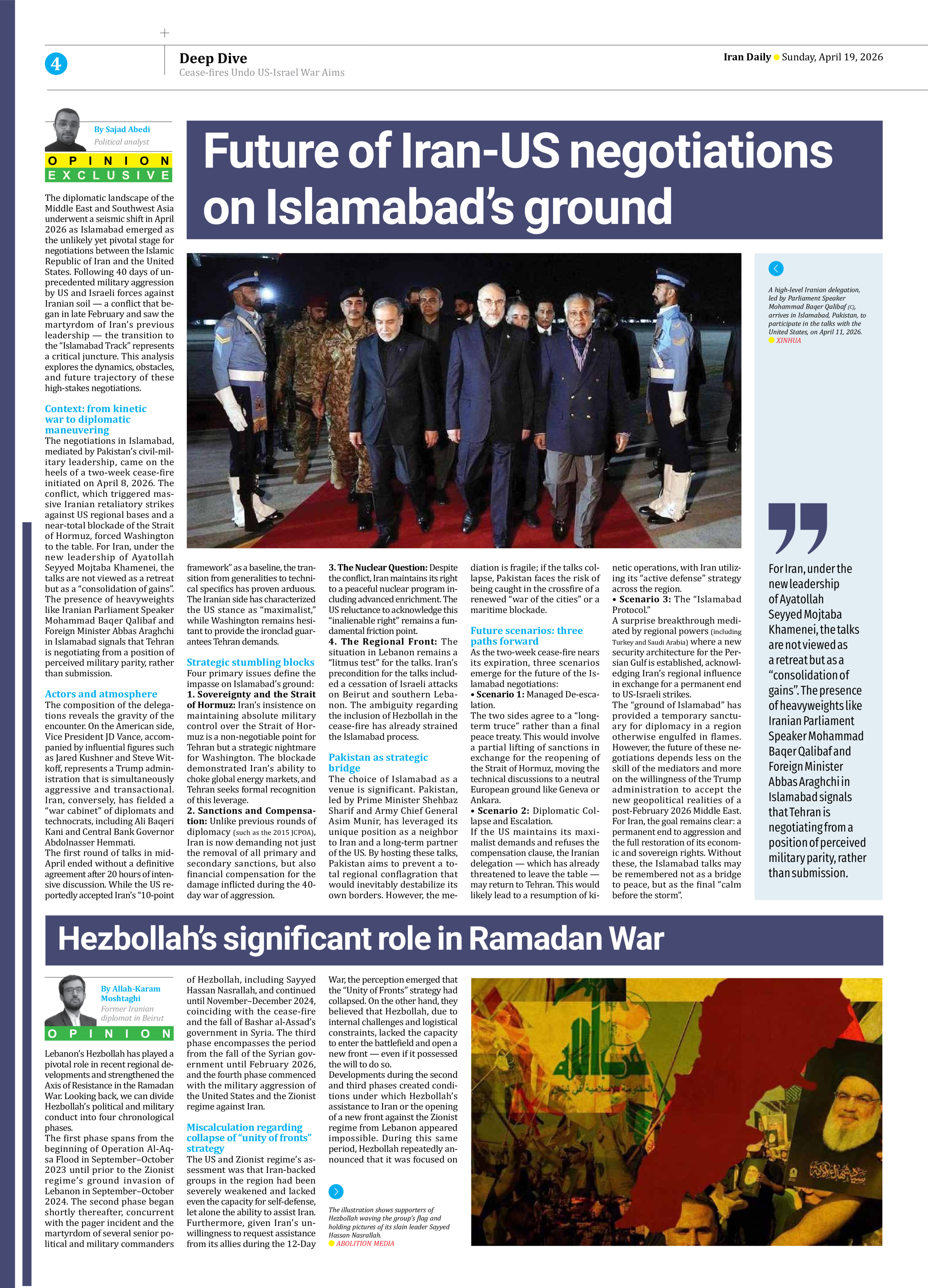
The negotiations in Islamabad, mediated by Pakistan’s civil-military leadership, came on the heels of a two-week cease-fire initiated on April 8, 2026. The conflict, which triggered massive Iranian retaliatory strikes against US regional bases and a near-total blockade of the Strait of Hormuz, forced Washington to the table. For Iran, under the new leadership of Ayatollah Seyyed Mojtaba Khamenei, the talks are not viewed as a retreat but as a “consolidation of gains”. The presence of heavyweights like Iranian Parliament Speaker Mohammad Baqer Qalibaf and Foreign Minister Abbas Araghchi in Islamabad signals that Tehran is negotiating from a position of perceived military parity, rather than submission.
Actors and atmosphere
The composition of the delegations reveals the gravity of the encounter. On the American side, Vice President JD Vance, accompanied by influential figures such as Jared Kushner and Steve Witkoff, represents a Trump administration that is simultaneously aggressive and transactional. Iran, conversely, has fielded a “war cabinet” of diplomats and technocrats, including Ali Baqeri Kani and Central Bank Governor Abdolnasser Hemmati.
The first round of talks in mid-April ended without a definitive agreement after 20 hours of intensive discussion. While the US reportedly accepted Iran’s “10-point framework” as a baseline, the transition from generalities to technical specifics has proven arduous. The Iranian side has characterized the US stance as “maximalist,” while Washington remains hesitant to provide the ironclad guarantees Tehran demands.
Strategic stumbling blocks
Four primary issues define the impasse on Islamabad’s ground:
1. Sovereignty and the Strait of Hormuz: Iran’s insistence on maintaining absolute military control over the Strait of Hormuz is a non-negotiable point for Tehran but a strategic nightmare for Washington. The blockade demonstrated Iran’s ability to choke global energy markets, and Tehran seeks formal recognition of this leverage.
2. Sanctions and Compensation: Unlike previous rounds of diplomacy (such as the 2015 JCPOA), Iran is now demanding not just the removal of all primary and secondary sanctions, but also financial compensation for the damage inflicted during the 40-day war of aggression.
3. The Nuclear Question: Despite the conflict, Iran maintains its right to a peaceful nuclear program including advanced enrichment. The US reluctance to acknowledge this “inalienable right” remains a fundamental friction point.
4. The Regional Front: The situation in Lebanon remains a “litmus test” for the talks. Iran’s precondition for the talks included a cessation of Israeli attacks on Beirut and southern Lebanon. The ambiguity regarding the inclusion of Hezbollah in the cease-fire has already strained the Islamabad process.
Pakistan as strategic bridge
The choice of Islamabad as a venue is significant. Pakistan, led by Prime Minister Shehbaz Sharif and Army Chief General Asim Munir, has leveraged its unique position as a neighbor to Iran and a long-term partner of the US. By hosting these talks, Pakistan aims to prevent a total regional conflagration that would inevitably destabilize its own borders. However, the mediation is fragile; if the talks collapse, Pakistan faces the risk of being caught in the crossfire of a renewed “war of the cities” or a maritime blockade.
Future scenarios: three paths forward
As the two-week cease-fire nears its expiration, three scenarios emerge for the future of the Islamabad negotiations:
• Scenario 1: Managed De-escalation.
The two sides agree to a “long-term truce” rather than a final peace treaty. This would involve a partial lifting of sanctions in exchange for the reopening of the Strait of Hormuz, moving the technical discussions to a neutral European ground like Geneva or Ankara.
• Scenario 2: Diplomatic Collapse and Escalation.
If the US maintains its maximalist demands and refuses the compensation clause, the Iranian delegation — which has already threatened to leave the table — may return to Tehran. This would likely lead to a resumption of kinetic operations, with Iran utilizing its “active defense” strategy across the region.
• Scenario 3: The “Islamabad Protocol.”
A surprise breakthrough mediated by regional powers (including Turkey and Saudi Arabia) where a new security architecture for the Persian Gulf is established, acknowledging Iran’s regional influence in exchange for a permanent end to US-Israeli strikes.
The “ground of Islamabad” has provided a temporary sanctuary for diplomacy in a region otherwise engulfed in flames. However, the future of these negotiations depends less on the skill of the mediators and more on the willingness of the Trump administration to accept the new geopolitical realities of a post-February 2026 Middle East. For Iran, the goal remains clear: a permanent end to aggression and the full restoration of its economic and sovereign rights. Without these, the Islamabad talks may be remembered not as a bridge to peace, but as the final “calm before the storm”.